The Evolution of the Ferrari F430
The Ferrari F430 stands as one of the most celebrated models in Ferrari’s storied history, representing a pivotal chapter in the brand’s evolution during the early 2000s. Launched as a successor to the Ferrari 360 Modena, the F430 combined cutting-edge technology, exhilarating performance, and distinctive styling, reaffirming Ferrari’s reputation for crafting high-performance supercars. This article chronicles the F430’s development, production timeline, and the various models and trim levels that defined its era.
Introduction and Development
The development of the Ferrari F430 began in the early 2000s as Ferrari sought to build upon the success of the 360 Modena, which had been introduced in 1999. With the goal of delivering increased power, improved aerodynamics, and enhanced driving dynamics, Ferrari engineers focused on refining the chassis, upgrading the engine, and integrating innovative features. The F430 was officially unveiled at the 2004 Paris Motor Show and entered production shortly thereafter.
Production Timeline
Ferrari produced the F430 from 2004 through 2009, with a total production run of approximately 15,000 units. The model’s lifecycle spanned five years, during which Ferrari introduced several variants and special editions to cater to different markets and customer preferences.
Standard Ferrari F430 (2004–2009)
The core of the F430 lineup was the standard coupe, known simply as the Ferrari F430, which was produced from 2004 until 2009. It was characterized by its aggressive styling, innovative aerodynamics, and a powerful V8 engine.
Key Features:
- Engine: 4.3-liter naturally aspirated V8 engine (F136 E type)
- Power Output: 490 horsepower at 8,500 rpm
- Torque: 470 Nm (347 lb-ft) at 5,250 rpm
- Transmission: 6-speed manual or Ferrari’s F1-style semi-automatic paddle-shift transmission (F1 SuperFast)
- Performance: 0–60 mph in approximately 3.6 seconds; top speed around 193 mph
- Chassis: Aluminum space frame
- Design: Pioneering aerodynamics with features like the front splitter, rear diffuser, and movable rear wing (in some versions)
The F430’s design was penned by Pininfarina, featuring sharp lines, large air intakes, and a distinctive rear end with round taillights. The interior was driver-focused, with high-quality materials and advanced instrumentation.
Variants and Trim Levels
Over its production run, Ferrari introduced several notable variants of the F430, each with distinct features and target markets.
1. Ferrari F430 Spider (2005–2009)
- Overview: The convertible version of the F430, featuring a folding soft top.
- Features: Same performance as the coupe, with the added open-air driving experience.
- Special Notes: The Spider maintained the structural rigidity of the coupe through a sophisticated aluminum roof mechanism.
2. Ferrari F430 Scuderia (2007–2009)
- Overview: A high-performance, track-oriented variant designed for enthusiasts seeking superior handling.
- Key Features:
- Engine: Slightly upgraded 4.3-liter V8 producing 510 horsepower
- Weight Reduction: Extensive use of carbon fiber components, including the hood, front bumper, and interior trim
- Transmission: F1 automated manual with faster shift times
- Handling: Enhanced aerodynamics, reduced weight, and refined suspension for superior track performance
- Performance: 0–60 mph in approximately 3.3 seconds, with improved cornering abilities
- Special Features: Launch control, carbon-ceramic brakes, and a stripped-down interior emphasizing weight savings
3. Ferrari F430 Challenge Stradale (2007)
- Overview: A track-focused, limited-production version of the F430 Scuderia, optimized for racing.
- Production: Approximately 1,300 units
- Features: Similar to the Scuderia but with further weight reduction and racing modifications, including a roll cage, stripped interior, and racing tires.
- Performance: Slightly improved lap times compared to the Scuderia.
Special Editions and Notable Models
Throughout its lifecycle, Ferrari released several special editions and one-off models based on the F430 platform.
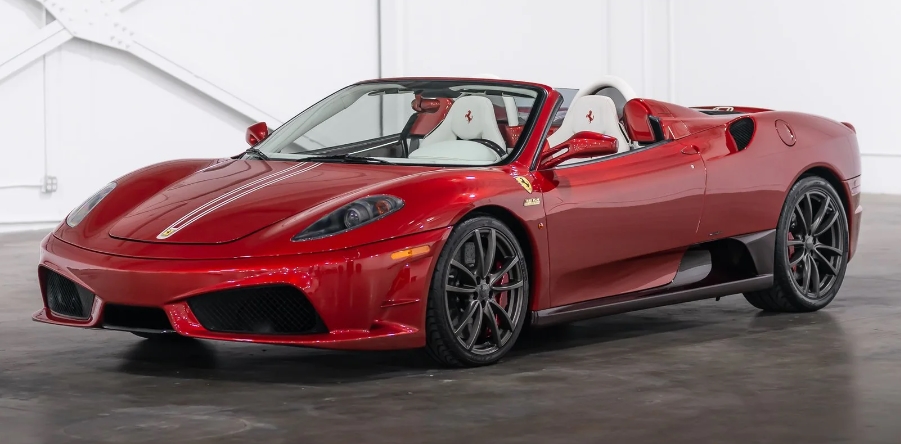
1. Ferrari F430 Scuderia Spider 16M (2008)
- Overview: A limited-edition spider celebrating Ferrari’s 16th Formula 1 Constructors’ Championship.
- Production: Only 499 units produced
- Features:
- Same mechanical upgrades as the Scuderia coupe
- Unique styling cues and interior details
- Slight weight savings and performance enhancements
- Performance: Similar to the Scuderia coupe, with added open-air driving experience
2. Ferrari F430 F1 Challenge
- Overview: A version equipped exclusively with Ferrari’s F1-style semi-automatic transmission, catering to customers seeking the ultimate in shifting speed and convenience.
Technological Innovations
The F430 was notable for several technological advancements:
- E-Diff Electronic Differential: Improved handling by actively distributing torque between the rear wheels.
- F1 SuperFast Transmission: A paddle-shift automated manual gearbox that provided rapid gear changes.
- Manettino Switch: A control on the steering wheel that allowed drivers to select different driving modes, adjusting the behavior of the traction control, suspension, and stability systems.
- Carbon-Ceramic Brakes: Available as an option, providing superior stopping power and reduced fade during high-performance driving.
- Aerodynamic Features: Including a movable rear wing on some models, to optimize downforce.
.
Many car aficionados have multiple hobbies, like boating as well as auto stuff. Those who don’t already own a boat (and even some that do), may have thought about building their own boats. It’s really not as hard as you’d think. Just take a look at these easy boat building plans!

.
End of Production and Legacy
Ferrari ceased production of the F430 in 2009, making way for the successor model, the Ferrari 458 Italia. Despite its relatively short production span, the F430 left a significant mark in the supercar world, admired for its blend of raw performance, innovative technology, and elegant design.
The F430 continues to be highly prized among collectors and enthusiasts. Its various models, especially the Scuderia and Challenge Stradale, are considered some of the best representations of Ferrari’s engineering prowess during the mid-2000s. The F430’s influence is evident in subsequent Ferrari models, which have continued to integrate advanced electronic systems and lightweight materials.
Conclusion
The Ferrari F430 is a testament to Ferrari’s commitment to pushing the boundaries of automotive engineering. From its debut in 2004 to its final model year in 2009, the F430 evolved through various models and special editions, each enhancing performance, handling, and driver engagement. Its combination of technological innovation, striking design, and exceptional performance solidifies its place as a modern classic in the Ferrari lineup.
As a symbol of Ferrari’s engineering evolution in the early 21st century, the F430 remains a sought-after model for collectors and driving enthusiasts alike, embodying the spirit of Ferrari’s racing heritage and road-going excellence.