The Evolution of the Geely Tugella: From Global Debut to Present-Day Variants
The Geely Tugella stands as one of the most intriguing and globally marketed models in Geely Auto’s recent history — blending Chinese automotive innovation with international ambitions. Known in its home market of China as the Geely Xingyue S, this coupe-style compact SUV carved out a niche that straddled performance, design flair, and broader market appeal. Its evolution from launch to discontinuation in some markets highlights Geely’s global strategy and shifting product priorities.
Origins and Launch: A New Era for Geely (2019)
The Tugella was first introduced in 2019, emerging from Geely’s longstanding effort to develop modern, globally competitive SUVs. Internally designated the “FY11”, it was built on the Compact Modular Architecture (CMA) co-developed by Geely and Volvo — a flexible platform designed for a range of drivetrain options, safety systems, and state-of-the-art technology.
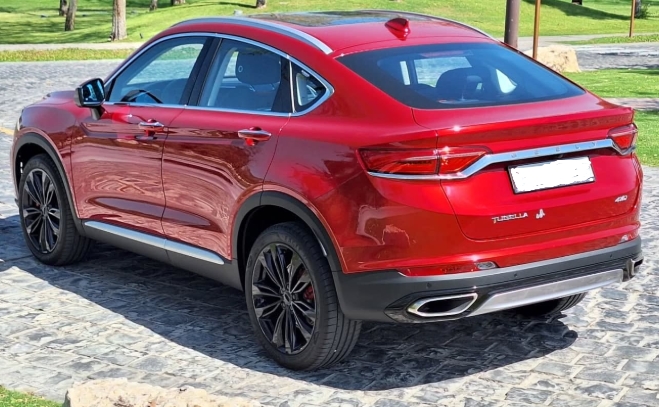
The vehicle’s design language was intentionally sporty and expressive. Geely described the styling as inspired by “dynamic moments in life and nature,” featuring a sharp fastback roofline and aggressive proportions uncommon in mainstream compact SUVs at the time. As the company’s first coupe-SUV built on CMA, it marked a strategic shift toward distinctive crossovers blending performance and premium cues.
Market Identity: “Tugella” and Geographic Variants
While sold domestically in China under the name Geely Xingyue S — with “Xingyue” translating roughly to “Star Cross” — international markets received the model as the Geely Tugella. This export naming helped position the vehicle as a purpose-built global offering rather than a China-only product.
Introduced domestically in May 2019, production commenced shortly thereafter, and the Tugella began appearing in markets across the Middle East, Africa, and parts of Europe and Asia. In some regions, efforts were made to keep the model fresh with mid-cycle updates and market-specific trim variations.
In Russia, for example, the Tugella remained on sale from late 2020 until 2024, after which local production and marketing shifted to a new brand under Geely — Knewstar, selling a rebranded version of the vehicle as the Knewstar 001.
.

.
Powertrains and Technical Overview
Gasoline Engines
From the outset, the Tugella/Xingyue S offered two primary internal combustion engines:
- 1.5-liter turbocharged three-cylinder — this was featured in entry-level models with outputs suitable for everyday performance and efficiency.
- 2.0-liter turbocharged four-cylinder — the headline performer producing around 238 horsepower and 350 Nm of torque, paired with an 8-speed Aisin automatic for smooth power delivery and a spirited driving feel.
The 2.0-liter version was a clear statement of intent from Geely — aiming for quick acceleration (approximately 0–100 km/h in around 6.9 seconds) and convincing performance for a mid-sized coupe SUV.
Hybrid and Plug-in Variants
Geely also catered to efficiency-focused buyers by introducing plug-in hybrid (PHEV) variants of the Tugella. These PHEVs paired a 1.5-liter turbo engine with electric assist and battery packs ranging in capacity (e.g., 11.3 kWh and 15.5 kWh options), delivering electric-only ranges between 56 km and 80 km on the CLTC cycle — respectable figures for the segment.
PHEV trim names varied across markets and years, including designations such as “Yew Starter,” “Harness,” and “ePro,” with combinations of battery capacity and electric range tailored to consumer needs. All were ultimately phased out as lifecycle changes took effect.
Trim Levels and Model Years (2019–2025)
Unlike some mass-market SUVs with long lists of well-documented trims, the Tugella’s trims often varied by region and model year. In general, the model line could be categorized as follows:
Gasoline-Only Trims
- Base / Entry-Level Models — Typically powered by the 1.5 L turbo engine with a 7-speed dual-clutch transmission (DCT).
- Mid-Tier 2.0 T Variants — Featuring the stronger 2.0 L engine, with front-wheel drive or optional all-wheel drive.
- Premium Options — In many export markets, the top-end trims included luxury touches, advanced safety systems, and aesthetic upgrades (e.g., larger wheels, panoramic sunroofs). Saudi Arabian listings from 2025, for example, showed trims such as Tugella GL, GF, and GF Plus, each with escalating content levels — though exact names and specs could differ by region.
PHEV Trim Variants
- PHEV Yew Starter — Lower electric range / smaller battery pack.
- PHEV Harness / ePro — Higher-range options with more substantial battery capacity and tech features.
Unlike many SUV lineups that see clear segmentation by trim year across global markets, Tugella trim offerings were often influenced by individual distributor strategies and local regulations rather than one definitive global list.
Facelift and Mid-Cycle Enhancements
In 2021, Geely introduced updates to the model, commonly referred to as a facelift in many markets, aligning its design and feature set with evolving consumer expectations. This included refreshed exterior styling (often adjusting bumpers, grille designs, and lighting elements), upgraded interior tech, and additional driver assistance systems designed to maintain competitiveness into the mid-2020s.
Beyond cosmetic changes, safety and comfort enhancements (such as expanded ADAS packages, improved infotainment screens, and premium audio options) were increasingly common in later model years.
Global Reception and Market Presence
The Tugella found varied success across regions. While it was often praised for its striking design, dynamic performance, and comprehensive feature sets relative to price, it did not always generate the sales volumes of more mainstream SUVs. In Russia, where it sold from 2020 through 2024, registrations exceeded 33,000 vehicles before the model left that market and was reborn under the new Knewstar brand due to shifting geopolitical and market conditions.
In many Middle Eastern and African markets, the Tugella continued to be offered into 2025 with updates for those market years, often grouped into lifestyle-focused trim packs featuring premium comforts, connectivity, and advanced driver support technology.
Discontinuation and Future Outlook
By 2026, several markets reported that the Tugella was no longer actively offered through official Geely dealerships, leading some enthusiasts to speculate about discontinuation or pending replacement by newer, more electrified models in Geely’s expanding lineup. While production of the domestic variant (Xingyue S) reportedly ended in China around 2023, the export identity as Tugella endured longer in select regions before being phased out or rebranded.
That transition reflects broader industry trends: increasing emphasis on electrification, expanding dedicated EV platforms, and market segmentation where coupe-SUVs may take on more electrified variants or successors under different naming schemes.
Geely’s broader strategy also includes a range of electric and hybrid SUVs under related brands (such as Geely Galaxy and Livan), suggesting that future vehicles may carry forward the spirit of Tugella’s sporty-crossover ethos in new, electrified forms. As global emissions standards tighten and consumer preferences shift toward EVs, models with similar positioning may be reimagined on dedicated EV architectures rather than traditional PHEV or ICE bases.
Conclusion: A Bold Step in Geely’s Globalization
The Geely Tugella represents a noteworthy chapter in Geely Auto’s evolution from a domestic Chinese manufacturer to a competitive global player. From its 2019 launch as a sporty coupe-SUV built on Volvo-aligned architecture, through varied trims and hybrid experimentation, to its phase-out in the mid-2020s, the Tugella signified Geely’s willingness to innovate in terms of design and drivetrain technology.
While its production run did not achieve blockbuster global sales, its influence lives on in Geely’s ongoing product development — particularly in how future models balance performance, style, and advanced technology on modular platforms.