The Evolution of the Koenigsegg Agera: A Hypercar that Redefined Speed and Innovation
The Koenigsegg Agera represents one of the most influential hypercars ever produced, a model that pushed the boundaries of performance, speed, and technology, solidifying Koenigsegg’s place at the forefront of the hypercar industry. Building on the innovations introduced with the brand’s earlier models like the CCX, the Agera continued the legacy of extreme engineering, but with a focus on even greater performance and cutting-edge design. With a series of iterations spanning from its debut in 2010 to the eventual release of its successor, the Jesko, the Agera evolved into a true engineering masterpiece. This article delves into the evolution of the Koenigsegg Agera, exploring its models, trim levels, innovations, and its future outlook in the world of hypercars.
.

.
The Birth of the Koenigsegg Agera
The Agera’s debut in 2010 marked a new chapter in Koenigsegg’s evolution, transitioning from the earlier CC series to a more advanced hypercar designed for the next generation of automotive performance. The name “Agera” comes from the Swedish verb “agera,” meaning “to act” or “to perform,” and perfectly captures the spirit of the car — a machine built for action, designed to break speed records and dominate the roads.
At the heart of the Agera’s design was a focus on lightweight engineering, extreme aerodynamics, and raw power. It combined Koenigsegg’s already advanced engineering with new technologies to create a car that was not only fast but incredibly efficient, precise, and responsive. With a 5.0-liter twin-turbo V8 engine, the Agera was designed to exceed the performance thresholds set by its predecessors, including its top speed and acceleration figures.
Koenigsegg Agera (2010 – 2014)
The first iteration of the Agera, simply named the Koenigsegg Agera, was introduced in 2010. It featured a 5.0-liter twin-turbocharged V8 engine producing 1,000 horsepower and 1,100 Nm (811 lb-ft) of torque. The car’s lightweight carbon fiber monocoque chassis, advanced suspension system, and active aerodynamics made it a car that could not only reach incredible speeds but also provide excellent handling and stability at those extreme velocities.
The Agera was engineered with precision and attention to detail, utilizing materials like carbon fiber and titanium to reduce weight while maintaining structural integrity. The car was equipped with a 7-speed dual-clutch transmission and an all-wheel-drive system, which further enhanced its performance capabilities. The Agera could reach a top speed in excess of 270 mph, with a 0-60 mph time of around 3 seconds, putting it squarely in the realm of the world’s fastest cars.
Koenigsegg’s focus on safety was also evident in the Agera, with the vehicle incorporating advanced safety features, including carbon fiber crash structures and sophisticated driver assistance systems. The car was designed not only to be a performance machine but also a safe and comfortable ride for its driver.
Key Features of the Koenigsegg Agera:
- Engine: 5.0L V8, twin-turbocharged
- Power Output: 1,000 horsepower
- 0-60 mph: 3.0 seconds
- Top Speed: 270 mph+
- Transmission: 7-speed dual-clutch
- Production: 2010-2014
Koenigsegg Agera R (2011 – 2014)
In 2011, Koenigsegg introduced the Agera R, an even more powerful version of the original Agera. The Agera R boasted a revised 5.0-liter twin-turbocharged V8 engine, producing a mind-boggling 1,141 horsepower and 1,200 Nm (885 lb-ft) of torque. This upgrade allowed the Agera R to achieve top speeds in excess of 270 mph, making it one of the fastest production cars in the world at the time. The car could accelerate from 0 to 60 mph in just 2.8 seconds, an incredibly fast time for a car of its caliber.
One of the standout features of the Agera R was its advanced aerodynamics, which included an active rear spoiler that adjusted based on the car’s speed. This helped maintain stability at higher speeds, while the car’s carbon fiber and lightweight construction kept the overall weight to a minimum, maximizing both performance and efficiency.
In addition to its powertrain and aerodynamic enhancements, the Agera R featured a host of technology upgrades, including a fully digital dashboard, improved suspension geometry, and an advanced traction control system. These updates made the Agera R a more refined version of the original Agera, while maintaining its status as a record-breaking hypercar.
Key Features of the Koenigsegg Agera R:
- Engine: 5.0L V8, twin-turbocharged
- Power Output: 1,141 horsepower
- 0-60 mph: 2.8 seconds
- Top Speed: 270 mph+
- Transmission: 7-speed dual-clutch
- Production: 2011-2014
Koenigsegg Agera One:1 (2014 – 2016)
The Koenigsegg Agera One:1 was introduced in 2014 as a further evolution of the Agera lineup. Named for its remarkable power-to-weight ratio of 1,341 horsepower and 1,341 kilograms (hence the name “One:1”), this variant of the Agera pushed the boundaries of lightweight engineering even further. The One:1 was not only about raw power but also about creating a car that was balanced, agile, and efficient at extreme speeds.
The Agera One:1 was built around a fully carbon fiber chassis and featured an active aerodynamics system, which allowed the car to generate massive downforce at high speeds. With a focus on achieving the perfect balance between power and weight, the car’s design allowed it to hit an astonishing top speed of around 270 mph and accelerate from 0 to 60 mph in under 3 seconds.
The Agera One:1 also introduced new technology, including the Race mode, which optimized the car’s aerodynamics and suspension for track use. The car’s advanced braking system and incredible cornering abilities made it a track-ready hypercar that could outperform nearly anything on the road.
Key Features of the Koenigsegg Agera One:1:
- Engine: 5.0L V8, twin-turbocharged
- Power Output: 1,341 horsepower
- 0-60 mph: 2.8 seconds
- Top Speed: 270 mph+
- Weight: 1,341 kg (1:1 power-to-weight ratio)
- Production: 2014-2016
Koenigsegg Agera RS (2015 – 2018)
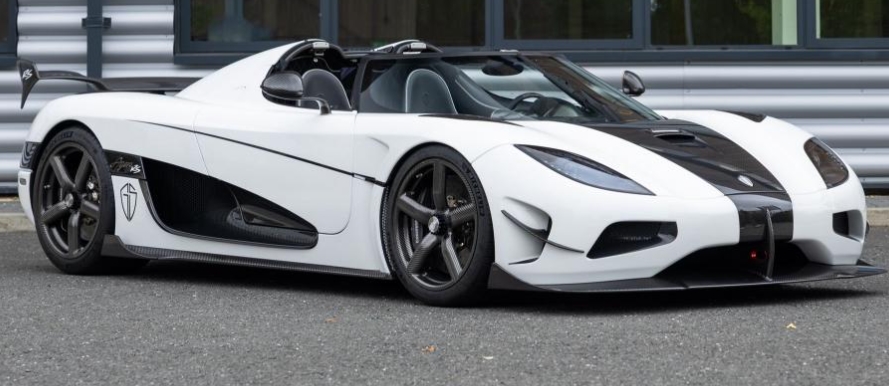
In 2015, Koenigsegg introduced the Agera RS, which would go on to break multiple speed records and cement its place in hypercar history. The Agera RS featured an upgraded 5.0-liter twin-turbocharged V8 engine that produced a staggering 1,160 horsepower (and even more with certain performance packages). The Agera RS became the first car to exceed 270 mph and, in 2017, it set a record for the highest top speed of any production car at the time, reaching 277.9 mph.
This remarkable feat was made possible by a series of upgrades, including improved aerodynamics, a more efficient turbocharging system, and lightweight materials that made the car even faster. The Agera RS also featured an improved braking system and stability control system, ensuring that it could handle extreme speeds with precision and safety.
The Agera RS also saw limited production, with only 25 units produced during its lifespan, making it one of the rarest and most exclusive Koenigsegg cars ever made.
Key Features of the Koenigsegg Agera RS:
- Engine: 5.0L V8, twin-turbocharged
- Power Output: 1,160 horsepower
- Top Speed: 277.9 mph (record-breaking)
- 0-60 mph: 2.8 seconds
- Production: 2015-2018
End of the Agera: Transition to the Jesko and Future Outlook
By 2018, the production of the Koenigsegg Agera had come to a close, with the Agera RS marking the final chapter in the model’s history. The Agera series played a crucial role in shaping the trajectory of the brand, cementing Koenigsegg’s reputation as one of the world’s leading hypercar manufacturers.
The legacy of the Agera lives on in the Koenigsegg Jesko, introduced in 2019. The Jesko is designed to be a successor to the Agera, taking everything Koenigsegg learned from the Agera’s development and pushing it further. With a focus on aerodynamics, extreme power, and advanced hybrid technologies, the Jesko is set to continue the tradition of pushing the envelope in terms of performance, while continuing Koenigsegg’s commitment to cutting-edge engineering.
The future of Koenigsegg will no doubt continue to be shaped by the innovations first introduced in the Agera, as the company seeks to expand its presence in the high-performance electric and hybrid hypercar market.
Conclusion
The Koenigsegg Agera series remains one of the most important and groundbreaking hypercar lineups in automotive history. From its debut in 2010 to the final Agera RS models in 2018, the Agera continually raised the bar for performance, speed, and innovation. Its combination of record-breaking top speeds, cutting-edge technologies, and stunning design solidified Koenigsegg’s place among the elite hypercar manufacturers of the world. As Koenigsegg transitions into a new era with the Jesko and other models, the Agera’s influence will undoubtedly continue to shape the future of automotive excellence.