The Evolution of The Packard Hawk
Of all the automobiles to emerge from the turbulent American automotive landscape of the 1950s, few are as visually dramatic, historically significant, and ultimately tragic as the Packard Hawk. It was a car born not of confidence, but of desperation; a final, flamboyant gasp from a once-proud industry titan. With its soaring tailfins and dramatic wraparound windshield, the Packard Hawk stands today as a rolling sculpture, a testament to what happens when engineering pragmatism collides with automotive opera. It is the story of a forced merger, a controversial design, and a final, defiant roar before the silence.
A Gilded Legacy on Shaky Ground
To understand the Packard Hawk, one must first understand the precipice on which the Packard Motor Car Company stood by the mid-1950s. For decades, Packard was synonymous with American luxury, a peer to Cadillac and a brand whose “Ask the man who owns one” slogan was a declaration of status. Its straight-eight and later V8 engines were renowned for their smooth power and reliability. Packard built engines for PT boats and tanks during World War II, a testament to its industrial might.
However, the post-war world changed. While Cadillac and Lincoln embraced the new aesthetic of chrome, panoramic windshields, and ever-larger tailfins, Packard clung to a more conservative, stately design language. The public’s taste was shifting towards flamboyance, and Packard’s sales began to dwindle. By 1954, the company was in dire financial straits, having lost money for two consecutive years. A merger was the only viable path to survival. In a move that would forever define its final years, Packard merged with the Studebaker Corporation to form Studebaker-Packard Corporation. This union was not one of equals; Packard, the once-proud luxury marque, was now effectively the senior partner in a company whose primary business was the production of more affordable, mass-market cars. The engine that would power the future Packards, including the Hawk, was the new Studebaker V8, a capable motor but one that lacked the unique character of the old Packard-built powerplants.
.

.
The Catalyst: The Studebaker Starlight
The genesis of the Hawk’s unforgettable shape lies not in a Packard boardroom, but in South Bend, Indiana, home of Studebaker. For 1953, Studebaker had introduced a revolutionary new car: the Starliner. Designed by the legendary Raymond Loewy’s studio, the Starliner was a stunningly modern pillared coupe with a dramatically sloping roofline and a greenhouse of glass that made it look like a jet fighter’s canopy. It was a design masterpiece, critically acclaimed for its clean lines and aerodynamic appeal. The Starliner Coupe and the related Commander Coupe were the darlings of the design press.
However, while the car was beautiful, its sales didn’t meet Studebaker’s expectations. The public was still drawn to the heavy-handed, chrome-laden designs from the “Big Three” (GM, Ford, and Chrysler). Studebaker’s management, now overseeing the Packard brand as well, saw an opportunity. What if they could take this advanced Loewy design and give it the kind of over-the-top treatment that the market seemed to crave? Could they graft the flashy elements of the burgeoning 1950s “youth car” and personal luxury segment onto this technologically sound platform? The result, they hoped, would be a halo car for both Studebaker and the newly-resurrected Packard, a vehicle that could generate buzz and lure buyers back into their showrooms.
The Birth of the Hawks (1956)
The new direction was set for the 1956 model year. The car, based on the Studebaker Loewy coupe platform, would be sold as two distinct models under two different brands: the Studebaker Golden Hawk and the Packard Hawk. While they shared the same basic body structure and chassis, the marketing, trim, and engines were intended to differentiate them for their target audiences.
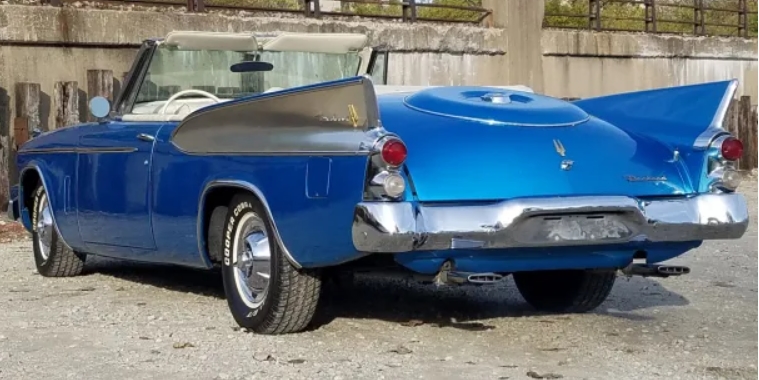
Packard Hawk (1956) The Packard Hawk was conceived as the premium, luxury-oriented version. Its purpose was to carry the Packard name into the future as a high-end grand touring coupe. In a controversial and cost-cutting move, the handsome Studebaker hardtop roof was discarded for the 1956 model year. In its place, designers, led by Brook Stevens, fitted the existing Packard Caribbean convertible’s trunk section and its dramatic tailfins to the Studebaker two-door sedan body. The result was a hybrid of sorts: the front half of the car featured the low-slung Studebaker hood and fenders, while the rear section was adorned with Packard’s signature tall, authoritative fins.
This marriage of styles was jarring. The sleek, modern lines of the Studebaker front were abruptly interrupted by the taller, more formal Packard rear. To complete the look, the Packard Hawk featured an all-new, massive wraparound panoramic windshield, a piece of complex automotive glass that was a hallmark of 1950s design futurism. Power came from a 352 cubic inch Studebaker President V8, mated to a two-speed automatic transmission.
Inside, the Packard Hawk was appointed with the best materials Studebaker-Packard could offer. High-quality cloth and vinyl “Comfort Disk” seats were standard, with an optional “Leather-Grained Vinyl” interior. A padded dashboard, full carpeting, and a distinctive two-spoke steering wheel with a horn ring were part of the luxury package. An AM radio and a clock were standard equipment. The exterior was a study in chrome, with a prominent grille, extensive side trim, and the aforementioned fins. Two-tone paint schemes were standard, with the “Mount Rainier White and Coral Red” combination being the most iconic.
The 1956 Packard Hawk was offered in one primary trim level, identified by model code 58L. The base price was approximately $4,500, placing it in competition with high-end Oldsmobile and Buick models, and even approaching the price of a Cadillac Eldorado. Its mission was to be the “new face of Packard.”
Refinement and The End of the Line (1957-1958)
Public reaction to the 1956 Packard Hawk was mixed. While the car’s audacity and uniqueness drew attention, the disjointed design was criticized by many. Sales were modest, and it was clear that the car needed some refinement. For 1957, the Packard Hawk returned, but with significant revisions.
Packard Hawk (1957) The most important and celebrated change for 1957 was the reintroduction of the beautiful Studebaker Starliner hardtop roof. The awkward seam between the Studebaker front and Packard rear was smoothed over, creating a much more cohesive and visually spectacular vehicle. This gave the Packard Hawk the “skyscreen” roof that was a major selling point for the Studebaker version, dramatically improving its lines.
Other updates included a restyled front grille, which looked a bit more integrated than the previous year’s unit. The “Packard” name was now prominently spelled out on the trunk lid. Power was upgraded to a 352 cubic inch V8 now rated at 275 horsepower, a respectable figure for the time. An “Expresso” (often misspelled “Espresso”) side trim option was available, which deleted the chrome spear along the car’s flanks for a cleaner look. The 1957 Hawk was offered in two trim levels:
- Base Hawk: This was the standard model, continuing with the luxurious appointments of the 1956 car.
- Hawk with Hardtown Trim: This was a slightly more upscale version, featuring two-tone paint with a contrasting roof (painted in a third color), upgraded interior trim, and more exterior chrome brightwork.
By 1958, the Studebaker-Packard Corporation was in a financial crisis of epic proportions. The company had lost the contract to build the Studebaker-based Checker cab, and new car sales were plummeting. The once-proud Packard brand was reduced to little more than a marketing designation on a Studebaker. The Packard name would be dropped at the end of the 1958 model year. The 1958 Hawk would be the last car to ever wear the Packard badge.
Packard Hawk (1958) The 1958 model underwent another significant change: its powertrain. The Packard Hawk now used the Studebaker President’s 289 cubic inch V8, which was available in two states of tune. The standard engine produced 210 horsepower, while a “Supercharged” version was available, using a McCulloch supercharger to produce 275 horsepower. This was the same engine found in the top-line Studebaker Golden Hawk.
Visually, the 1958 car featured a new, wider grille with prominent “bullet” style elements, and new “Delta” fins at the rear, which were sharper and more pronounced than the rounded fins of previous years. The “Expresso” trim option was continued, now offering a more defined two-tone paint scheme.
For 1958, the trim levels were again streamlined:
- Base Hawk: Continued as the standard luxury model, now with the supercharged engine as an option.
- Hawk with Flight Cruise Trim: This was the top-of-the-line version. It was essentially a cosmetic package that added three-tone paint, a painted roof, and additional chrome trim to the base Hawk.
Production of the 1958 Packard Hawk was minuscule, with only 588 units built. It was the final, flickering candle of a once-great flame.
The Final Roar and Legacy
After the 1958 model year, the Packard name was retired. The Studebaker Golden Hawk, now a Studebaker-only model, continued for two more years (1959-1960) with its own unique styling, powered by a supercharged 289 V8. In a strange twist of fate, the Packard name was briefly revived in 1962 for a mythical “Packardbaker” promotional car that never saw production, and again on a series of Studebaker sedans sold in Mexico in the mid-1960s. But the Packard Hawk was the last true Packard built in Detroit.
Today, the Packard Hawk is a highly sought-after collector car. It is appreciated not just for its rarity, but for its audacity. It represents a fascinating, flawed, and ultimately brave attempt to defy the inevitable. It was the product of a company on its last legs, trying to merge two different corporate cultures, two different design philosophies, and two different sets of consumer expectations into one last, grand statement.
The future of the Packard Hawk, in terms of new production, is non-existent. The brand is gone, and the name now belongs to a company that produces industrial and consumer goods, not automobiles. Its future lies entirely in the hands of collectors and automotive historians. The Hawk is a monument to the end of an era, a time when design was as much about emotion and fantasy as it was about function. It is a beautiful, awkward, powerful, and poignant final chapter in the long and storied history of the Packard Motor Car Company.