The Final Flourish: Charting the Evolution of the Lotus Emira
In the pantheon of automotive history, some cars are celebrated for their revolutionary technology, others for their sheer dominance, and a select few for their profound significance as the end of an era. The Lotus Emira falls squarely into this last, hallowed category. It is not merely another sports car from the storied workshops of Hethel, England; it is the final, definitive statement on the internal combustion engine (ICE) from a company built on the philosophy of lightweight, driver-focused purity. The Emira represents a culmination of over 70 years of engineering prowess, a bridge between a cherished analogue past and an inevitable electric future. Its evolution, though condensed into a short period, tells a story of strategic rebirth, thoughtful engineering, and the creation of a modern classic from its very inception.
The Genesis: Vision80 and the Need for a New Champion
To understand the Emira, one must first understand the context of its birth. By the late 2010s, Lotus was at a crossroads. Its celebrated but aging lineup—the Elise, Exige, and Evora—were icons of the automotive world, yet they were all based on platforms that had their roots in the 1990s and 2000s. While brilliant to drive, they were increasingly niche, lacking the modern amenities, build quality, and daily usability demanded by a broader premium sports car market.
The turning point came in 2017 with the acquisition of a majority stake in Lotus by Chinese automotive giant Geely. This injection of capital and strategic vision led to the “Vision80” business plan, a roadmap to transform Lotus into a globally competitive performance brand by its 80th anniversary in 2028. A key pillar of this plan was the consolidation of its existing sports car range. The decision was made to retire the Elise, Exige, and Evora simultaneously and replace them with a single, all-new model.
This car, internally codenamed “Type 131,” would need to achieve the impossible: capture the raw, telepathic driving dynamics of its predecessors while offering the refinement, technology, and quality of a Porsche Cayman or Alpine A110. This was the monumental task assigned to the car that would become the Emira.
The Unveiling and Design Philosophy (2021)
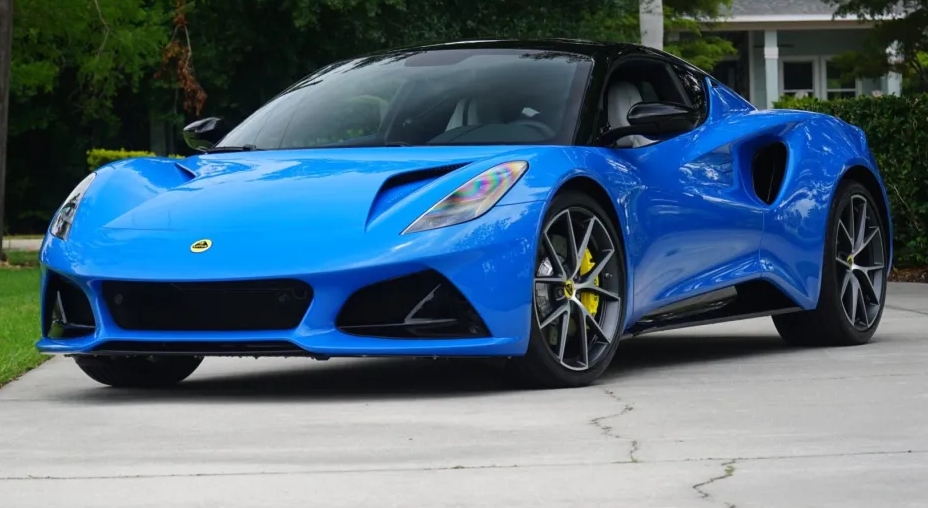
The Lotus Emira was officially unveiled to the world on July 6, 2021. The name, derived from a word in various ancient languages meaning ‘commander’ or ‘leader’, was fitting for a car destined to lead Lotus into its new era. Visually, it was a dramatic departure from the familiar shapes of its forebears. Heavily inspired by the all-electric Evija hypercar, the Emira sported a shrink-wrapped, exotic aesthetic with deep sculpts, functional aerodynamics, and a wide, purposeful stance. Critically, it was designed with everyday usability in mind—a first for a modern series-production Lotus. The doors opened wider for easier ingress and egress, cabin space was increased, and practical storage was included, with 208 litres of space behind the seats and a further 151 litres in a rear boot.
Inside, the evolution was even more profound. Gone were the spartan, parts-bin interiors of old. In their place was a driver-centric cockpit featuring high-quality materials, a 12.3-inch digital driver’s display, and a 10.25-inch central touchscreen infotainment system with Apple CarPlay and Android Auto. This quantum leap in technology and perceived quality was a clear signal of intent: the Emira was designed not just to be driven, but to be lived with.
The Drivetrain Dichotomy: Two Hearts, One Soul
From the outset, Lotus planned a two-pronged powertrain strategy for the Emira, catering to different driving tastes and market requirements.
The Supercharged V6: For the purists and long-time Lotus fans, the Emira launched with a familiar and much-loved engine: the Toyota-sourced 3.5-litre 2GR-FE V6, enhanced with an Edelbrock 1740 supercharger. This was the same fundamental engine that powered the most potent versions of the Exige and Evora. In the Emira, it was tuned to produce 400 horsepower and 420 Nm of torque (430 Nm for the automatic version). Crucially, it was offered with two transmission choices: a six-speed manual gearbox with a beautiful open-linkage mechanism, or a six-speed torque-converter automatic with paddle shifters. This powertrain represented the pinnacle of Lotus’s traditional formula.
The Turbocharged i4: To broaden the Emira’s appeal and introduce a technologically advanced alternative, Lotus formed a technical partnership with Mercedes-AMG. The result was the inclusion of the AMG M139 engine, a 2.0-litre turbocharged inline-four-cylinder renowned as the world’s most powerful production four-cylinder. Sourced from the A45 S hot hatch, the engine was specifically calibrated for the mid-engined Emira, featuring a unique intake and exhaust system. It produced 360 horsepower but a substantial 430 Nm of torque. This engine was exclusively paired with an eight-speed dual-clutch transmission (DCT), also from AMG, promising lightning-fast shifts and greater efficiency.
The Phased Rollout: An Evolution of Models and Trims (2022-Present)
Unlike a car with decades of history, the Emira’s evolution has been a carefully staged rollout of its planned variants. This began with highly specified launch editions before moving to the standard production models.
- Emira V6 First Edition (Years Produced: 2022–2023)
The first Emiras to reach customers were the V6 First Edition models, with production commencing in 2022. As the name implies, this was a fully-loaded launch specification designed to showcase the car’s full potential and create a halo effect. It came at a fixed premium price but included a vast array of features that would later become optional.
Key features of the V6 First Edition included:
Lower Black Pack: Gloss black finish on the front splitter, side sills, and rear diffuser.
20-inch V-Spoke Forged Alloy Wheels: Available in silver, gloss black, or diamond-cut finishes.
Two-Piece Brake Discs: With branded calipers in a choice of colors.
Drivers Pack: This gave buyers the choice of two distinct suspension setups. Touring suspension was tuned for everyday road use with Goodyear Eagle F1 Supersport tires.
Sport suspension offered a stiffer setup for enhanced track performance, paired with ultra-sticky Michelin Pilot Sport Cup 2 tires.
Design Pack: Included privacy glass, sports pedals, and a choice of interior trim colors.
Convenience Pack: Added front parking sensors, a reversing camera, rain-sensing wipers, and auto-dimming mirrors.
KEF Premium Audio: A 560-watt, 10-channel sound system developed specifically for the Emira.
Choice of Seven Exterior Colors: Including the launch-specific Seneca Blue.
The V6 First Edition served as the celebratory vanguard, satisfying the initial wave of enthusiastic depositors and establishing the Emira as a credible, high-spec contender in the premium sports car segment.
- Emira i4 First Edition (Years Produced: 2023–2024)
Following the successful launch of the V6, production of the i4 First Edition began in 2023. This model followed the same high-specification philosophy as its V6 sibling, bundling most options as standard. It shared the majority of the V6 First Edition’s equipment, including the various packs (Drivers, Design, Convenience) and the KEF audio system.
The key differentiators were, of course, powertrain-related:
AMG Engine and DCT Gearbox: The 360 hp M139 engine and 8-speed DCT.
Unique Engine Cover and Exhaust: A bespoke rear engine cover and exhaust finisher distinguished it visually from the V6 model.
Paddleshift Controls: The only transmission option was the DCT operated via steering wheel-mounted paddles.
The i4 First Edition was aimed at a different kind of driver—one perhaps more accustomed to modern German performance cars, who valued the rapid-fire shifts of a DCT and the high-tech character of the AMG engine.
- Emira Base Models (Years Produced: 2023–Present)
Once the launch excitement of the First Editions subsided, Lotus transitioned to producing the standard, or “base,” Emira in both V6 and i4 configurations, starting in late 2023 for some markets and into 2024. This phase represents the long-term, established state of the model line.
The evolution here is one of choice and accessibility. The base models start at a lower price point, allowing customers to build a car to their own specification.
Features that were standard on the First Editions became part of optional packs:
The Drivers Pack, Design Pack, and Convenience Pack are now optional add-ons.
The KEF Premium Audio system is an optional upgrade over the standard system.
The Lower Black Pack is also an optional extra.
This allows a customer to specify a more stripped-back, purist Emira focusing solely on the driving experience, or to build a fully-loaded grand tourer that rivals the specification of the original First Editions. This à la carte approach is typical for the premium market and marks the Emira’s maturity into a regular series-production vehicle.
The Motorsport Evolution: Emira GT4 (2022–Present)
No Lotus story is complete without a chapter on motorsport. Concurrent with the road car’s development, Lotus worked with the RML Group to create the Emira GT4, a dedicated, track-only race car. Unveiled in 2021 and beginning its competitive life in 2023, the GT4 is a testament to the inherent capability of the Emira’s bonded aluminium chassis.
The GT4 utilises the 3.5-litre supercharged V6, race-tuned to approximately 400 hp (subject to Balance of Performance regulations) and equipped with a dry-sump lubrication system. The road car’s manual and automatic gearboxes are replaced by a six-speed xTrac sequential racing transmission with paddle shifters. Its evolution from the road car includes:
Advanced Aerodynamics: A massive, swan-neck rear wing, an aggressive front splitter, and optimised ducting for maximum downforce.
Stripped-Out Interior: All creature comforts are removed, replaced by an FIA-compliant roll cage, racing seat, and a motorsport-specific steering wheel and data-logging system.
Uprated components: Motorsport-specific suspension, brakes, and a 96-litre fuel cell.
The Emira GT4 continues Lotus’s rich racing heritage, proving the platform’s robustness and dynamic excellence on the world’s most demanding circuits.
.
THIS could come in handy for your auto garage (and everywhere else!):

.
Conclusion: The Perfect Bridge
The evolution of the Lotus Emira is a story not of generational change, but of strategic, deliberate execution. In just a few short years, it has transformed from “Project Type 131″—the ambitious answer to an aging lineup—into a multi-faceted sports car available in V6, i4, manual, DCT, road, and track configurations. It began with the celebratory, all-inclusive First Editions and has now matured into a customisable series-production model.
The Emira is the ultimate expression of everything Lotus learned about the internal combustion engine sports car. It is the final flourish, a masterpiece of balance, feel, and beauty that honours its lineage while embracing modernity. As the last of its kind from Hethel, every Emira that rolls off the production line is not just a car, but a piece of history—the closing statement of one glorious chapter and the perfect, powerful bridge to the electric age that lies ahead.