The Genius in Miniature: Charting the Evolution of the Toyota iQ
In the landscape of automotive history, some cars are celebrated for their speed, others for their luxury, and many for their sheer sales volume. Then there are the quiet innovators, the vehicles that challenge convention so profoundly that their true genius is often only appreciated in retrospect. The Toyota iQ was one such car. A marvel of packaging and a statement of intent, it was Toyota’s bold answer to the challenges of 21st-century urban mobility. More than just a small car, the iQ was a masterclass in engineering, a “concentrated-car” that packed the safety, features, and refinement of a larger vehicle into a footprint barely larger than a postage stamp. Its evolution from a clever concept to a global micro-premium offering, spawning both an American cousin and an unlikely aristocratic relative, is a fascinating chapter in modern automotive design.
The Genesis: A Concept of Concentrated Innovation (2007-2008)
The story of the iQ begins in the mid-2000s, a time of rising fuel costs and increasing urban congestion. The Smart Fortwo had proven that a market existed for a truly compact, two-seater city car. Toyota, however, aimed to upend the paradigm. Their goal wasn’t just to build a small car, but to build a better car that happened to be small. The guiding philosophy was “J-Factor,” a term representing Japanese originality and ingenuity.
The first public glimpse of this philosophy was the Toyota iQ Concept, unveiled at the 2007 Frankfurt Motor Show. Its sub-three-meter length was shocking, but even more so was its promise of seating for three adults and one child (or luggage), a configuration dubbed “3+1.” This seemingly impossible feat was achieved through a series of six space-saving engineering breakthroughs that would define the production car:
- A Compact Front-Mounted Differential: This allowed the front wheels to be pushed to the absolute corners of the car, drastically reducing the front overhang and maximizing the cabin length.
- A Center Take-Off Steering Gear: Mounting the steering rack higher in the engine bay freed up space for the compact differential and contributed to the short front end.
- A Flat Underfloor Fuel Tank: A specially designed, slim fuel tank located beneath the vehicle floor, rather than behind the rear seats, allowed for a shorter rear overhang and deeper luggage space.
- Slim-Profile Seats: Thinner seatbacks created crucial extra millimeters of legroom for rear passengers without compromising comfort or safety.
- An Asymmetrical Dashboard: The passenger side of the dashboard was carved away, pushed further forward to give the front passenger significantly more legroom. This allowed their seat to be moved forward, creating viable space for an adult passenger directly behind them.
- A Miniaturized Heater/Air Conditioning Unit: A significantly smaller HVAC unit, located centrally behind the dashboard, freed up the space needed for the asymmetrical design.
These innovations were not just clever tricks; they were a fundamental reimagining of small car architecture. When the production version debuted in Japan in late 2008 and arrived in Europe in early 2009, it was remarkably faithful to the concept, a testament to Toyota’s commitment to the project.
.

.
The Global Rollout and Model Lineup (2009-2015)
The production Toyota iQ was launched with a clear premium positioning. It was priced higher than many traditional A-segment cars like the Toyota Aygo, competing instead on its refinement, high standard specification, and revolutionary design. Its evolution over its production life can be tracked through its powertrain options and trim levels.
Powertrain Evolution:
- 1.0-litre 1KR-FE VVT-i Petrol (2008-2015): The launch engine was Toyota’s award-winning 998cc 3-cylinder unit, producing 67 horsepower. It was available with either a 5-speed manual transmission or a “Multidrive” Continuously Variable Transmission (CVT), prioritizing fuel economy and low emissions.
- 1.4-litre D-4D Diesel (2009-2012, Europe Only): Introduced shortly after launch, this 1,364cc 4-cylinder turbodiesel engine produced 89 horsepower and a substantial 190 Nm of torque. Available only with a 6-speed manual gearbox, it offered punchy performance and exceptional fuel economy, but its higher price and increasing focus on petrol-hybrids led to its early discontinuation.
- 1.33-litre 1NR-FE Dual VVT-i Petrol (2009-2015): The most significant addition came in mid-2009. This 1,329cc 4-cylinder engine offered a healthier 97 horsepower and came equipped with Stop & Start technology for improved urban efficiency. It was paired with either a 6-speed manual or the Multidrive CVT, positioning it as the top-tier performance option.
Trim Level Progression (European Market example):
The trim structure for the iQ was designed to reinforce its premium status, avoiding a spartan, budget-oriented base model. While names and specifications varied slightly by country, a typical structure in a major market like the UK evolved as follows:
- iQ (Base Model): Available from launch, primarily with the 1.0-litre engine. The standard specification was impressively high for a city car of its era, including 15-inch alloy wheels (a notable departure from the steel wheels of most competitors), air conditioning, a six-speaker audio system with MP3 compatibility, electric windows, and heated, electrically adjustable door mirrors. Critically, it also featured a suite of nine airbags, including the world’s first rear-window curtain shield airbag, earning it a 5-star Euro NCAP safety rating.
- iQ2: This mid-tier trim added more luxurious features such as automatic climate control, keyless smart entry and start, dusk-sensing headlights, and rain-sensing wipers. Cosmetically, it often featured high-gloss alloy wheels and additional chrome detailing.
- iQ3: Introduced with the 1.33-litre engine, this became the flagship model. It built upon the iQ2 specification, often including unique 16-inch alloy wheel designs, partial leather upholstery, and a more premium interior finish.
Throughout its life, Toyota also offered numerous special editions to maintain interest, such as the iQ Collection with bespoke interior color schemes and the iQ Burlap in Japan, which featured unique exterior and interior appointments.
The American Cousin and the British Aristocrat (2011-2013)
The iQ’s unique platform proved versatile enough to be adapted for two vastly different brands.
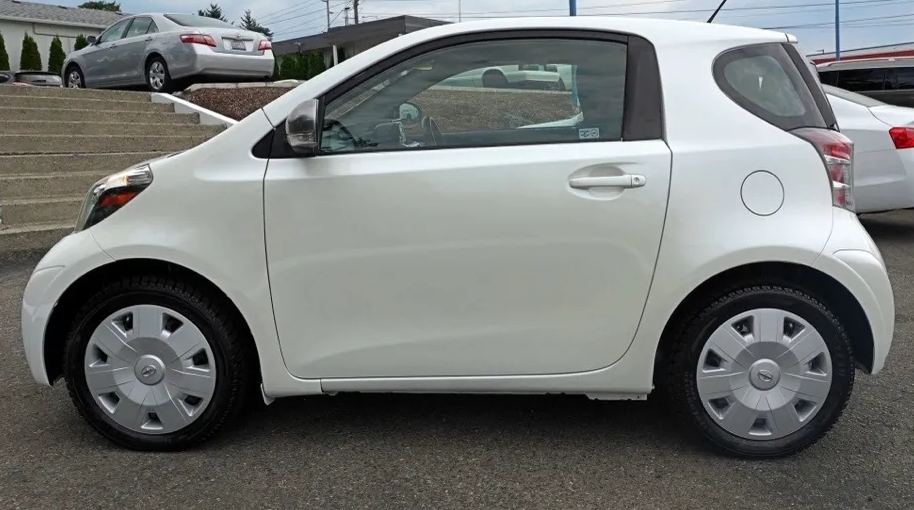
- Scion iQ (2012-2015): For its North American debut, the iQ was rebadged under Toyota’s youth-oriented Scion brand. Launched for the 2012 model year, it was marketed as a premium urban micro-compact. The Scion iQ was offered in a “monospec” strategy. There was only one engine—the 1.33-litre (marketed as 1.3-litre) petrol engine, exclusively paired with the CVT. It came well-equipped with 11 airbags (adding a driver’s knee airbag and a front passenger seat cushion airbag), 16-inch steel wheels with covers, and a Pioneer audio system. Customization came via dealer-installed accessories and limited “Release Series” editions, like the RS 10.0 which featured a silver body, bespoke interior, and numbered badging. Despite its cleverness, the Scion iQ struggled to find its footing in a market that favors larger vehicles and was discontinued in 2015 when the Scion brand was folded back into Toyota.
- Aston Martin Cygnet (2011-2013): The most bizarre and fascinating chapter in the iQ’s history was its transformation into the Aston Martin Cygnet. Faced with stringent new EU fleet-wide CO2 emission regulations, Aston Martin needed a highly efficient car to offset its V8 and V12 supercars. The iQ provided the perfect solution. Mechanically, the Cygnet was identical to a 1.33-litre iQ. The magic was in the finish. Each Cygnet was hand-finished at Aston Martin’s Gaydon facility. The exterior received the iconic Aston Martin grille, side strakes, and unique paint options, while the interior was completely re-trimmed in the same Bridge of Weir leather used in their sports cars. The result was a £30,000+ city car—more than double the price of a top-spec iQ. Produced from 2011 to 2013, it remains one of the most audacious examples of badge engineering in automotive history.
The Electric Dream and The Final Years (2012-2016)
Toyota also used the iQ platform as a testbed for future technologies. In 2012, the company produced the Toyota eQ (or Scion iQ EV in the US). This was not a mass-market vehicle but a limited-production run of around 100 units for fleet and car-sharing demonstration programs. It featured a 12 kWh battery pack, providing a modest real-world range of about 50 miles (80 km). While not a commercial success, the eQ project provided invaluable data for Toyota’s ongoing electrification efforts.
By the mid-2010s, the market had shifted. The high development cost of the iQ meant it was always an expensive proposition, and it faced tough competition from more conventional (and affordable) city cars and even larger superminis. Sales began to wane, and production of the Scion iQ ceased in 2015, followed by the final Toyota iQ models rolling off the line for the European market in early 2016.
Legacy: A Small Car with a Big Impact
The Toyota iQ was produced from 2008 to 2016. Though its sales figures never matched its engineering brilliance, its legacy is undeniable. It proved that a sub-three-meter car did not have to compromise on safety, features, or refinement. The innovative packaging solutions it pioneered have influenced the design of countless subsequent small cars, all striving to maximize interior volume within a compact footprint. It remains a cult classic, a car for those who appreciate intelligent design over sheer size. The iQ was a paradox: a commercial disappointment but an engineering triumph, a humble Toyota that became an Aston Martin, and a small car that left a very big mark.