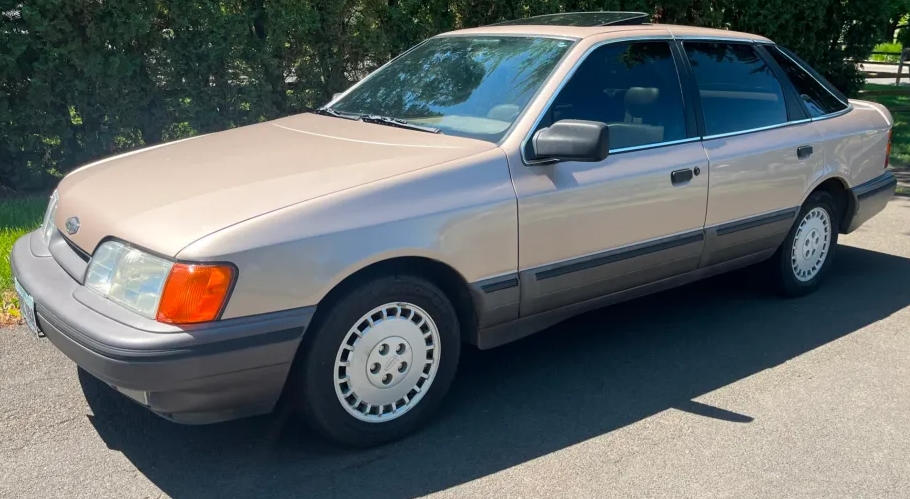
The German Heart in a British Shell: The History of the Merkur Scorpio
In the automotive landscape of the late 1980s and early 1990s, a unique experiment unfolded on American highways. It was a time when Japanese reliability was beginning to dominate, American luxury was defined by size and landau roofs, and German engineering was the reserved, expensive domain of Mercedes-Benz and BMW. Into this fray stepped Ford Motor Company, not with a new brand, but with a resurrected one: Merkur.
While the XR4Ti, the sporty two-door hatchback, kicked off the revival in 1984, it was the sedan that was meant to carry the torch of sophisticated, accessible German performance. This was the Merkur Scorpio.
For a brief window, from 1988 to 1990, the Scorpio offered a fascinating blend of British design, German mechanicals, and American market needs. It was a car that was critically acclaimed but commercially misunderstood, and its story is a compelling chapter in the history of badge engineering and import strategies.
Genesis: The Ford of Europe Connection
To understand the Merkur Scorpio, one must first understand its sibling, the Ford Scorpio. In the mid-1980s, Ford of Europe was riding high on the success of the Sierra and needed a new flagship to compete in the executive E-segment. The result, launched in 1984 in Europe (1985 in the UK as the Granada), was the Scorpio.
It was a thoroughly modern car for its time, featuring a sleek, aerodynamic notchback design credited to Uwe Bahnsen, the head of design at Ford of Europe. It shared its platform with the Sierra, but it was larger, more luxurious, and featured advanced technology like anti-lock brakes (ABS) as standard on many models—a rarity at the time.
By 1987, Ford of North America was looking to expand the Merkur brand beyond the single XR4Ti model. The Ford Sierra platform was already being utilized for the Merkur, so it made strategic and financial sense to import another model from the European portfolio. The executive Scorpio was chosen, and a plan was set to adapt it for the demanding American market.
.
NO MORE dead batteries with this:

.
The U.S. Debut: 1988-1989
The Merkur Scorpio made its U.S. debut for the 1988 model year. Ford didn’t simply ship European-spec cars across the Atlantic; it made significant modifications to meet U.S. regulations and consumer expectations.
The most notable change was under the hood. The European Ford Scorpio was available with a range of four-cylinder and V6 engines. For the U.S., it received the 2.9-liter, fuel-injected Cologne V6, the same robust engine used in the Ford Ranger and Bronco II. However, in the Merkur, it was tuned to produce 145 horsepower and 170 lb-ft of torque, a respectable figure for the era. It was paired with a 4-speed AOD automatic transmission, the only gearbox offered.
The interior was where the European roots truly shone. Unlike its American contemporaries, the Scorpio was a driver-focused cockpit. The shifter was mounted on the center console, not the column, and it was connected to a German-built ZF 4HP22 transmission. The dashboard was a symphony of gray and black, dominated by an array of green-lit digital gauges and, on early models, a distinct “spaceship” center stack with numerous buttons for climate and audio controls.
However, to appease the American market, Ford added features not found on European models. The single overhead cam engine was fitted with a “TWIN-CAM” badge, playing on the buzzword of the day, even though it was a pushrod V6. More significantly, the suspension was softened, and the car was fitted with larger, more comfortable seats.
Trim Levels (1988-1989)
Ford kept the trim structure simple, focusing on content rather than performance tiers.
- Base: This was the standard model, which was hardly “base.” It included the 2.9L V6, automatic transmission, power windows, locks, and mirrors, air conditioning, cruise control, a premium sound system, and the signature 15-inch “continental” style wheels.
- Premium: The upgrade model, which added features like a sunroof, keyless entry, a trip computer, and an 8-way power passenger seat.
In a move that confused many, Ford discontinued the Merkur XR4Ti for 1988, leaving the Scorpio as the sole offering in the showroom. This positioned the four-door sedan as the brand’s premium product.
The Facelift and Final Year: 1990
For 1990, the Scorpio received a mild facelift and a significant power boost. The European market had received a major update in 1989, which included a redesigned front end with quad headlights, a new grille, and a revised rear fascia. The U.S. model adopted these changes for 1990, giving it a slightly more modern and aggressive look.
More importantly, the engine was upgraded. The 2.9-liter V6 was replaced by the 4.0-liter OHV V6, borrowed from the newly released Ford Explorer. This engine was a powerhouse by Merkur standards, churning out 160 horsepower and 223 lb-ft of torque. While the 0-60 time only improved slightly (around 10.5 seconds, down from 11.5), the low-end torque made the car feel noticeably more responsive and drivable.
Inside, the cockpit was also updated. The quirky, button-heavy center stack was replaced with a more conventional, integrated climate control system. The all-digital instrument cluster remained, but it was slightly revised. Ride quality was further improved with new suspension tuning, making the car even more comfortable, if less sporty.
A Unique Appeal: The “Poor Man’s BMW”
The Merkur Scorpio occupied a unique niche. Priced in the mid-$20,000s, it was more expensive than a Buick LeSabre or a Chrysler New Yorker but significantly cheaper than a BMW 5-series or a Mercedes-Benz E-Class.
Its appeal lay in its combination of qualities. It offered the rear-wheel-drive dynamics and handling of a European sports sedan, thanks to its German platform and well-sorted suspension. The interior was ergonomic and felt more substantial than its American rivals. Yet, it also had the features and comfort that American buyers expected.
For the discerning buyer who wanted something different from the sea of sedans in the U.S., the Scorpio was a compelling choice. It was subtle, sophisticated, and a genuinely international car.
The Downfall: Why Did Merkur Fail?
Despite its merits, the Merkur brand, Scorpio included, was a commercial failure. Ford sold just under 48,000 Merkurs in total over its five-year run. The Scorpio itself sold around 15,000 units in its three-year lifespan.
Several factors contributed to this:
- Brand Confusion: “Merkur” was a German word meaning “Mercury,” but it was neither a Mercury nor a Lincoln. Dealerships were not equipped to market or service a quasi-premium European import.
- Price Point: While cheaper than a BMW, it was still expensive for a Ford-badged car. The reliability and maintenance costs were perceived to be of the German luxury variety.
- Sedan Aesthetics: The Scorpio’s “three-box” design was handsome but conservative. It didn’t scream “performance” like the XR4Ti had.
- Marketing: Ford never figured out how to market the brand effectively. Was it a sporty import? A luxury car? The ads were often confusing, and the public simply didn’t understand the value proposition.
Legacy and the Future Outlook
Production of the Merkur Scorpio ended in 1990. That same year, the Ford Scorpio was updated to a second generation in Europe, but Ford of North America decided not to import it. The Merkur experiment was over.
Today, the Merkur Scorpio is a rare sight on American roads. It exists as a footnote in Ford’s history—a noble effort that failed to find a buyer base. However, for enthusiasts of quirky European-American hybrids, it is a beloved cult classic. Its reliability (the 4.0L V6 is legendary), simple mechanics, and unique character make it an interesting and affordable collector’s item.
The future outlook for the Scorpio is one of appreciation. As it passes the 30-year mark, it is becoming eligible for classic car shows and is gaining a following among fans of 80s and 90s oddities. It stands as a testament to a time when Ford was willing to take risks and bring true global products to American shores. The Merkur Scorpio may not have changed the world, but for a few short years, it provided a compelling, German-engineered alternative to the status quo.