The Heartbeat of an Era: The Complete Evolution of the Honda Beat
In the annals of automotive history, some cars are defined by their colossal power, some by their opulent luxury, and others by their sheer utility. The Honda Beat, however, belongs to a rarer, more cherished category: cars defined by pure, unadulterated joy. A product of Japan’s exuberant “Bubble Era,” the Beat was a micro-machine with a macro-sized heart, a mid-engined, high-revving roadster that packed the spirit of a supercar into the footprint of a city runabout. It was a testament to Honda’s engineering prowess and, poignantly, the final car to receive the personal approval of the company’s legendary founder, Soichiro Honda, before his passing. This is the story of its evolution, a short but brilliant chapter in Honda’s history.
The Perfect Storm: The Birth of a Kei-Car Legend
To understand the Honda Beat, one must first understand the context of its creation. The late 1980s and early 1990s were a period of unprecedented economic prosperity in Japan. This “Bubble Economy” fostered a climate of immense creativity and financial fearlessness within the Japanese automotive industry. Manufacturers were willing to invest in niche, experimental projects, leading to an explosion of iconic sports cars like the Nissan Skyline GT-R, Mazda RX-7, and Honda’s own NSX.
Simultaneously, the domestic Kei car (or keijidōsha) class was thriving. These vehicles are a specific category of small Japanese cars subject to strict government regulations on physical size and engine displacement, in return for tax and insurance benefits. In 1990, the regulations were updated, allowing for a maximum engine displacement of 660cc and a maximum power output of 64 PS (63 horsepower). This update opened the door for manufacturers to create more spirited and exciting Kei cars.
It was at this intersection of economic boom and regulatory change that the “ABC” trio of Kei sports cars was born: the Autozam AZ-1 (A), the Honda Beat (B), and the Suzuki Cappuccino (C). Each took a different approach to performance, and the Beat’s path was arguably the most pure. The initial design concept was penned not by Honda, but by the famed Italian design house Pininfarina, who presented it as the HP-X (Honda Pininfarina Xperimental) concept in 1984. While the final production car was heavily reworked by Honda’s internal design team, the Italian DNA—the low-slung, mid-engined proportions—remained. The project was officially greenlit, becoming the last car personally signed off on by Soichiro Honda, a fitting final testament to his lifelong passion for engineering and motorsports.
The Engineering Soul: MTREC and Mid-Ship Purity
The heart of the Honda Beat was its engine: the E07A. This was a 656cc, three-cylinder, 12-valve SOHC engine. On its own, this was a fairly standard Kei car powerplant. However, Honda gifted it a piece of race-derived magic called MTREC (Multi Throttle Responsive Engine Control). Instead of a single throttle body feeding all three cylinders, the MTREC system gave each cylinder its own individual throttle body, a technology typically found on high-performance motorcycles and racing engines.
This system allowed for razor-sharp throttle response and efficient, high-rpm breathing. The engine produced the regulation-maximum 64 PS, but the story was in how it produced it. Peak power arrived at a screaming 8,100 rpm, with a redline set at a dizzying 8,500 rpm. The result was an engine that begged to be revved, delivering a frenetic, motorcycle-like soundtrack and an experience unlike any other car in its class. Coupled exclusively to a 5-speed manual transmission sending power to the rear wheels, the Beat was a purist’s delight.
The chassis was equally brilliant. The mid-engine, rear-wheel-drive layout provided near-perfect 48/52 front-to-rear weight distribution, endowing the Beat with incredibly nimble, go-kart-like handling. With MacPherson struts at all four corners and a curb weight of just 760 kg (1,675 lbs), the car was a masterclass in momentum driving, rewarding a skilled driver who could keep the engine singing in its upper rev range.
The Production Timeline: Models and Trims (1991-1996)
The Honda Beat was produced for a relatively short period, from May 1991 to February 1996, with approximately 33,600 units rolling off the assembly line. Throughout its lifespan, the model code remained PP1, but subtle changes and special editions delineated its evolution.
Initial Launch (May 1991 – January 1992) – Model PP1-100
The Honda Beat launched to immense fanfare. For its first year, there was essentially just one standard trim level.
- Standard Model:
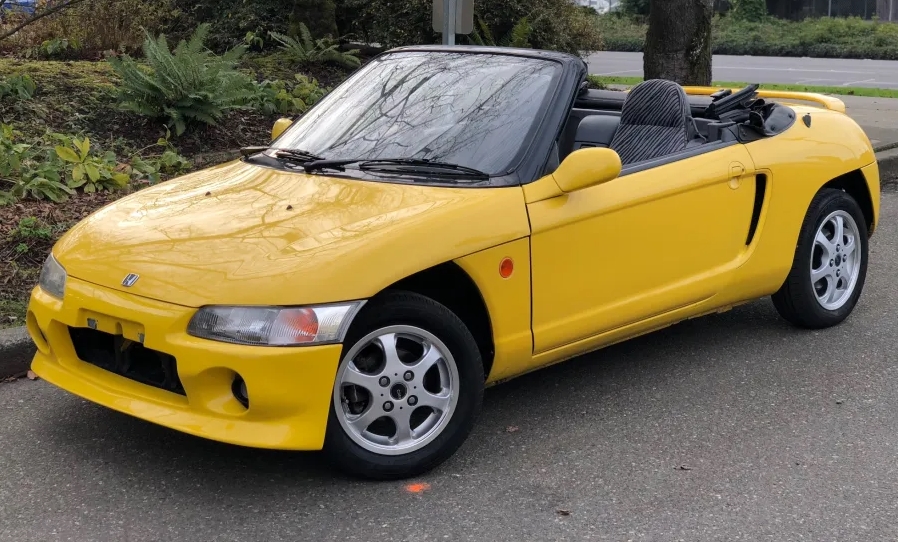
- Key Features: The most iconic feature of the early models was the “Zebra Stripe” seat upholstery and matching floor mats, a bold design choice that perfectly captured the car’s playful character. It came standard with a manual-folding soft top, power windows, and air conditioning. The instrument cluster was a work of art, with individual, motorcycle-inspired gauges for the speedometer, tachometer, and temperature/fuel. The standard wheels were 13-inch (front) and 14-inch (rear) steel rims with plastic hubcaps.
- Audio: A “Gathers” sky-sound audio system with a cassette player and radio was a popular dealer-installed option.
- Launch Colors: Festival Red and Carnival Yellow.
The First Special Editions (1992) – Model PP1-100
In its second year, Honda introduced limited-run versions with unique colors and features to maintain sales momentum.
- Version F (Released February 1992):
- Limited Run: 600 units.
- Exclusive Color: Captiva Blue Pearl.
- Features: This version came with special white alloy wheels and a body-colored rear spoiler, giving it a sportier appearance.
- Version C (Released May 1992):
- Limited Run: 500 units.
- Exclusive Color: Aztec Green Pearl.
- Features: It included unique alloy wheels (different from Version F), mudguards, and a special key. This version celebrated the car’s first anniversary.
The Mid-Cycle Refresh: Version II (February 1993 onwards) – Model PP1-110
In early 1993, the Beat received its only significant update, often colloquially referred to as “Version II” by enthusiasts. These later models carry the PP1-110 chassis code.
- Standard Model (Version II):
- Key Changes: The most noticeable change was inside. The iconic Zebra Stripe seats were discontinued and replaced with plain, solid gray fabric upholstery. The alloy wheels, previously only available on special editions, became standard equipment, though the design was a new, simpler five-spoke style. The color palette was also expanded.
- Colors added: Blade Silver Metallic and Everglade Green Metallic.
- Version Z (Released May 1993):
- This is the most well-known and desirable special edition.
- Exclusive Colors: Blade Silver Metallic or Everglade Green Metallic.
- Features: The Version Z was a premium offering. It included the standard alloy wheels, a rear spoiler, mudguards, and an exclusive black-faced Gathers CD player audio system. The “Beat” logos on the side were also rendered in a unique green font.
Final Years (1994 – 1996)
From late 1993 until the end of production in early 1996, no new trim levels or major changes were introduced. Production gradually wound down as the Bubble Economy deflated and the market for niche sports cars began to shrink. The Beat was officially discontinued in February 1996, with final sales continuing for a few months after.
Legacy and Spiritual Successor
The Honda Beat’s production run may have been short, but its legacy is immense. It perfectly encapsulated a moment in time when a major manufacturer dared to build a car dedicated solely to the joy of driving, unbound by practical considerations. Today, it is a cult classic, celebrated by enthusiasts worldwide. Thanks to the 25-year import rule, it has found a loving new home in markets like the United States, where drivers are discovering its unique charm for the first time.
The Beat’s spirit lived on. Nearly two decades after the last Beat left the factory, Honda revived the concept with the Honda S660, launched in 2015. Like its forefather, the S660 was a mid-engined, rear-wheel-drive, two-seater Kei roadster. While it swapped the Beat’s naturally aspirated, high-revving engine for a more modern turbocharged three-cylinder unit, the core philosophy remained the same: to deliver maximum driving fun in a minimal package. The S660 served as a fitting tribute, proving that the Beat’s formula for happiness was timeless.
In conclusion, the evolution of the Honda Beat was not one of drastic redesigns or a complex web of trim levels. It was a story of a brilliant concept executed nearly perfectly from the start, punctuated by small, thoughtful updates and charming special editions. It was, and remains, a pure, elemental sports car—a reminder that the size of a car has no bearing on the size of the smile it can put on your face. The Honda Beat wasn’t just a car; it was a pulse, a rhythm, a tiny, screaming heartbeat from one of the most exciting eras in automotive history.