The History of the Lincoln Motor Company
The Legacy of Luxury
In the grand tapestry of American automotive history, few names evoke a sense of timeless elegance, presidential gravitas, and mid-century optimism quite like Lincoln. It is a brand born from the ambition of an aviation pioneer, forged in the crucible of a global conflict, and reborn as a symbol of post-war prosperity. Lincoln’s story is not merely one of manufacturing cars; it is the story of an enterprise that consistently sought to define luxury for the American motorist, weathered immense economic storms, and ultimately found its modern identity within the vast ecosystem of the Ford Motor Company. This is the history of Lincoln, from its ambitious inception to its current status as a purveyor of modern utility and comfort.
The Aviator’s Ambition: The Birth of Lincoln (1917-1922)
The Lincoln Motor Company was founded in August 1917 by none other than Henry Leland, a man with an impeccable reputation for precision engineering and manufacturing. Leland was already a titan of the industry, credited with saving the nascent Cadillac Motor Car Company from financial ruin and establishing its reputation for unparalleled quality and interchangeability of parts. At 74 years of age, he embarked on a new venture, but this time, his focus was not on a car for the masses.
Leland’s personal background was steeped in mechanics and manufacturing. Starting as a machinist in Rhode Island, he eventually became a leading manufacturer of automotive engines and components. His philosophy was simple: quality above all else. This principle would define the early years of Lincoln.
The company’s name was a deliberate tribute to another American icon: President Abraham Lincoln. Leland was a passionate patriot, and he saw his new luxury automobile as the pinnacle of American craftsmanship, a fitting tribute to the man who preserved the Union.
Lincoln’s first project, however, was not a car. With World War I raging in Europe, Leland’s new company secured a contract from the U.S. government to build a Liberty aircraft engine. The company’s factories were built and operated with this singular purpose, and it produced over 6,000 of these powerful V12 engines before the war concluded. This aviation-first origin is a crucial part of the Lincoln story, as it imbued the company from its inception with a culture of building high-performance, complex machinery to the most exacting standards.
With the war over, Leland turned his full attention to his original goal: building a luxury motorcar. The first Lincoln production car, the Lincoln Model L, was introduced in 1920. It was a magnificent machine, powered by a robust L-head V8 engine displacing 358 cubic inches and producing a then-impressive 60 horsepower. The Model L was a heavy, substantial car, built with the same meticulous attention to detail that Leland had applied to the Liberty engine. It featured a three-speed manual transmission, a long 140-inch wheelbase, and was offered as a chassis-only for wealthy buyers to have custom coachwork fitted by specialists like Fleetwood, Brunn, or LeBaron. With a price starting at $4,100, the Model L was squarely aimed at the most affluent echelon of American society.
A Savior in a Black Ford Suit
The early years were not easy. The post-war economy quickly soured, and the high-end luxury market was the first to suffer. By 1921, Lincoln was hemorrhaging money. Leland, a brilliant engineer but less of a financier, found himself in deep water. Production of the Model L was minuscule, with only 2,045 cars built in the first two years.
It was at this critical juncture that a historical figure stepped in. Henry Ford, the titan of the burgeoning mass-market automobile manufacturing industry, had recently sold his interest in the Ford Motor Company to his son, Edsel, and was looking for a new challenge. He saw in Lincoln a brand with immense prestige and potential, and he admired Leland’s engineering prowess. In February 1922, Ford purchased the failing Lincoln Motor Company for a reported $8 million, a vast sum at the time.
Crucially, Henry Ford did not fire Henry Leland. He kept him on as president, respecting his expertise. However, the partnership was doomed from the start. The two automotive giants had fundamentally opposing philosophies. Ford was obsessed with efficiency, mass production, and cost control—his mantra was the moving assembly line. Leland believed in bespoke craftsmanship, precision fitting of parts, and a more traditional, slower manufacturing process. The clash was inevitable. After a year and a half of constant friction, Leland and his son Wilfrid resigned in 1926, ending the founding era of Lincoln.
The V12 Era and The Last Great Pre-War Model
Under Ford’s control, Lincoln entered a new golden age. The Model L was continued, but Ford’s resources allowed for improvements and more accessible pricing. By 1926, the design was updated, and the price had been lowered to $3,300, but sales remained stagnant. The car was seen as too old-fashioned. A new direction was needed.
In 1928, Lincoln made a bold move that would become a core part of its identity for decades: it introduced its first V12 engine. The new Lincoln Model K featured a 385 cubic inch L-head V12 that was exceptionally smooth and quiet, a significant advantage over the vibration-prone V8s of competitors like Cadillac. The Model K became the new flagship, with various body styles available over its long production run. It was a car that exuded power and grace, becoming a favorite of Hollywood stars and industrial magnates.
As the Great Depression took hold in the 1930s, Lincoln faced a severe hardship. Sales of ultra-luxury cars plummeted. However, the company showed remarkable resilience. It introduced the Lincoln Model L, a smaller and more affordable V12-powered car that provided a crucial lifeline. This era also saw the rise of the “Personal Car” concept, initiated by Edsel Ford, who commissioned the legendary Lincoln-Zephyr “Custom” convertible for his personal use in 1939. This car, with its streamlined design and elegant proportions, was a precursor to what would become Lincoln’s most iconic creation.
The pinnacle of pre-war Lincoln design and engineering, and arguably the most beautiful American car ever made, was the Lincoln Continental. Introduced in 1939, it was the brainchild of Edsel Ford, who, dissatisfied with the available custom coachwork, tasked his personal designer, Eugene “Bob” Gregorie, with creating a sleek, European-style grand tourer. The resulting car featured a low-slung profile, a distinctive “long hood, short deck” proportion, and a prominent horizontal spare tire mounted on the rear deck. It was an instant sensation. Production was initially limited to a handful of hand-built units for Edsel and his friends, but its popularity demanded its addition to the official lineup in 1940. The Continental Mk I was a masterpiece of design that set Lincoln apart from its boxier competitors.
World War II halted all civilian car production. From 1942 to 1945, the Lincoln plant was converted to war work, producing the M4 Sherman tank, aircraft components, and other military hardware.
Post-War Boom and The Cruiser
After the war, Lincoln, like all automakers, struggled with the transition back to civilian production. The first post-war Lincoln, the 1946 model, was essentially a slightly updated version of the 1941 car. The new, truly modern post-war Lincoln arrived in 1948: the Lincoln Cosmopolitan. This was a completely new car, featuring modern “unibody” construction (though Ford called it “bridge-frame” construction) and a new overhead-valve Y-block V8 engine. The Continental name was retired for a time, and the Cosmopolitan became the flagship.
The 1950s were a period of flamboyant design and constant innovation across the industry. Lincoln was no exception, but it struggled to find a consistent design identity. The 1950 and 1951 models featured distinctive “pontoon” fenders, but a major redesign was needed for 1952, Lincoln’s 35th anniversary. The result was the Lincoln Capri and the top-of-the-line Lincoln Cosmopolitan with its new 341 cubic inch overhead-valve V8. But the most significant car of this era was the 1956-1957 Lincoln Continental Mark II.
Conceived as a successor to the original Continental, the Mark II was a bold statement in an era of excess. It was extravagantly long, low, and wide, featuring the dramatic and controversial “Dagmars” (large conical bumpers) and a continental spare tire integrated into the trunk. It was powered by a massive 368 cubic inch V8. The Mark II had a long, 131-inch wheelbase and was priced at a staggering $5,995 (over $67,000 in today’s money), making it one of the most expensive American cars ever sold. Despite its grand presence and immense power, it was a commercial failure, with less than 21,000 units sold in its two-year run. It was a symbol of an era, but also a sign that consumers were beginning to find such flamboyant excess less appealing.
The “Personal Luxury” Revolution and a Tumble into Mediocrity
By the early 1960s, the American automotive landscape was shifting. The Continental Division was established in 1961 to build a new kind of luxury car, one that was more exclusive and refined. The result was the 1961 Lincoln Continental. This car was a masterpiece of understated elegance. It was a clean, sharp-edged four-door hardtop (with rear “suicide” doors on the four-door models) that did away with most of the chrome and fins that had defined the previous decade. It was an immediate success, praised for its handsome styling and smooth ride. A convertible version, discontinued after 1961 due to slow sales and a high price tag, has since become one of the most valuable collector cars of the 20th century.
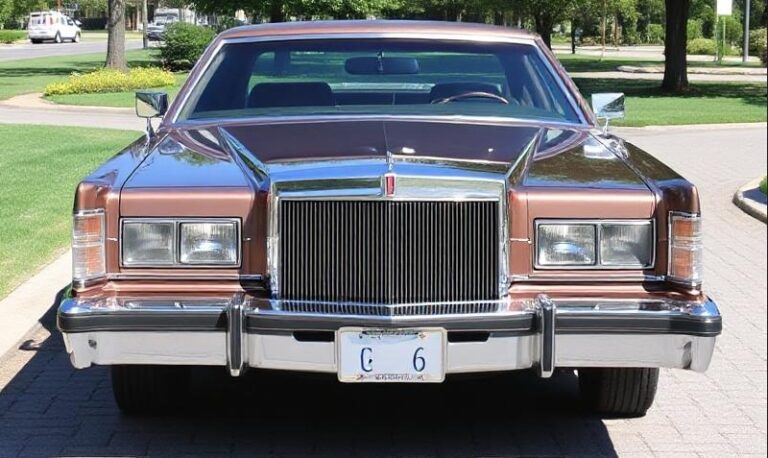
However, the rest of the decade saw Lincoln struggle to maintain its edge. The 1970s brought the “Brougham” era, where luxury was equated with plush velour, fake woodgrain, and massive, pillowy suspensions. The company produced cars like the Lincoln Town Car and the Mark IV and V, which sold well to an older, conservative demographic but lacked the driving refinement of rivals like Cadillac’s new Seville. The company was also hit hard by the 1973 oil crisis, as its hulking V8s were notoriously thirsty. Lincoln’s response was a series of attempts at fuel efficiency, including the controversial “Versatile” V8 that could run on fewer cylinders, but these were stopgap measures.
The 1980s brought the worst crisis in Lincoln’s history. In 1984, Lincoln launched the Continental Mark VII, a sleek, aerodynamic coupe based on the Ford Fox platform. It was a technological marvel, featuring a standard 215-horsepower 4.9L V8 and, on the high-tech LSC model, an advanced air suspension system. It was praised by critics for its handling and efficiency. But the true disaster was the 1988 Lincoln Continental. Intended to be a flagship sedan, it was a front-wheel-drive car that shared its chassis with the Ford Taurus and Mercury Sable. While competent, it simply did not look or feel like a $35,000 luxury sedan. Consumers, who associated Lincoln with rear-wheel-drive comfort and prestige, rejected it outright. It was a critical and commercial flop that nearly destroyed the brand’s reputation.
The Panther and the Rise of the SUV
Lincoln’s salvation came in 1990 with the introduction of the Lincoln Town Car based on the new “Panther” rear-wheel-drive platform. This car was everything the Continental was not: traditional, spacious, comfortable, and reliable. It quickly became the best-selling luxury car in America, dominating the livery and fleet markets and winning back loyal customers. The Panther platform would form the backbone of Lincoln’s sedan lineup for over two decades.
The 1990s also saw Lincoln embrace the future with the introduction of the Lincoln Mark VIII in 1993. This was a return to the personal luxury coupe, featuring a sleek, aerodynamic design and a powerful, smooth 4.6L DOHC V8. It was a modern successor to the Mark VII and was well-received for its performance and style.
However, the most significant strategic shift in Lincoln’s modern history occurred in the late 1990s: the brand’s move into the luxury SUV market. In 1997, Lincoln launched the Navigator, a three-row, truck-based SUV that was essentially a gussied-up Ford Expedition. It was an instant, massive success. The Navigator tapped into the burgeoning demand for large, family-friendly luxury vehicles and quickly became Lincoln’s best-selling model, generating huge profits and attracting a new, younger demographic to the brand. This single vehicle arguably saved Lincoln financially for the next decade.
Throughout the 2000s and 2010s, Lincoln continued to produce well-regarded vehicles like the LS sports sedan, the Aviator SUV, and the MKX crossover, while the Town Car limped on until 2011. However, the brand struggled to find a consistent identity, often falling behind competitors like Lexus, BMW, and Mercedes-Benz in terms of brand prestige and technological innovation. In 2010, Ford officially retired the Mercury brand to focus all its resources on Ford and Lincoln, positioning Lincoln as its sole luxury arm.
Lincoln Today: American Luxury Reimagined
Today, Lincoln exists as a division of the Ford Motor Company. It is no longer a standalone entity but a curated brand within a global corporate structure. The company’s strategy has pivoted away from trying to compete with German performance sedans. Instead, Lincoln has carved out a unique niche it calls “American Luxury”—a focus on serene comfort, effortless power, and elegant, quiet interiors. This is most evident in its current lineup of “Black Label” models, which offer a private-club-like purchasing experience with exclusive interior themes and concierge-level service.
Lincoln’s current outlook is one of careful reinvention. With the automotive world transitioning to electric vehicles, Lincoln has committed to a fully electric future by 2030. Its recent concepts, like the all-electric Star and the Aviator Grand Touring plug-in hybrid, signal a new era of silent, powerful, and technology-focused luxury.
The company’s first vehicle was the 1920 Lincoln Model L, which sold only 2,045 units in its first two years. Its latest flagship is the 2024 Lincoln Navigator, a massive, three-row SUV that continues to be a cornerstone of the brand. In 2023, Lincoln sold approximately 124,000 vehicles in the United States, with the Navigator, Aviator, and Corsair leading the charge.
While difficult to track exact historical global sales, the brand’s modern presence is primarily North American, with some sales in the Middle East and China. The single most popular vehicle in the brand’s history is the Lincoln Town Car. Produced in various forms for over 50 years, its final generation (1998-2011) alone sold over 1.1 million units in the U.S. Its success was built on its V8 rear-wheel-drive platform, immense interior space, legendary reliability, and its ubiquitous presence as the default “limousine” and livery car across America.
From the precision-machined engine that powered a war effort to the silent, comfortable cocoon of a modern Navigator, Lincoln’s history is a reflection of the American luxury car itself. It has survived depressions, world wars, corporate clashes, and near-fatal identity crises. Its legacy, built on the foundation of Henry Leland’s engineering integrity and Edsel Ford’s design vision, endures today not in its original form, but as a testament to its ability to adapt. Lincoln may no longer be an independent kingdom, but within the Ford empire, it continues its century-long mission to provide Americans with a quiet, comfortable, and distinctly American place on the road.