The Honda N-BOX: The Tiny Titan That Conquered Japan
In the global automotive landscape, titans are often measured by horsepower, size, and brand prestige. Yet, in Japan, the undisputed king of the road for over a decade has been a vehicle that embodies the complete opposite: a tiny, box-shaped car with an engine smaller than most motorcycles. This vehicle is the Honda N-BOX, a masterclass in packaging, efficiency, and understanding a market’s needs. It is not merely a car; it is a cultural and engineering phenomenon, a testament to Honda’s “Man-Maximum, Machine-Minimum” philosophy, and the best-selling vehicle in a nation of 125 million people.
A Brief History: The Rebirth of “N”
To understand the N-BOX, one must first understand the “kei car” (keijidōsha or “light automobile”). Governed by strict regulations on physical size, engine displacement (currently capped at 660cc), and power output, these vehicles receive significant tax and insurance benefits, making them ideal for Japan’s congested cities and narrow streets.
The N-BOX’s story begins with the revival of Honda’s historic “N” moniker, which first appeared on the revolutionary 1967 Honda N360. That car was a breakthrough, offering surprising space and performance in a minuscule package. Fast forward to the early 2010s, Honda aimed to recapture that innovative spirit. The N-BOX, launched in November 2011, was the first model in this new “N-Series” and was developed with a singular, ambitious goal: to create a new standard for mini-vehicles.
Its timing was poignant. In the wake of the 2011 Tōhoku earthquake and tsunami, Japanese consumers shifted their priorities towards practicality, economy, and safety. The N-BOX, with its incredible space efficiency, low running costs, and reassuring build, was the perfect car for the moment.
First Generation (JF1/JF2): 2011–2017
The first-generation N-BOX (chassis codes JF1 for front-wheel drive, JF2 for all-wheel drive) immediately set a new benchmark. It was built on a newly designed platform that incorporated Honda’s patented center-tank layout. By placing the thin fuel tank under the front seats, engineers freed up the entire rear floor, creating an astonishingly low and flat cargo area and enabling cavernous interior space that rivaled vehicles a class above.
The powertrain was a newly developed 660cc S07A three-cylinder engine, available in two forms: a naturally aspirated version producing 58 horsepower and a turbocharged version for more spirited performance, delivering 64 horsepower (the voluntary kei car limit). Both were paired with a smooth Continuously Variable Transmission (CVT).
.
NO MORE dead batteries with this:

.
Models and Trim Levels:
The first generation established a two-pronged model strategy that continues today: the standard N-BOX for mainstream appeal and the N-BOX Custom for a more stylish, aggressive look.
- Honda N-BOX:
- G: The base model, equipped with essential features.
- G L Package: The volume seller, adding popular features like power sliding doors, full-auto air conditioning, and smarter keyless entry.
- G Turbo Package: Combined the practicality of the L Package with the more powerful turbocharged engine.
- Honda N-BOX Custom:
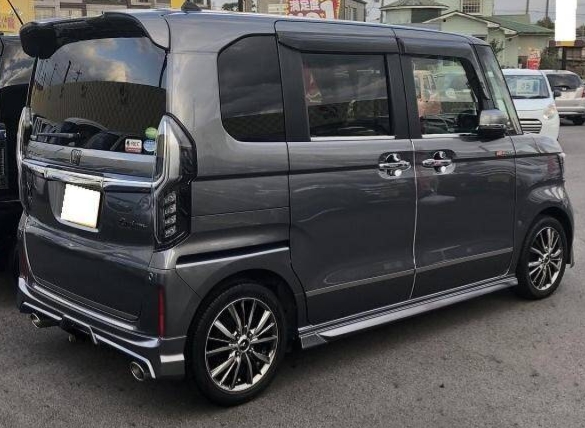
- This variant was distinguished by its large chrome grille, unique quad-headlight design (projector-style), clear taillights, and sporty aero body kit.
- G: The entry-level Custom.
- G L Package: Mirrored the standard N-BOX but with the Custom’s aesthetic upgrades and often more premium interior materials.
- G Turbo Package: The top-of-the-line model, offering the most powerful engine and the boldest styling.
Key Variants of the First Generation:
- N-BOX+ (Plus) (2012–2017): An ingenious utility-focused variant. It featured the “Universal Bridge,” a combination of a sloped floor and multi-configurable cargo boards. This allowed for loading heavy items like wheelchairs or bicycles with an attachable ramp, or creating a perfectly flat floor for sleeping. It was a vehicle designed for hobbies, small businesses, and accessibility.
- N-BOX Slash (2014–2020): A quirky, style-focused spin-off. It featured a “chopped” roofline, a distinctly retro-inspired interior with bold color schemes, and a high-end “Sound Mapping System” audio setup, making it a rolling design statement rather than a pure utility vehicle.
Second Generation (JF3/JF4): 2017–2023
If the first generation was a revolution, the second (JF3/JF4) was a calculated and masterful refinement. Honda, now the clear market leader, didn’t need to reinvent the wheel; it just needed to perfect it. The new N-BOX was built on a lighter yet more rigid platform, shedding approximately 80 kg (176 lbs). This, combined with an improved S07B engine featuring VTEC on the naturally aspirated models, resulted in better fuel economy and a more refined driving experience.
The biggest leap forward, however, was in safety. The second-generation N-BOX made the Honda SENSING suite of advanced safety and driver-assistive technologies standard on all trim levels. This was a game-changing move in the kei car segment, offering features like Collision Mitigation Braking, Lane Keeping Assist, and Adaptive Cruise Control to the masses.
Models and Trim Levels:
The model structure was simplified, with the N-BOX+ and Slash eventually being discontinued as the standard model became even more versatile. A key new feature was the “Super Slide Seat” on front-passenger side of higher trims, which could slide forward and back by a massive 570mm, creating limousine-like rear legroom or a cavernous front cargo area.
- Honda N-BOX:
- G: The base model, now with standard Honda SENSING.
- L: Added a left-side power sliding door and other comfort features.
- EX: The new top-tier standard model, featuring the Super Slide Seat.
- Turbo versions of the L and EX trims were also available.
- Honda N-BOX Custom:
- Featured a more aggressive design with full LED sequential turn signals and a commanding dark chrome grille.
- G L: The core Custom model with a power sliding door.
- G EX: The premium Custom with the Super Slide Seat.
- G L Turbo & G EX Turbo: Combined the top trims with the turbocharged engine for maximum performance and features.
Third Generation (JF5/JF6): 2023–Present
Launched in the fall of 2023, the third-generation N-BOX (JF5/JF6) follows a philosophy of “evolution, not revolution.” Honda wisely chose not to tamper with a winning formula. The design was softened and refined, with the theme of creating a “Happy Rhythm Box” that enriches daily life.
The standard N-BOX adopted friendly, round LED daytime running lights, while the Custom received a more sophisticated look with a new three-dimensional grille and direct-projection full LED headlights. Inside, the instrument cluster was moved from atop the dashboard to behind the steering wheel, incorporating a 7-inch TFT display for a cleaner forward view. The infotainment system was updated to include Honda CONNECT, offering connected services like remote air conditioning control and an in-car Wi-Fi hotspot.
Honda SENSING was also enhanced with a wider-angle front camera and the addition of short-range sonar, improving its collision mitigation capabilities at low speeds and helping to prevent false starts.
Models and Trim Levels:
The trim structure was slightly revised to focus on style packages.
- Honda N-BOX:
- Standard Trim: The new base model, well-equipped from the start.
- Fashion Style: A new package adding off-white door mirrors and door handles, and body-colored full-wheel caps for a chic, personalized look.
- Honda N-BOX Custom:
- Standard Trim: The core Custom model.
- Coordination Style: A premium monochrome or two-tone package featuring a dark chrome grille, black aluminum wheels, and a more upscale interior feel.
- A Turbo option is available for both Custom trims.
Beyond the Standard: The N-BOX Slope
An integral part of the N-BOX lineup across generations has been the N-BOX Slope. This is a factory-built wheelchair-accessible vehicle. Thanks to the low, flat floor, it can be equipped with an extendable ramp and an electric winch system, allowing a person in a wheelchair to be secured safely and comfortably in the rear passenger space. This model underscores the N-BOX’s role in Japan’s aging society, providing mobility and independence.
The Secret to its Success and Future Outlook
The N-BOX’s decade-long reign as Japan’s best-selling car is no accident. It is the result of a perfect storm of factors:
- Unparalleled Space Utility: The “Man-Maximum, Machine-Minimum” principle is executed flawlessly. No other vehicle in its class, and few in any class, offers such a vast and usable interior within such a tiny footprint.
- Broad Appeal: The dual-model strategy is brilliant. The standard N-BOX appeals to families and pragmatists, while the N-BOX Custom caters to a younger, style-conscious demographic that desires a premium feel without the size.
- Leadership in Safety: Making Honda SENSING standard across the board was a decisive move that established the N-BOX as the safest and most technologically advanced car in its segment.
- Economic Viability: It delivers exceptional fuel economy and benefits from the lowest tax and insurance rates, making it an incredibly logical financial choice for millions.
Looking ahead, the N-BOX faces the same challenge as the entire industry: electrification. Honda has already announced the N-VAN e:, an all-electric version of its commercial kei van, for 2024. This signals that an electric N-BOX is not a matter of “if,” but “when.” The challenge will be incorporating a battery without compromising the vehicle’s signature low floor and lightweight design, all while keeping the price within the accessible kei car bracket.
The Honda N-BOX is more than just a metal box on wheels. It is a rolling solution to the unique challenges of modern urban life in Japan. It is a vehicle that proves innovation isn’t always about being the biggest, fastest, or loudest, but about being the smartest. Its continued dominance is a testament to the simple, powerful idea that the best design is the one that gives the most back to the people who use it.