The Hybrid Heart of a Hot Rod: The Unconventional Evolution of the Panoz Esperante
In the pantheon of automotive history, many cars are born of calculated market strategy. They are designed by committee, engineered for a specific demographic, and built to compete in a pre-existing segment. And then, there is the Panoz Esperante. Born not from a boardroom spreadsheet but from the passionate vision of a motorsport-loving entrepreneur, the Esperante was an automotive anomaly—a hand-built, American-powered, neo-classical grand tourer that defied easy categorization. Its evolution is a story of persistence, innovation, and a refusal to compromise, culminating in a final act of engineering genius that remains profoundly relevant today.
A Passion Project Forged in Steel and Aluminum
The story of the Panoz Esperante cannot be told without its creator, Dan Panoz. The son of the legendary race car engine builder Don Panoz, Dan inherited a deep-seated love for what he called “automotive hot rods.” He envisioned a car that blended the soulful rumble of a large American V8 with the nimble handling and bespoke craftsmanship of a European sports car. The existing market offered either one or the other, but rarely a genuine fusion of both.
In 1989, Dan Panoz began work on a prototype in the basement of his Georgia home. The initial concept was a two-seater roadster, but feedback from potential customers led to a crucial pivot: they wanted a car that could accommodate more than just two people, something that could serve as a practical, if highly spirited, grand tourer.
The project was formally established in 1996 as Panoz Auto Development. The production car, officially unveiled at the 1998 Detroit Auto Show, was named the Esperante, a nod to a legendary pre-war sports car. At a time when other boutique manufacturers like TVR and Morgan were building bespoke sports cars, the Esperante carved its own niche with its unique blend of ingredients: a lightweight bonded-and-bonded aluminum chassis, a luxurious leather-clad interior, and a thunderous 4.6-liter Ford “Modular” V8 engine, sourced from the Ford Mustang Cobra.
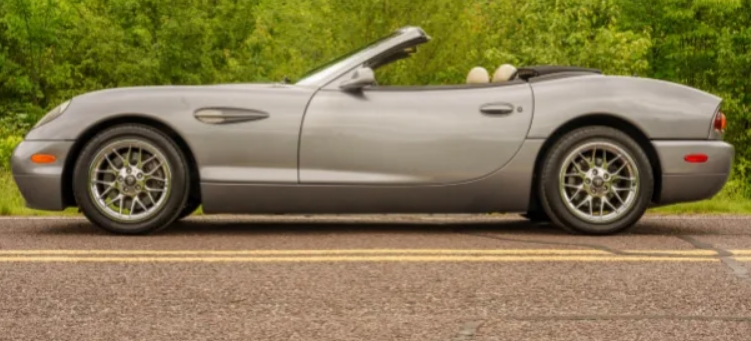
Production officially ran from 2000 to 2008, with a small number of cars built annually, each assembled by a dedicated team of craftsmen in an old hangar at the Briscoe Field airport in Georgia. The car was immediately notable for its “neo-classical” styling, featuring long, flowing lines, minimal overhangs, and a distinctive egg-crate grille. It looked like a car from the 1930s reinterpreted through a modern lens, complete with Stylish “suicide” (rear-hinged) doors for the rear passengers, a feature that enhanced both elegance and access to the rear bench.
.

.
The Evolution of the Main Line: From Standard to GT
Throughout its production run, the core Esperante remained remarkably consistent, but it was refined through a series of trim levels and special editions that allowed customers to tailor the car to their desires.
1. The Standard Esperante (2000-2008): The foundation of the model line. It featured the 4.6L SOHC V8 (initially 260 hp, later up to 320 hp), a five-speed manual transmission (with a four-speed automatic option), and a rear-wheel-drive layout. The body was a unique mix: the hood, roof, and rear decklid were hand-laid fiberglass, while the doors, fenders, and quarter panels were aluminum. The interior was a showcase of old-world craftsmanship, swathed in hand-stitched Italian leather, wood trim, and classic Smiths-style gauges. This was the purest expression of Dan Panoz’s vision.
2. The Esperante GT (2002-2008): For customers who desired a more focused driving experience, the GT was the answer. This trim level represented a significant step up in performance. The primary change was an engine upgrade to the more powerful 4.6L DOHC V8, borrowed from the Ford Mustang Cobra, producing 390 horsepower. This model also received a Ford 6-speed manual transmission (the Tremec T56), which offered closer ratios and a stronger drivetrain to handle the increased torque. The GT was a true performance grand tourer, capable of exhilarating acceleration and a top speed approaching 170 mph. It was a testament to Panoz’s “hot rod” philosophy, leveraging readily available and robust American powertrains.
3. The Esperante GTR (2004): The GTR was the pinnacle of the standard Esperante’s performance, born from the company’s “All American” racing program. It was a limited-edition, street-legal track car. The GTR featured an even more powerful version of the DOHC V8, a Bilstein coil-over suspension system, Brembo brakes, and extensive aerodynamic aids including a prominent rear wing and front splitter. With only a handful produced, the GTR was a rare and visceral machine, a direct competitor to cars like the Chevrolet Corvette Z06 in spirit, if not in price or production volume.
The Second Act: The Legendary Q1
By the mid-2000s, the Esperante was well-regarded but faced the constant challenges of a low-volume manufacturer. The market, however, was shifting. Hybrid technology was emerging, but it was almost exclusively associated with small, economy-focused cars. Dan Panoz saw an opportunity to do what Panoz does best: create a “hot rod” hybrid.
This audacious project culminated in 2005 with the unveiling of the Panoz Q1. While visually similar to the Esperante, the Q1 was a technological masterpiece that redefined the car’s legacy.
The Powertrain: The Q1 was powered by a 1.6-liter Hyundai “Alpha” inline-4 engine, producing a modest 115 horsepower. This seemingly underwhelming engine was chosen specifically for its compact size and efficiency. Its job was to act as a generator for an innovative “series hybrid” system.
The “Volterra” Powertrain: Instead of a conventional battery, the Q1 utilized a Gold Cart Power System (GCPS), a revolutionary setup co-developed with Gold Cart Technologies. It featured a bank of ultracapacitors (referred to as “Power Cells”) and a high-voltage electric motor. The ultracapacitors could absorb and release energy far more rapidly and with greater longevity than traditional batteries. The gasoline engine ran at its most efficient speed, sending power to the capacitors, which then fed the electric motor that drove the rear wheels.
The Experience: The result was a car that was utterly unique. It had the instant, silent torque of an electric vehicle, but with the range of a gasoline car. The ultracapacitors provided a blast of acceleration, and energy was recaptured under braking with astonishing efficiency. The Q1 was capable of running on electric power alone at low speeds and in stop-and-go traffic. It was a functional, drivable, and lightning-fast proof-of-concept for a performance-oriented hybrid system—a full decade before Porsche would popularize the idea with the 918 Spyder.
Dan Panoz’s philosophy was clear: “Hybrids don’t have to be boring.” The Q1 was the ultimate validation of his principles, proving that electrification could enhance, not dilute, the thrill of driving.
The Apex Predator: The Roadster S
Just as the Q1 was redefining the brand’s technological potential, the traditional V8 model received its final and most extreme evolution: the Esperante Roadster S, revealed in 2007.
This was the ultimate expression of the original Esperante concept. It took the GT’s underpinnings and pushed them to the absolute limit. The engine was a supercharged 4.6L DOHC V8, now producing a staggering 550 horsepower and 550 lb-ft of torque.
The Roadster S was a full convertible (unlike the standard Esperante’s removable hardtop) and featured a heavily revised, more aggressive body style. It sat lower and wider, with a muscular “power bulge” hood, new side skirts, and a distinctive integrated rear diffuser. The interior was driver-focused, yet still retained the Esperante’s signature luxury. This car was a true American supercar, with performance that could humble much more expensive machinery, yet it retained the hand-built charm that defined the brand.
The End of an Era and a Lasting Legacy
Despite the innovation of the Q1 and the raw power of the Roadster S, the global financial crisis of 2008 proved too much for the small company to overcome. Production of the Esperante line ceased in 2008, and the company pivoted fully to its racing endeavors, particularly the Empula hybrid Le Mans prototype project.
The Panoz Esperante remains a footnote in automotive history for many, but for enthusiasts, it is a cherished icon. It represents a time when a small group of passionate individuals could create a legitimate, world-class performance car on their own terms. It was a car that honored the past with its classic lines and handcrafted interior while embracing the future with its innovative racing technology and, most presciently, with the groundbreaking hybrid Q1.
Today, the Esperante’s spirit endures. The ethos of creating an unconventional, American-powered, driver-focused performance car can be seen in modern offerings from companies like Rossion and Noble (which have their own roots in the low-volume sports car world). More importantly, the Q1’s philosophy of using electrification to boost performance, not just efficiency, is now the dominant trend in the high-performance automotive world. Dan Panoz was simply ahead of his time. The Esperante, in all its forms, is a testament to the power of a single, uncompromising vision.