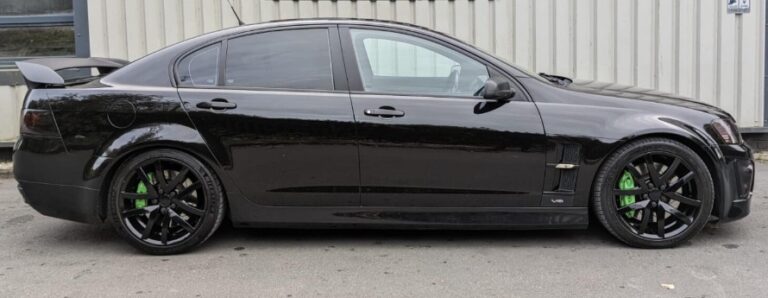
The Italian Gran Turismo in a Tuxedo: The Complete History of the De Tomaso Deauville
In the pantheon of automotive history, few marques encapsulate the spirit of 1970s “Milanese Muscle” quite like De Tomaso. Founded by the Argentine racing driver Alejandro de Tomaso, the Modena-based manufacturer is best known for the Pantera—a mid-engined, American-powered wedge that became a poster child for exotic supercars. However, the Pantera’s older, more refined sibling, the De Tomaso Deauville, represents a different, arguably more sophisticated vision of performance.
A four-door luxury sedan with the heart of a supercar, the Deauville was an anomaly in its era: a high-performance executive express that offered the styling of an Italian flagship with the reliability of a Ford. Produced during the turbulent economic climate of the 1970s and early 1980s, the Deauville’s evolution is a story of adaptation, resilience, and a singular obsession with blending luxury with brute force.
Origins and Design (1972–1975)
The Deauville debuted at the 1972 Turin Motor Show, arriving at a time when the market was saturated with staid, boxy sedans from Germany and Britain. De Tomaso sought to inject Latin flair into the executive segment. Unlike the Pantera, which utilized a steel backbone chassis, the Deauville employed a traditional steel monocoque chassis with fully independent suspension (double wishbones at the front and a solid axle with coil springs at the rear, later modified).
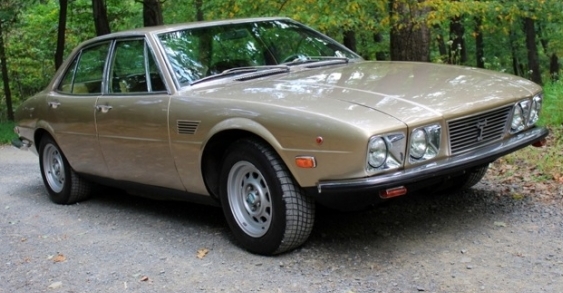
Designed by the legendary Ghia, the first generation Deauville was penned by Giorgetto Giugiaro during his tenure at the design house. The styling was remarkably restrained for an Italian car, characterized by a clean, angular profile with a distinct Coke-bottle shape, a chrome-slatted grille, and quad circular headlights. At nearly 4.9 meters long, it was an imposing vehicle, intended to compete with the Mercedes-Benz 450SEL and the Jaguar XJ6.
The First Generation (1972–1975)
- Model Designation: De Tomaso Deauville (Series I)
- Engine: 351 cu in (5.8L) Ford Windsor V8 (Cleveland head)
- Power Output: Approximately 305–320 HP (US Spec)
The initial Deauville was powered by the ubiquitous Ford 351 Windsor V8, the same engine found in the Ford Mustang. However, De Tomaso added a touch of Italian engineering by fitting it with a magnesium alloy oil pan and mounting the engine longitudinally. Mated to a 3-speed Ford C3 automatic transmission, the car was capable of reaching speeds of over 130 mph, with a 0–60 time of roughly 7.5 seconds—respectable for a nearly two-ton sedan.
Trim Levels and Variations The first generation was relatively simple in its offerings. While options lists allowed for customization, the primary trims were dictated by market requirements:
- US Spec: The most common variant, featuring large rubber safety bumpers (to meet NHTSA regulations) and emissions-controlled engines.
- European Spec: Featured chrome bumpers, higher compression ratios, and slightly more aggressive tuning.
A notable “special” model from this era was the Deauville Ghia 2+2, a prototype commissioned for the Italian government to replace the presidential fleet. It featured extended wheelbase, rear-hinged “suicide” doors, and opulent velvet interiors. While only a few were built, it validated the Deauville’s capability as a state limousine.
.

.
The Second Generation (1975–1978)
By 1975, the automotive world was shifting. The 1973 oil crisis had shaken consumer confidence, and strict emissions regulations were strangling performance. De Tomaso responded with a facelifted version of the Deauville, often referred to as the Series II.
- Model Designation: De Tomaso Deauville (Series II)
- Engine: 351 cu in (5.8L) Ford Windsor V8
- Power Output: Dropped to ~220 HP (due to catalytic converters and emission controls)
Visually, the Series II distinguished itself with a revised front end. The quad headlights were replaced with rectangular units, and the grille was simplified. The most significant change inside was the introduction of a new instrument cluster sourced from the De Tomaso Longchamp (their two-door grand tourer), featuring Veglia gauges.
Trim Levels and Variations During this period, De Tomaso began to explore the Deauville’s versatility as a high-performance chassis.
- Standard Deauville: The four-door luxury sedan.
- Deauville Estate (Prototypes): While the Longchamp served as the coupe, De Tomaso commissioned Carrozzeria Ghia to build an estate wagon (station wagon) prototype based on the Deauville platform. Only two were built (one for Alejandro de Tomaso himself, another for the King of Spain), but they hinted at the car’s potential for family-oriented performance.
- Longchamp (Related Model): Although technically a separate model line, the De Tomaso Longchamp (launched in 1972) is the two-door sibling of the Deauville, sharing the same chassis, engine, and interior architecture. In many collector circles, the Longchamp is grouped with the Deauville as part of the “Ford-powered De Tomaso luxury lineage.”
The Third Generation (1979–1985)
The late 1970s brought the greatest challenge to De Tomaso: the collapse of the US market for Italian luxury sedans. The oil crisis and strict safety standards led De Tomaso to withdraw from the United States in 1976. Consequently, the final evolution of the Deauville was designed primarily for European and Middle Eastern markets.
- Model Designation: De Tomaso Deauville (Series III)
- Years Produced: 1979–1985
- Engine: 351 cu in (5.8L) Ford Windsor V8 (European tune)
The Series III is the rarest and most distinct version. The exterior underwent a significant redesign to modernize the silhouette.
- Front: A completely new fascia with integrated rectangular headlights and airdams.
- Rear: A wraparound taillight bar (reminiscent of contemporary American cars) and a restyled trunk lid.
Trim Levels and Special Editions In this final phase, the Deauville became a niche product, often custom-ordered by wealthy European or Arab clients.
- Standard Deauville: Retained the 5.8L V8, producing around 250–270 HP in European trim (unrestricted).
- Deauville 4.9: A limited-run model produced around 1980–1981, specifically for the Italian market to lower road tax. Italy taxed cars over 2000cc heavily, and the 5.8L V8 attracted exorbitant fees. De Tomaso managed to offer a detuned 4.9L (298 cu in) Ford V8 variant. Despite the smaller displacement, performance remained spirited due to better breathing, though power dropped to roughly 200 HP.
- Deauville Automatic: By this time, the 3-speed C3 transmission was phased out in favor of the more robust Ford C5 3-speed automatic (and in some rare cases, a 4-speed manual was available on request, though extremely rare).
Technical Evolution: The Ford Connection
Throughout its life, the Deauville’s greatest strength—and occasional criticism—was its reliance on Ford mechanicals. Unlike the Pantera, which used a Ford chassis in addition to the engine, the Deauville used a true Italian chassis with Ford running gear.
- Engine: The Ford 351 Windsor was chosen for its torque, reliability, and parts availability. In the Deauville, it was mounted longitudinally, driving the rear wheels.
- Suspension: The front suspension used double wishbones with coil springs and an anti-roll bar, independent of the engine. The rear utilized a de Dion axle setup in early models (for handling precision) before simplifying to a live axle in later years to reduce costs.
- Brakes: Ventilated disc brakes were standard on all four wheels, providing stopping power appropriate for a vehicle weighing over 1,700 kg.
Market Performance and Production Numbers
The Deauville never achieved mass-market success. It was a hand-built vehicle with a price tag that rivaled established luxury marques. Production figures are estimates, as records from De Tomaso (a company that faced bankruptcy multiple times) are incomplete.
- Total Estimated Production: Approximately 250–300 units across all generations.
- Primary Markets:
- Italy: The domestic market favored the 4.9L version for tax reasons.
- Europe: Wealthy buyers in Germany, Switzerland, and the UK sought the Deauville as a curio—a high-speed executive car without the ubiquity of a Mercedes.
- Middle East: The final batches of Series III cars were exported to the Gulf states, where the heat-resistant cooling system and spacious interiors were appreciated.
The End of the Road and Legacy
By 1985, the Deauville was technologically obsolete. The interior, while luxurious with leather and wood trim, lacked modern amenities like air conditioning (often an expensive option), power steering (absent on most), and advanced sound insulation. Furthermore, the rising cost of production and the decreasing demand for large, V8 sedans in Europe forced De Tomaso to discontinue the model. The factory focused on the smaller, more modern Kjara and the Giugiaro-designed Bigura.
Future Outlook
Today, the De Tomaso Deauville exists as a cult classic. It appeals to a specific type of collector: one who appreciates the analog feel of 1970s Italian design but craves the simplicity of American V8 maintenance.
Current Market Status
- Availability: Extremely rare. Finding one for sale requires patience and connections to European specialist dealers.
- Value: Prices have seen a steady increase. In the early 2000s, neglected Deauvilles could be acquired for nominal sums. Today, a pristine Series III Deauville can command between €60,000 and €100,000. The rarer 4.9L “Tax Trap” models and the few surviving estates command premiums.
- Modifications: A common trend among owners is engine swaps. While the Ford 351 remains popular, some owners have swapped in more modern Ford modular V8s or Chevy LS engines to improve reliability and power.
The Deauville in Pop Culture The Deauville remains largely absent from Hollywood blockbusters, unlike the Pantera (featured in Risky Business and Kill Bill). However, this obscurity adds to its allure. It is the “sleeper” of the De Tomaso lineage—often overshadowed by the flashy Pantera but appreciated by connoisseurs for its grand touring elegance.
Conclusion
The De Tomaso Deauville was born from a singular vision: to create a car that could cross continents in comfort yet outperform sports cars on the autobahn. It bridged the gap between the old world of handcrafted Italian coachbuilding and the new world of mass-produced American powertrains.
While the Deauville never achieved the commercial volume of a Mercedes S-Class or the timeless icon status of a Ferrari, it carved out a unique niche. It remains a testament to the era when car manufacturing was bold, experimental, and unafraid to mix cultures. For the few who own them today, the Deauville offers a driving experience that no modern sedan can replicate: the sensation of piloting a bespoke Italian tuxedo wrapped around a Detroit heartbeat.