The K-Series Revolution: A Deep Dive into the Kia K4 and K5
In the modern automotive landscape, few brands have undergone a more dramatic and successful transformation than Kia. Once considered a purely budget-oriented choice, the South Korean automaker has systematically reinvented itself into a powerhouse of design, technology, and performance. Nowhere is this evolution more apparent than in its sedan lineup, spearheaded by the “K-Series.” This naming convention, long used in Kia’s domestic market, signifies a global strategy of cohesive design and ambitious market positioning. The cornerstones of this strategy in North America are the mid-size K5 and the all-new compact K4—two vehicles that, while serving different segments, perfectly encapsulate Kia’s bold vision for the future of the sedan.
This article provides a comprehensive look at the Kia K5 and its upcoming sibling, the K4, covering their history, production years, detailed model and trim breakdowns, and their collective role in Kia’s ongoing revolution.
Part 1: The Trailblazer – The Kia K5 (2021-Present)
The Kia K5 did not emerge from a vacuum. It is the direct successor to the Kia Optima, a nameplate that was instrumental in changing public perception of the brand. The 2011 Optima, penned by legendary designer Peter Schreyer, was a watershed moment, trading anonymity for a sleek, European-inspired design that made competitors look dated overnight. Over its subsequent generations, the Optima solidified its reputation for offering style, features, and value.
When the fifth-generation model was due, Kia made a strategic decision for the North American market: it retired the well-known Optima name in favor of its global moniker, K5. This move, starting with the 2021 model year, was intended to align its branding worldwide and project a more modern, tech-forward image.
.

.
Design and Platform
Built on the advanced Hyundai-Kia N3 platform, which it shares with the Hyundai Sonata, the K5 presented a radical departure from even its stylish predecessor. Its design is dominated by a dramatic fastback-like silhouette that blurs the line between a traditional sedan and a four-door coupe. The front fascia features an aggressive evolution of the brand’s “Tiger Nose” grille, seamlessly integrated into sharp, angular headlights. The most distinctive feature is the “Heartbeat” LED daytime running light signature, which zig-zags from the fender into the headlight housing, giving the K5 an unmistakable and aggressive presence on the road.
Models and Trim Levels Offered (North American Market)
The K5 lineup was intelligently structured to cater to a wide range of buyers, from those seeking a stylish and efficient commuter to enthusiasts demanding genuine performance.
Powertrains:
- 1.6L Turbocharged GDI 4-Cylinder: The standard engine, producing 180 horsepower and 195 lb-ft of torque. It is paired with a smooth 8-speed automatic transmission. This is the engine found in the majority of K5 trims.
- 2.5L Turbocharged GDI 4-Cylinder: Exclusive to the GT model, this potent engine churns out an impressive 290 horsepower and 311 lb-ft of torque. It is mated to a unique 8-speed “wet” dual-clutch transmission (DCT) for lightning-fast shifts.
Trim Levels (2021-Present):
- LXS (Formerly LX): The entry point to the K5 lineup. It comes standard with the 1.6T engine and front-wheel drive (FWD). Key features include an 8-inch touchscreen infotainment system with wireless Apple CarPlay and Android Auto, and Kia’s Drive Wise suite of safety technologies, including Forward Collision-Avoidance Assist.
- GT-Line: Arguably the most popular trim, the GT-Line focuses on delivering a sporty aesthetic without the cost of the high-performance engine. It adds aggressive front and rear bumpers, a gloss black rear spoiler, 18-inch alloy wheels, and a flat-bottomed steering wheel. The interior receives a larger 10.25-inch infotainment screen (with wired Apple CarPlay/Android Auto) and synthetic leather/cloth combination seating. Crucially, the GT-Line is the only trim to offer an all-wheel drive (AWD) option, making it a compelling choice in colder climates.
- EX: This trim leans into comfort and luxury. It builds upon the LXS with features like a panoramic sunroof, heated and ventilated front seats, full SynTex synthetic leather seating, rear air vents, and satellite radio. The EX is designed for buyers who prioritize premium amenities over sporty looks.
- GT: The pinnacle of K5 performance. The GT is not just an appearance package; it is a genuine sport sedan. It is exclusively equipped with the 2.5T engine and 8-speed wet DCT. To manage the power, it features a sport-tuned suspension, larger brakes with GT-branded calipers, a quad-tip dual exhaust system, and 19-inch wheels with Pirelli P-Zero tires. The GT is FWD only, a deliberate choice by Kia to create a thrilling, if occasionally unruly, driving experience.
Part 2: The New Challenger – The Kia K4 (2025-Present)
Just as the K5 replaced the Optima, the Kia K4 is set to replace the brand’s highly successful compact sedan, the Forte. The Forte was a formidable competitor in its class, known for its exceptional value, strong warranty, and available turbocharged performance. However, with the K4, Kia is once again choosing to disrupt the segment with a vehicle that prioritizes radical design and cutting-edge technology.
Unveiled in 2024 for the 2025 model year, the K4 is the latest and most dramatic expression of Kia’s “Opposites United” design philosophy. This language, which blends natural forms with modern architecture, was first seen on the all-electric EV9 and is now being translated to the brand’s core models.
Design and Philosophy
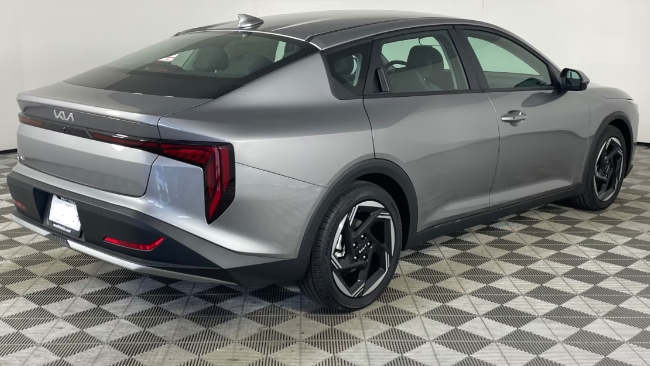
The K4 looks like nothing else in the compact sedan class. It eschews the soft curves of its rivals for a bold, almost architectural form. Its most striking features include:
- Star Map Lighting: T-shaped LED light signatures at the front and rear create a futuristic and instantly recognizable look.
- Angular Fastback Profile: The roofline extends far back, and the rear door handles are cleverly hidden in the C-pillar, creating the illusion of a two-door coupe.
- Geometric Fenders: The body panels feature unconventional angles and creases, giving the car a dynamic and technical appearance.
Models and Trim Levels (Announced for Launch)
The K4 will launch with a familiar trim structure, offering clear choices for value, style, and performance.
Powertrains:
- 2.0L MPI 4-Cylinder: The standard engine, carried over from the Forte, produces 147 horsepower and 132 lb-ft of torque. It is paired with an Intelligent Variable Transmission (IVT), Kia’s version of a CVT.
- 1.6L Turbocharged GDI 4-Cylinder: The optional performance engine, available in the top trims, will produce an estimated 190 horsepower and 195 lb-ft of torque. Notably, it will be paired with an 8-speed automatic transmission, moving away from the 7-speed DCT used in the previous Forte GT.
Trim Levels (Planned for 2025):
- LX, LXS, EX: These trims will form the core of the lineup, powered by the 2.0L engine. They are expected to come with a high level of standard equipment, including a large integrated panoramic display combining the digital instrument cluster and central touchscreen, wireless Apple CarPlay/Android Auto, and an advanced suite of Drive Wise safety features.
- GT-Line: Similar to its K5 counterpart, this trim will add a host of sporty design elements, including unique bumpers, gloss black accents, and 18-inch wheels. It will be available with both the standard 2.0L engine and the optional 1.6L turbo.
- GT-Line Turbo: This will be the top-tier performance model. In addition to the 1.6L turbo engine and 8-speed automatic, it will receive a crucial mechanical upgrade: a multi-link rear suspension. This more sophisticated setup (compared to the torsion beam on non-turbo models) promises significantly improved handling dynamics and ride comfort.
The K4 5-Door: In a significant move, Kia has also confirmed that a 5-door hatchback version of the K4 will be produced, directly targeting competitors like the Honda Civic Hatchback and Mazda3 Sport. This adds a layer of practicality and European flair to the lineup.
The Unifying Strategy and Future Outlook
The K4 and K5 are more than just two separate models; they are the manifestation of a single, coherent strategy.
- Design as a Weapon: Kia is using bold, uncompromising design to carve out a distinct identity. While Japanese rivals often opt for more conservative styling, Kia is betting that a growing number of consumers want their vehicles—even practical sedans—to make a statement.
- Democratization of Technology: Both vehicles offer large digital displays, comprehensive safety suites, and premium convenience features at accessible price points. The K4, for example, will bring class-leading screen real estate and features like a digital key to the compact segment.
- A Multi-Pronged Attack: The K5 targets the heart of the mid-size market with its blend of style, available AWD, and high-performance GT variant. The K4 assaults the compact segment with its avant-garde design and the added practicality of a 5-door model, challenging the status quo from all angles.
Future Outlook:
For the Kia K5, a mid-cycle refresh is likely on the horizon. This could involve adopting the “Star Map” lighting from the K4 and EV9, further refining the interior technology, and potentially introducing a hybrid or plug-in hybrid variant to the North American lineup, leveraging the electrified powertrains already available on its Sonata platform-mate.
For the Kia K4, its future is about establishing its place in the market. Its success will be a major test case for Kia’s “Opposites United” design philosophy. Will buyers embrace its radical looks, or will it prove too polarizing for the traditionally conservative compact sedan segment? The answer will likely dictate Kia’s design direction for years to come.
In conclusion, the Kia K5 and K4 represent the past, present, and future of Kia’s sedan ambitions. The K5 established the “K-Series” in North America as a force of style and performance, building on the legacy of the Optima. The K4 is set to carry that torch into the next generation, pushing the boundaries of design and technology even further. Together, they form a formidable duo, proving that in a market increasingly dominated by SUVs, the sedan is not only alive but is being driven forward by Kia’s relentless innovation and revolutionary spirit.