The Last Fang of the Pampas: The Evolution of the De Tomaso Guara
The Ghost of Modena
In the pantheon of Italian supercars, the name De Tomaso evokes images of brutal V8 power wrapped in flamboyant, Marcello Gandini-penned bodies. The Pantera, with its mid-engine layout and Ford Cleveland heart, remains an icon of 1970s excess. Yet, the story of Alejandro De Tomaso’s automotive empire did not end with the Pantera. It culminated in a car that was smaller, sharper, and arguably more authentically Italian than its predecessor: the De Tomaso Guara.
Produced from 1993 to 2004, the Guara was the final act of a company that had fought valiantly to keep the mid-engine, two-seater sports car alive during an era dominated by the electronic traction control and safety regulations of the 1990s. It was a low-volume, hand-built exotic that bridged the gap between the analog supercars of the past and the technological titans of the future. This is the evolution of the De Tomaso Guara, the last fang of the pampas.
Part I: The Genesis (1993)
To understand the Guara, one must understand the context of De Tomaso in the early 1990s. The Pantera, which had been in production for over two decades, was finally showing its age. Regulations regarding crash safety and emissions were tightening, and the market was shifting toward supercars like the Ferrari F40 and the emerging McLaren F1.
Alejandro De Tomaso needed a successor. He had initially collaborated with Giugiaro on the “Biga” concept in 1989, but that design was eventually set aside in favor of a new shape. The task of designing the new car was given to Carrozzeria Coggiola, specifically designer Mario Felice Coggiola. The result was the Guara prototype, unveiled at the 1993 Geneva Motor Show.
The name “Guara” is derived from the Portuguese word for a particularly fierce breed of cattle native to South America—a fitting moniker for a car that looked aggressive yet possessed a certain organic, flowing elegance.
Unlike the Pantera, which utilized a steel backbone chassis, the Guara was built on a steel tube frame chassis with integrated roll bars, providing a safer, stiffer foundation. The body was crafted entirely from fiberglass, a choice made to keep weight down and allow for complex, flowing curves that sheet metal could not easily replicate at low volumes.
.

.
Part II: The Targa – The Guara Barchetta (1993–1994)
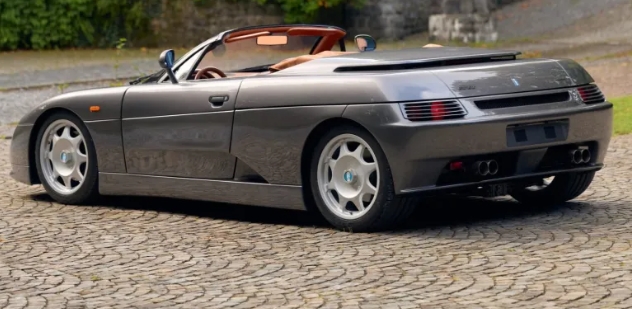
When the Guara debuted, it was not presented as a closed coupe, but as a “Barchetta” (little boat). This was the initial model offered to the public and the purest expression of the Guara concept.
- Model: Guara Barchetta
- Years: 1993–1994
- Body Style: Open-top Targa
The Barchetta was an uncompromising driving machine. It featured a removable roof panel that stowed in the trunk, but no side windows or windscreen wipers, strictly limiting its weather capability to fair-weather driving. The interior was spartan, featuring leather-clad bucket seats and a simple, driver-focused dashboard.
Engine and Performance: The Barchetta was powered by a 4.9-liter (4942 cc) Ford Cleveland V8 engine. This was the same family of engines that had powered the Pantera, though the Guara’s iteration was updated with sequential fuel injection and new cylinder heads to meet the emissions standards of the early 90s. It produced approximately 315 horsepower and 323 lb-ft of torque.
Mated to a 5-speed manual transaxle (derived from the Pantera but modified), this engine propelled the lightweight fiberglass body (weighing just under 1,100 kg / 2,425 lbs) to a top speed of around 160 mph (257 km/h). The Barchetta was raw, loud, and visceral—a true analog experience.
Part III: The Evolution to Coupe – The Guara Cup (1994–1996)
While the Barchetta won praise for its purity, De Tomaso recognized the need for a more practical, road-going variant that offered better weather protection. In 1994, the coupe version of the Guara was introduced.
This model was marketed as the Guara Cup, a nod to the one-make racing series De Tomaso attempted to organize to bolster the car’s reputation (though the series never truly took off).
- Model: Guara Cup
- Years: 1994–1996
- Body Style: Closed Coupe
Aesthetic Changes: The Guara Cup introduced the distinctive double-bubble roof, a classic Italian design feature that provided extra headroom and improved aerodynamics. The side profile became sleeker, and the rear featured a more pronounced spoiler integrated into the engine cover glass.
Interior and Features: Unlike the spartan Barchetta, the Cup offered a fully enclosed cabin with glass windows, a windshield with wipers, and optional air conditioning. The build quality improved significantly during this period as Carrozzeria Coggiola refined its manufacturing processes.
Mechanical Specifications: The mechanicals remained largely unchanged from the Barchetta. The Ford 4.9L V8 remained the heart of the car, still producing around 315 hp. However, with the added weight of the roof and glass, performance remained brisk but not earth-shattering compared to contemporaries like the Ferrari 348. The Guara was not built for straight-line dominance; it was built for balance and handling.
Part IV: The Maserati Era – The Guara S (1996–2001)
In 1996, a significant corporate shift occurred. De Tomaso Automobili was acquired by Fiat, which immediately began restructuring the company. In a move that shocked many enthusiasts, Fiat decided to shift the production of De Tomaso vehicles from the small Coggiola facility to the main Maserati factory in Modena.
This change marked the introduction of the Guara S.
- Model: Guara S
- Years: 1996–2001
- Body Style: Coupe and Spider
Build Quality and Refinement: Under Maserati’s stewardship, the Guara underwent a transformation in quality. The fit and finish of the fiberglass body panels improved, panel gaps tightened, and the interior materials were upgraded to match Maserati standards. Leather quality increased, and sound deadening was added, making the S a more comfortable grand tourer.
Performance Tweaks: While the engine remained the 4.9L Ford V8, it was now managed by a new Bosch Motronic system. Power saw a slight increase, rising to approximately 330 hp. The suspension was retuned for a slightly softer ride, accommodating the car’s new role as a long-distance cruiser.
During this era, De Tomaso also experimented with a “Cristallo” edition, which featured a transparent roof, but the S remained the core offering. The Guara S was the most refined version of the car, possessing a level of fit-and-finish that the earlier Coggiola-built cars struggled to match.
Part V: The Final Iteration – The Guara Spider (2000–2004)
The final chapter in the Guara’s production life saw the return of an open-top variant, this time with a proper convertible top.
- Model: Guara Spider
- Years: 2000–2004
- Body Style: Convertible
Design and Function: The Spider was based on the Coupe chassis but featured a soft top that folded neatly behind the seats. Unlike the original Barchetta, the Spider was fully road-legal with side windows and a windscreen. The rear deck was reshaped to accommodate the convertible mechanism, giving the car a more muscular stance.
The End of an Era: By the early 2000s, the Guara was severely outdated. The Ford V8, while reliable, lacked the exotic soundtrack and high-revving character of Italian engines. Furthermore, safety regulations were changing again, and the fiberglass construction of the Guara made it expensive to certify for new markets, particularly the United States.
Production wound down slowly. The last Guara Spider was completed in 2004, marking the end of production for De Tomaso sports cars. The factory in Modena shifted focus to the Mangusta (a retro-styled car based on a Ford Mustang platform) which was a commercial failure, effectively ending the lineage of hand-built De Tomaso supercars.
Technical Analysis: The Ford Heart in an Italian Body
A key aspect of the Guara’s evolution was its reliance on the Ford Cleveland V8. In the 1990s, this was a controversial choice. Rivals like Lamborghini (using V12s) and Ferrari (using V8s) focused on high-revving, naturally aspirated engines with distinct personalities.
The Guara’s 4.9L V8 was torquey and reliable, but it lacked the aural drama expected of a supercar. It sounded more like a muscle car than a Formula 1 car. However, this choice of engine was deliberate. Alejandro De Tomaso had always believed in the reliability of American powertrains paired with Italian styling. The Ford engine was lightweight, compact, and easy to service—advantages for a small manufacturer building low-volume cars.
Comparisons and Market Position
Throughout its life, the Guara occupied a niche space. It was more expensive than a Lotus Esprit but less prestigious than a Ferrari 355. Its fiberglass body and American engine kept costs lower than its Italian rivals, but the hand-built nature meant it was never cheap.
- Vs. Ferrari 348: The Ferrari was faster, higher-revving, and held its value better. The Guara offered a unique alternative with better low-end torque and a more exclusive presence.
- Vs. Lotus Esprit V8: The Esprit was technologically advanced with a twin-turbo setup. The Guara was simpler, naturally aspirated, and offered a classic, analog driving feel that the Lotus had largely abandoned by the late 90s.
Legacy and Future Outlook
Today, the De Tomaso Guara is a “cult classic.” It is appreciated by collectors who value obscurity and the end of an era. Because only approximately 130 to 150 units were produced across all variants (including the Barchetta, Cup, and S), the Guara is exceptionally rare.
Model Breakdown and Rarity:
- Guara Barchetta (1993-1994): The rarest, most hardcore version. Only a handful were built. It appeals to track day enthusiasts.
- Guara Cup (1994-1996): The bridge between the Barchetta and the S. Slightly more common, known for the double-bubble roof.
- Guara S (1996-2001): The most produced version, benefiting from Maserati build quality. This is the most desirable for road use.
- Guara Spider (2000-2004): Very rare, offering open-air driving with the refinement of the S.
Future Value: The Guara has seen a slow but steady appreciation in value. While it hasn’t skyrocketed like the Ferrari F40, clean examples are increasingly hard to find. The 2000s “De Tomaso” era is currently being reassessed by the market. The Guara represents the last true, independent vision of Alejandro De Tomaso before the brand became a shell of its former self.
The Modern De Tomaso Revival It is worth noting that the De Tomaso name has been revived in recent years by a Hong Kong-based company, launching the P72 (based on a Lister chassis) and the P900. These new cars pay homage to the Guara and Pantera by focusing on analog driving experiences and V8 power. However, the Guara remains the last of the originals—the final car built in Modena under the watchful eye of the brand’s founder.
Conclusion
The De Tomaso Guara is not a perfect car. It is unrefined by modern standards, the ergonomics can be awkward, and the engine note is less inspiring than its Italian rivals. However, its evolution from the raw Barchetta to the polished Maserati-built S tells a compelling story of a manufacturer fighting for survival.
It was a car built without the aid of computers or focus groups—a pure expression of the designer’s vision and the driver’s needs. For ten years, the Guara carried the torch for De Tomaso, standing as a testament to a time when supercars were defined by their mechanical soul rather than their electronic aids. Today, it remains a beautiful, rare, and visceral reminder of the last fang of the pampas.