The Lasting Roar: The Evolution of the Lister Le Mans
In the annals of British motorsport, few names evoke the raw, untamed spirit of the 1950s like Lister. Founded by the brilliant engineer and racing driver Brian Lister, the Cambridge-based company built a reputation for crafting agile, lightweight, and potent sports racers. While the original “Lister-Jaguar” or “Knobbly” is the celebrated icon of this era, its story did not end when production ceased. A phoenix would rise from its ashes, bearing one of the most evocative names in motorsport: the Lister Le Mans. This is the story of its evolution, a journey that spanned decades and saw the name reborn not once, but twice, in a remarkable tale of endurance.
The Genesis: The 1959-1960 Lister-Le Mans
The original Lister story is one of triumph and adaptation. After initial successes with a Chevrolet engine in 1954, Brian Lister correctly deduced that the future lay with the dominant 3.4-litre Jaguar XK engine. The resulting 1957 “Lister-Jaguar,” with its iconic finned radiator and flowing lines, was a giant-killer. Driven by the likes of Stirling Moss and Archie Scott Brown, it decimated the competition, including the formidable Ferrari 250 Testa Rossas.
By 1959, however, regulations were shifting, and a new challenger was needed. The result was the car that would bear the legendary name: the Lister-Le Mans. Designed by loycologist and aerodynamicist Frank Costin, the car was a visual departure from its “Knobbly” predecessor. It featured a coupe body with a large, single circular headlight and a distinctive long-tail aerodynamic profile, designed to provide stability at high speeds on the Mulsanne Straight.
Mechanically, it retained the proven Jaguar XK engine, bored out to 3.8 litres and producing around 300 horsepower. The chassis was a spaceframe construction, independent front suspension with double wishbones and a De Dion rear axle, providing exceptional handling.
Crucially, the Lister-Le Mans was not a complete car sold to customers; it was a racing prototype. The majority were sold as rolling chassis, with customers expected to fit their own engine and drivetrain. While the Jaguar unit was the most common, this flexibility led to some fascinating variants:
- Lister-Jaguar Le Mans: The standard and most numerous version, utilizing the 3.8-litre Jaguar engine.
- Lister-Chevrolet Le Mans: A handful of cars were fitted with the 4.6-litre Chevrolet Corvette V8 engine, a popular choice in US racing that offered immense torque.
- Lister-Climax Le Mans: A single car was famously fitted with the 2.5-litre Coventry Climax FPF engine for hillclimbing and Formula Libre events, showcasing the chassis’s versatility.
Tragically, the 1959 Lister-Le Mans’ competitive life was cut short. At the 24 Hours of Le Mans, the leading car, driven by Ron Flockhart and Masten Gregory, suffered a catastrophic accident at the end of the Mulsanne Straight. The car was launched into the air, destroying a section of the guardrail before tumbling down an embankment. Miraculously, both drivers escaped with minor injuries, but the incident led to the prototype coupe bodies being banned for safety reasons. This forced Lister to revert to the open-top “Knobbly” design for continued competition. Only four Lister-Le Mans coupes were ever built, making them some of the rarest and most significant British racing cars of their era.
.
THIS might be a great place to get your new car from!
Or for those who are into the “car flipping” business, here’s an excellent resource for you!

.
The Wilderness Years and an American Rebirth
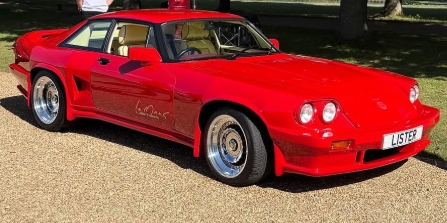
For nearly three decades, the Lister name lay dormant. Brian Lister had sold the company in 1960, and after passing through several hands, it eventually disappeared. However, in the late 1980s, the Lister name was revived in the United States by a determined enthusiast named Laurence Pearce. His vision was not to produce historical replicas, but to create a modern interpretation of a Lister, built for the booming “supercar” market.
The result, launched in 1990, was the first road-going Lister Le Mans. Based on the legendary Jaguar XJ220, the car was a dramatic re-body of the already exotic British supercar.
- Body and Design: The XJ220’s low-slung, wedge-shaped profile was replaced with a tall, aggressive, and distinctly retro-inspired coupe body. It featured a large, prominent grille reminiscent of the original Lister-Jaguar, a steeply raked windscreen, and massive air intakes for cooling the mid-mounted engine.
- Mechanicals: The biggest change was under the skin. While the XJ220 used a twin-turbo V6, the initial plan for the Lister Le Mans was to use a supercharged 7.0-litre V8 sourced from the American Corvette ZR1. However, this engine proved too heavy for the car’s balance. Ultimately, the production cars reverted to the XJ220’s 3.5-litre twin-turbocharged V6 engine, but heavily modified by Lister. Power was increased from the standard 542 bhp to a claimed 660 bhp, making it one of the fastest cars of its time.
- Performance: With a top speed of over 220 mph and a 0-60 time of around 3.6 seconds, the Lister Le Mans was a formidable machine. It also offered a level of exclusivity that even the XJ220 couldn’t match, with a production run of just 10 to 12 units built between 1990 and 1994. The car’s aggressive styling and monstrous performance made it a “brute in a suit,” a raw and unfiltered supercar experience.
While the Lister Le Mans (XJ220-based) was a success, the company under Laurence Pearce continued to evolve. It produced the Storm, a V12-powered supercar, and later, in a fascinating twist, the Lister Storm GT1 racer. This race car, powered by a 7.0-litre Jaguar-derived V12, was a spiritual successor to the original 1950s racers, proving the company’s enduring racing DNA.
The Modern Era: A Revival on the Track and for the Road
The 21st century saw yet another chapter for Lister. After a period of decline, the company was acquired by a new consortium in 2013, with a clear vision: to take the Lister name back to its motorsport roots. This led to the creation of the Lister LMP, a Le Mans Prototype that, although it never raced, signaled a new direction.
The true culmination of this revival came in 2018 with the reveal of the new Lister Le Mans. This was not a re-body of an existing supercar but a ground-up creation, designed as a track-only “supercar” reminiscent of modern GT3 racers.
- Foundation: The car is based on the revered Jaguar F-Type R, retaining its 5.0-litre supercharged V8 engine.
- The “Le Mans” Trim: In its standard F-Type R guise, the engine produces 550 bhp. Lister’s first step was to offer the “Le Mans” trim package for the F-Type, which included a comprehensive aerodynamic kit (splitter, rear diffuser, large wing), lowered suspension, and a power boost to 575 bhp, alongside unique “Le Mans” badging and wheels. This served as a bridge between the road and the track.
- The Lister Le Mans GT3: The ultimate evolution is the purebred track car. Lister’s engineers stripped the F-Type down to its core, rebuilding it with a full roll cage and extensively modifying the body with carbon fiber panels to reduce weight and improve aerodynamics. The supercharged V8 is pushed to a thunderous 670 bhp, and the car features a 6-speed sequential racing gearbox, FIA-spec safety cell, and fully adjustable suspension. It is a true racing machine, a direct homage to the spirit of Brian Lister’s original creations.
Legacy and Future Outlook
The evolution of the Lister Le Mans is a microcosm of the classic car world’s relationship with heritage. It began as a pure, purpose-built racing prototype. After a long slumber, it was reborn as an audacious, exclusive supercar that captured the excess of its era. Finally, it has come full circle, returning as a dedicated track weapon that channels the raw power and engineering passion of its namesake.
Today, Lister continues as a bespoke car manufacturer and engineering company. While the new Le Mans GT3 is the flagship, the company also offers tuning packages for modern Jaguars, including the F-Type and the I-PACE EV, proving its ability to adapt to a changing automotive landscape.
The future of the Lister Le Mans name is secure precisely because it has never lost its core identity. It represents British engineering at its most passionate and uncompromising. From the delicate curves of the 1959 coupe to the brutalist aggression of the 1990s supercar and the focused intensity of the modern GT3, the Lister Le Mans is more than just a name; it is a symbol of endurance, rebirth, and the unyielding roar of a true racing spirit.