The Little Giant: A Comprehensive History of the Daihatsu Move
In the dense, bustling cityscapes of Japan, where space is the ultimate luxury, a unique class of vehicle reigns supreme: the kei jidōsha, or kei car. These miniature automobiles, defined by strict government regulations on size and engine displacement, are marvels of packaging and efficiency. For nearly three decades, one name has stood as a titan in this category, a rolling testament to clever design and relentless innovation: the Daihatsu Move. More than just a car, the Move is a cultural icon, a solution to urban mobility, and a fascinating case study in making the most out of the very least.
The Genesis: Born from Rivalry and Necessity
The story of the Daihatsu Move begins in the early 1990s, a period of economic adjustment in Japan. The kei car market was vibrant, but a rival manufacturer had just changed the game. In 1993, Suzuki launched the Wagon R, a revolutionary “tall wagon” kei car that prioritized vertical space, creating an interior far more spacious than its tiny footprint suggested. It was an instant sensation, and Daihatsu, a long-established specialist in small vehicles, knew it needed a compelling answer.
In August 1995, that answer arrived. The first-generation Daihatsu Move (L600 series) was launched. While sharing its platform with the existing Daihatsu Mira, the Move was taller, boxier, and focused squarely on practicality and interior volume, directly challenging the Wagon R’s dominance. It established the core philosophy that would define the model for decades: maximum utility within minimal dimensions.
A Journey Through Generations
The Move’s history is one of constant, incremental evolution, with each generation reflecting new technologies, shifting consumer tastes, and updated kei car regulations.
First Generation (L600/L610): The Challenger (1995–1998)
The original Move was a pragmatic Cylon. It featured a conventional four-door layout with a side-hinged tailgate, which distinguished it from the Wagon R’s top-hinged hatch. The design was simple and functional, a two-box shape dedicated to maximizing headroom and cargo capacity.
- Models and Trim Levels:
- The lineup was diverse, catering to a wide range of buyers. Base models were typically designated CL and CG.
- Mid-range models offered more amenities, often under the CX trim.
- The performance variant was the exciting SR-XX, featuring a 659cc DOHC turbocharged four-cylinder engine (the JB-JL) producing the regulatory maximum of 64 PS (63 hp). It was a pocket rocket that combined the Move’s practicality with spirited performance.
- Initially, all models were front-wheel drive (L600S), with four-wheel drive variants (L610S) available across the range.
Second Generation (L900/L910): Finding Its Identity (1998–2002)
In October 1998, new kei car regulations allowed for slightly larger dimensions. Daihatsu capitalized on this with the L900 series Move. This generation marked a significant step forward in design and refinement. It also firmly established the two-pronged identity that would become a Move hallmark: the standard Move and the stylish, aggressive Move Custom.
- Models and Trim Levels:
- Standard Move: Featured a friendly front fascia with large, single headlights. Trims included CG, CL, and the better-equipped CX.
- Move Custom: This became the aspirational model. It sported a bold front end with distinctive quad-round headlights, an aerodynamic body kit, and a more premium interior. Trims included the Custom L, Custom S, and the top-tier Aerodown Custom, which often featured the turbocharged engine.
- Engines: The Move transitioned from the older EF-series engines to the newer, more efficient TOPAZ series engines, available in both naturally aspirated and turbocharged forms. The introduction of a Continuously Variable Transmission (CVT) as an option improved fuel economy and smoothness.
Third Generation (L150/L160): A New Platform for a New Era (2002–2006)
The third-generation Move represented a complete redesign. Built on an all-new platform, it boasted significant improvements in crash safety, ride comfort, and handling. The styling became sharper and more angular, with a distinctive sloping A-pillar and a clean, modern aesthetic. The interior quality also took a major leap forward, feeling less like a budget car and more like a scaled-down premium vehicle.
- Models and Trim Levels:
- Standard Move (L/X): Continued as the practical choice, with a simple, clean design.
- Move Custom (Custom L/X/R/RS): The Custom line grew more aggressive, with a large chrome grille and vertically stacked projector headlights. The flagship Custom RS came standard with the 64 PS turbocharged engine, sport-tuned suspension, and larger alloy wheels.
- The First Spin-Off: Move Latte (L550/L560): In 2004, recognizing a new market segment, Daihatsu launched the Move Latte. Based on the same platform but with completely different bodywork, the Latte was a retro-styled model with round headlights, soft curves, and a pastel color palette aimed squarely at female buyers seeking a cute, fashionable vehicle.
Fourth Generation (L175/L185): Efficiency and Innovation (2006–2010)
With fuel prices on the rise, efficiency became the paramount goal. The fourth-generation Move introduced the all-new KF-series engine, a lightweight and highly efficient 658cc DOHC three-cylinder that would become the heart of Daihatsu’s kei car lineup for years to come. The design became more organic and rounded, and the world’s first “Intelligent Catalyst” was adopted to improve emissions performance from a cold start.
- Models and Trim Levels:
- Standard Move (L/X/X Limited): The design was softer, with large, swept-back headlights.
- Move Custom (Custom L/R/RS): The Custom maintained its sporty edge with a more technical-looking front end and clear-lens tail lights. The CVT was further refined for an exceptional balance of performance and economy.
- The Second Spin-Off: Move Conte (L575/L585): Launched in 2008, the Conte was another stylistic departure. Its design was intentionally simple and squared-off, creating a comfortable, lounge-like interior space—a “square you can relax in.” It was marketed as a comfortable and user-friendly alternative to the more mainstream Move.
Fifth Generation (LA100/LA110): The Age of “e:S Technology” (2010–2014)
This generation was a technological tour-de-force in fuel saving. Daihatsu introduced its “e:S Technology” (Eco & Smart), a suite of features including an advanced idle-stop system, improved aerodynamics, and significant weight reduction of up to 35 kg. This allowed the LA100 Move to achieve class-leading fuel economy. This era also saw the introduction of early active safety systems, with Daihatsu’s “Smart Assist” collision avoidance system becoming available.
- Models and Trim Levels:
- The trim structure remained similar, with standard L and X models and the sporty Custom X, Custom G, and Custom RS.
- The focus was on offering high-tech features, like push-button start and automatic climate control, even on lower-trim models.
Sixth Generation (LA150/LA160): Lightweight, High-Tech, and Stylish (2014–Present)
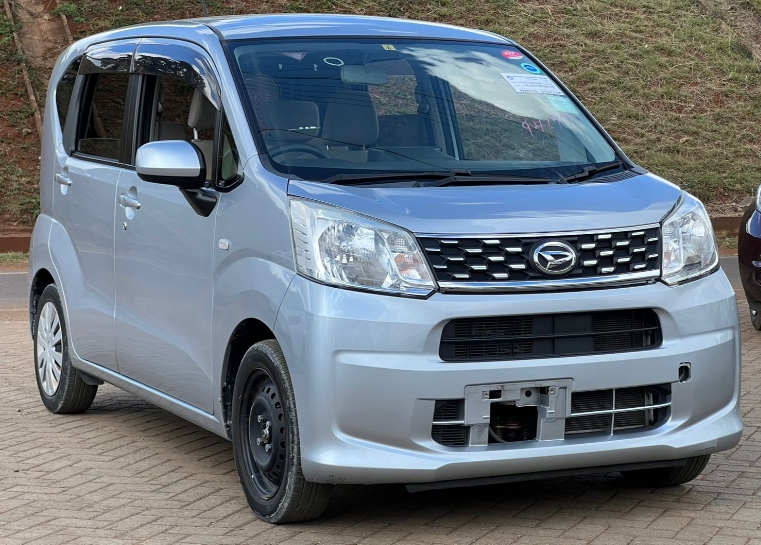
The current generation of the Move debuted in December 2014 and represented another major leap. It was one of the first models to benefit from the Daihatsu New Global Architecture (DNGA), which utilized a high-tensile steel monocoque body that was both lighter and significantly more rigid. This improved safety, performance, and ride quality simultaneously. The “Smart Assist” system evolved through versions II and III, adding features like pedestrian detection and lane departure warning.
- Models and Trim Levels:
- Standard Move (L/X/X “SA III”): The design is sharp and modern, with a focus on aerodynamics.
- Move Custom (X/RS “Hyper SA III”): The Custom features a dramatic, multi-layered grille and full LED lighting, giving it a presence far exceeding its size. The “Hyper” designation denotes the most luxurious and feature-packed versions.
- The Third Spin-Off: Move Canbus (LA800/LA810): Perhaps the most successful spin-off, the Canbus launched in 2016. It broke the mold with its retro, minivan-like design, two-tone color schemes, and, crucially, power sliding rear doors on both sides. Designed based on extensive feedback from female drivers, its thoughtful interior storage and charming looks have made it a massive hit, often outselling the standard Move.
Beyond Japan: The Move’s Limited Global Reach
While overwhelmingly a Japanese Domestic Market (JDM) vehicle, the Move has seen limited exposure overseas. The most notable example is in Malaysia, where the first-generation Move was produced and sold as the Perodua Kenari from 2000 to 2009, helping to popularize the tall wagon concept in the region.
.
NO MORE dead batteries with this:

.
The Future Outlook: Electrification on the Horizon
The Daihatsu Move stands at a crossroads. The Japanese auto industry is pivoting towards electrification, and the kei car segment is no exception. Daihatsu, in partnership with its parent company Toyota, is heavily invested in developing affordable kei-class electric vehicles.
The future of the “Move” nameplate is likely electric. We can expect a future generation to be built on an electrified version of the DNGA platform, retaining the car’s core values—compact size, incredible interior packaging, and efficiency—but replacing the venerable KF-series gasoline engine with a battery and electric motor. The challenge will be maintaining the affordability that is central to the kei car’s appeal. The Move Canbus, with its focus on lifestyle and convenience, provides a strong blueprint for how the brand can continue to innovate in user experience, a key battleground for future EVs.
Conclusion: More Than Just a Car
To dismiss the Daihatsu Move as just another small car is to miss the point entirely. It is a masterclass in design and engineering under constraint. For nearly 30 years and across six distinct generations, it has provided millions of people with affordable, reliable, and incredibly practical mobility. From the turbocharged SR-XX of the 90s to the high-tech, safety-conscious models of today, and through its charmingly diverse spin-offs like the Latte, Conte, and Canbus, the Move has consistently adapted and evolved. It is a giant of the small car world, a silent, humble workhorse of Japan’s streets, and a shining example of how innovative thinking can turn limitations into a resounding strength.