The Little Giant: A Comprehensive History of the Subaru Sambar
In the sprawling world of automotive history, giants like Ford, Toyota, and Volkswagen often dominate the narrative with their globe-spanning bestsellers. Yet, tucked away in the uniquely Japanese category of kei-jidosha, or “light automobiles,” exists a vehicle that embodies a philosophy of brilliant, unconventional engineering: the Subaru Sambar. For over half a century, this diminutive truck and van has been a workhorse, a lifestyle icon, and, for a passionate group of enthusiasts, the “Porsche of kei trucks.” Its story is one of innovation, adherence to a unique design principle, and an eventual, bittersweet end of an era.
The Genesis: A Kei Car for a New Japan
To understand the Sambar, one must first understand the kei car. Established in post-war Japan to mobilize the populace with affordable, tax-friendly vehicles, the kei class is defined by strict government regulations on physical size and engine displacement. The Sambar was born from this environment, debuting in 1961 as Subaru’s first foray into the commercial kei vehicle market.
Subaru, then known as Fuji Heavy Industries, was already enjoying success with its first passenger car, the equally iconic Subaru 360. In an act of brilliant resourcefulness, engineers based the first-generation Sambar directly on the 360’s platform. This decision would define the Sambar for the next 50 years. Unlike its competitors, which typically used a front-engine, rear-drive layout with a solid axle, the Sambar inherited the 360’s rear-engine, rear-wheel-drive (RR) configuration and four-wheel independent suspension.
This layout provided immediate, significant advantages. Placing the engine and transaxle at the very back put the weight directly over the drive wheels, granting the tiny, empty truck exceptional traction. It also allowed for a completely flat cargo bed and cabin floor, unencumbered by a driveshaft tunnel. Furthermore, the independent suspension provided a ride quality and handling stability that was simply unheard of in the commercial utility class. The Sambar wasn’t just a box on wheels; it was an intelligently designed tool.
.
NO MORE dead batteries with this:

.
The Generations of Innovation (1961-2012)
The Sambar’s history is best viewed through its six distinct, Subaru-built generations, each adapting to evolving kei car regulations while stubbornly retaining its core engineering DNA.
First Generation (1961-1966) The original Sambar was powered by the 356cc, two-stroke, air-cooled EK31 engine from the Subaru 360. It was offered as a cab-over truck and a van, with its small, rounded, and friendly face becoming a common sight on Japan’s narrow streets. Its low, flat floor made it incredibly easy to load and unload goods, a feature cherished by small business owners.
Second Generation (1966-1973) Still retaining a similar aesthetic, the second generation brought subtle modernization and a new, more powerful EK32 engine. While still a 356cc two-stroke, it offered improved performance. This generation famously earned the nickname “baban” Sambar in Japan, an affectionate term akin to “granny,” due to its somewhat dated but lovable appearance toward the end of its run.
Third Generation (1973-1982) Kei car regulations changed in the mid-70s, allowing engine displacement to increase to 550cc. The third-generation Sambar, nicknamed the “Gōriki” (Herculean Strength) Sambar, responded. It launched initially with a water-cooled 360cc two-stroke but was soon updated with a 544cc (EK21) water-cooled, two-stroke two-cylinder engine. This era also saw the introduction of a key innovation in 1980: on-demand four-wheel drive (4WD), making the Sambar an incredibly capable vehicle in Japan’s snowy northern regions.
Fourth Generation (1982-1990) The fourth generation marked a significant leap forward in modernity. The styling became more angular and contemporary, and the interior more car-like. The biggest change was under the rear deck, with the introduction of the 544cc EK23 two-cylinder, four-stroke engine, which was smoother, quieter, and more efficient. An electric clutch option became available, and the 4WD system was refined. This generation also spawned the Subaru Domingo, a larger-bodied version with a 1.0L, three-cylinder engine, designed for export and domestic markets that weren’t constrained by kei rules.
Fifth Generation (1990-1999) The 1990s brought another regulatory change, increasing engine size to 660cc. Subaru responded with what is arguably their most revered engine: the EN07. This 658cc, inline four-cylinder engine was a marvel of smoothness and sophistication in a class dominated by three-cylinders. The fifth-generation Sambar, with its more rounded styling, offered this engine in several configurations: a carbureted version, a fuel-injected version, and, most excitingly, a supercharged variant. The supercharger provided instant, lag-free power, making the Sambar feel surprisingly quick and capable, especially when carrying a load. This generation also saw the debut of the retro-styled “Sambar Classic” trim, which proved immensely popular.
Sixth Generation (1999-2012): The End of the Line The sixth and final Subaru-designed Sambar was a refinement of the previous generation, launched to meet new safety standards. It carried over the superb EN07 four-cylinder engine, including the much-loved supercharged option. This generation represents the pinnacle of the Sambar’s unique lineage. The ride quality from its four-wheel independent suspension, the balanced handling from its RR layout, and the smooth power from its four-cylinder engine set it apart. It was, by all accounts, the most car-like and comfortable vehicle in its class. In 2012, after 51 years of continuous in-house production, Fuji Heavy Industries built its last Sambar, marking the end of one of Japan’s most unique automotive bloodlines.
Models and Trim Levels: A Vehicle for Every Need
Throughout its six generations, the Sambar was offered in a staggering array of configurations. While a complete, exhaustive list is nearly impossible due to countless special editions and regional variations, the core models and trim hierarchies remained consistent.
1. Sambar Truck (トラック) The utilitarian backbone of the lineup.
- TB: The most basic, no-frills work truck.
- TC: A slightly better-appointed model, often with features like a radio.
- JA (JAサンバー): A special designation for trucks sold through Japan’s agricultural cooperatives, often equipped with specific features for farm use like differential locks.
- High-Roof/Panel Van: Various enclosed cargo box options built onto the truck chassis.
2. Sambar Van (バン) The enclosed cargo and light passenger version.
- VB: The base model “blind van,” typically with metal panels instead of rear windows, designed purely for cargo.
- Transporter: A step up from the VB, often with a rear bench seat that could be folded down, offering a dual-use cargo/passenger capability.
3. Sambar Dias Wagon (ディアスワゴン) The dedicated passenger version, which became progressively more luxurious over the generations.
- Dias: The standard passenger model, featuring full interior trim, comfortable seating for four, and large windows. In later generations, this became the mid-range trim.
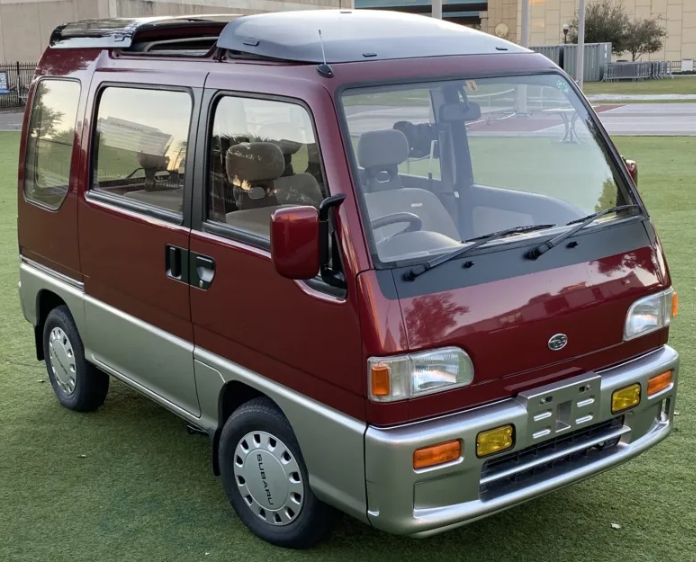
- Dias Classic: Introduced in the fifth generation, this highly sought-after trim featured a retro-inspired front fascia with a chrome grille, round headlights, and often two-tone paint schemes. It was a purely aesthetic package that created a huge following.
- Dias Wagon: The top-of-the-line model in the sixth generation. These could be equipped with features rivaling passenger cars, including power windows and locks, air conditioning, better upholstery, and crucially, the optional supercharger paired with an automatic transmission. This was the ultimate expression of the Sambar as a comfortable, capable micro-van.
The Badge-Engineering Era and Future Outlook (2012-Present)
Why did Subaru stop making its masterpiece? The decision was purely economic. As a smaller manufacturer, the cost of developing a unique commercial vehicle platform to meet ever-stricter emissions and safety standards became prohibitive. Subaru chose to focus its R&D resources on its globally successful passenger cars like the Impreza and Forester.
Since 2012, the Subaru Sambar name has lived on, but the vehicle itself has been a rebadged Daihatsu Hijet. This means the seventh (2012-2014) and eighth (2014-Present) generation Sambars are entirely conventional kei trucks, featuring a front-engine, rear-drive layout with a solid rear axle. While perfectly competent and reliable vehicles, they lack the unique engineering soul—the rear engine, the independent suspension—that defined the Sambar for half a century.
The future outlook for the Sambar name is tied to the future of the Daihatsu Hijet. With the automotive industry moving toward electrification, it is almost certain that a future Sambar will be an electric kei truck, a rebadged version of whatever Daihatsu (and its parent company, Toyota) develops.
A Lasting Legacy
Today, the Subaru-built Sambars, particularly the final two generations, have a massive cult following both in Japan and abroad. Under the “25-year rule,” which allows for the legal importation of older vehicles into the United States, thousands of Sambars have found new homes with small business owners, farmers, campers, and JDM enthusiasts who appreciate their incredible utility and quirky character.
The Subaru Sambar is more than just a small truck. It is a testament to an engineering philosophy that prioritized clever solutions over conventional ones. It proved that a utility vehicle didn’t have to be crude or uncomfortable. For 51 years, it was a plucky, rear-engined workhorse that punched far above its weight, a true “little giant” in the automotive world. While its unique spirit may no longer roll off the assembly line, its legacy endures on farms, in cities, and on enthusiast forums across the globe, a constant reminder of Subaru’s golden age of engineering audacity.