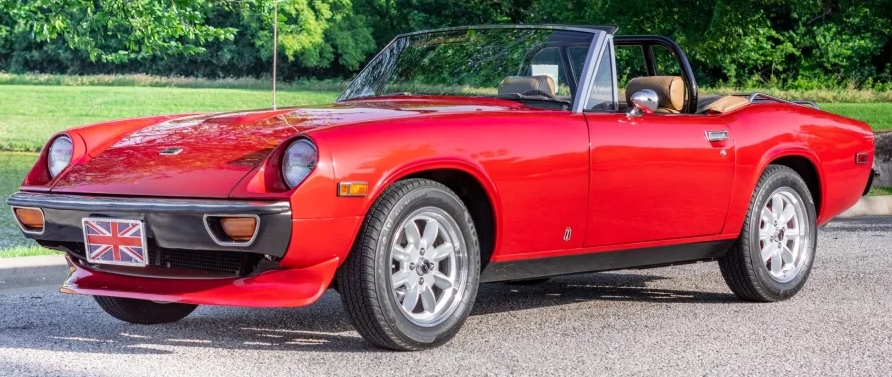
The Lotus-Powered Brit: A Comprehensive History of the Jensen-Healey
In the pantheon of British sports cars, few vehicles occupy a space as simultaneously celebrated and misunderstood as the Jensen-Healey. Produced for a brief, turbulent window in the mid-1970s, this wedge-shaped coupe was a product of necessity, collaboration, and engineering ambition. It was designed to bridge the gap between the sprightly MG B and the more expensive Triumph TR6, yet it ended up carving out a unique legacy defined by its sophisticated engineering and, most notably, its heart: a Lotus twin-cam engine.
Though its production run lasted only four years, the Jensen-Healey remains a beloved classic today, cherished for its performance, its styling, and the fascinating corporate drama that surrounded its birth.
The Genesis: A Marriage of Convenience
To understand the Jensen-Healey, one must understand the state of the British automotive industry in the early 1970s. Jensen Motors, based in West Bromwich, was known for grand tourers like the Interceptor and the exotic, stainless-steel-bodied CV8. However, by 1970, the company was looking to expand its lineup with a smaller, more affordable roadster.
Simultaneously, Donald Healey, the legendary engineer and chairman of the British Motor Corporation (BMC), was looking for a new chassis for his Austin-Healey line. The aging Austin-Healey 3000 had ceased production in 1967, and BMC was reluctant to fund a successor. Healey, recognizing a mutual opportunity, approached Jensen with a proposal: Jensen would build the car, and Healey would provide the engineering expertise and the badge.
The result was the Healey SX, a prototype revealed at the 1970 London Motor Show. However, the project hit a snag almost immediately. BMC (soon to become British Leyland) refused to supply engines to a competitor. Consequently, Jensen was forced to look elsewhere for power. The solution came from a fellow British manufacturer facing its own challenges: Lotus.
The Engine: The Heart of the Matter
The defining characteristic of the Jensen-Healey was its engine. While competitors like the MG B and Triumph TR6 utilized pushrod inline-fours and sixes, the Jensen-Healey debuted with the Lotus 907 engine.
This 2.0-liter, dual-overhead-cam, four-cylinder engine was a masterpiece of the era. In a time when most British cars suffered from Lucas electrical systems and carburetor issues, the Lotus engine offered a robust 106 horsepower (later rising to 125 hp in the MkII). It was a unit originally designed for the Jensen-Healey but subsequently used by Lotus for the Europa and Elite, creating a symbiotic relationship between the two manufacturers. The engine gave the lightweight Jensen-Healey a top speed of over 115 mph and a 0–60 mph time of under 8 seconds, outperforming most of its contemporaries.
.

.
The Models and Production History (1972–1976)
The Jensen-Healey was produced in a single body style—a two-seat convertible with a removable hardtop—but it evolved through several distinct iterations and trim levels.
1. The MkI (1972–1973) The production model debuted at the 1972 London Motor Show. Visually, it was distinguished by its lack of side markers and a simple, clean aesthetic designed by Kjell Qvale and Malcolm Eve.
- Specs: Powered by the Lotus 907 Type 14 engine (907/2).
- Trim: The interior was functional, featuring Smiths instrumentation and a wood veneer dashboard. The MkI was offered in a variety of “British Racing Green” inspired colors, though bright oranges and yellows were also popular.
- Issues: The early cars were plagued by teething problems. The Lotus engine, while powerful, was complex. Early units suffered from oil leaks, cooling issues, and distributor failures. Furthermore, the build quality at Jensen’s factory was inconsistent, leading to rattles and electrical gremlins.
2. The MkII (1973–1975) By 1973, Jensen had addressed many of the initial reliability concerns, resulting in the MkII.
- Specs: The engine was upgraded to the Lotus 907 Type 15, increasing displacement slightly and improving reliability. Horsepower remained roughly the same, but torque and drivability improved.
- Trim: The MkII introduced several aesthetic changes, most notably the addition of side marker lights (a US safety requirement that became standard) and a revised rear bumper. The interior saw improvements in fit and finish, with better-quality leather seats and enhanced sound deadening.
- The “Green” Model: In 1974, a specific trim level known as the “Green” model was introduced for the US market to comply with strict emissions regulations. While it retained the Lotus engine, it was detuned to approximately 86 horsepower due to exhaust gas recirculation and lower compression ratios. Despite the power drop, it remained a spirited performer.
3. The MkIII (1975–1976) The final iteration of the Jensen-Healey was the MkIII, produced during the company’s financial decline.
- Specs: The MkIII reverted to the higher-output 125 hp engine specification, effectively undoing the detuning of the US “Green” model.
- Trim: The most significant visual change was the introduction of black rubber impact bumpers, replacing the chrome bumpers of earlier models. This was a response to US safety regulations (and a cost-saving measure). The interior received a facelift with new door cards and a slightly revised dashboard layout.
- The GT: Toward the very end of production, Jensen experimented with a “GT” trim. This was essentially a hardtop-only version intended for the US market, featuring a fixed roof and improved aerodynamics. However, very few were built before the factory gates closed.
The Demise: Bankruptcy and Legacy
Despite a strong launch and favorable reviews from the automotive press, the Jensen-Healey was doomed by external economic forces. The 1973 Oil Crisis sent fuel prices skyrocketing, dampening demand for thirsty, high-performance sports cars in the US, the car’s primary market.
Simultaneously, Jensen Motors faced internal turmoil. The company was heavily reliant on the success of the Healey, but production delays and warranty claims (particularly regarding the Lotus engines) strained cash flow. In 1975, the British government withdrew financial support, and Jensen Motors went into receivership. Production ceased in May 1976.
Total production figures vary slightly depending on the source, but approximately 10,500 Jensen-Healeys were built.
The “What If”: The Jensen-Healey GT
One of the most intriguing chapters in the car’s history occurred post-production. In 1976, the rights to the Jensen-Healey were acquired by a new company, Jensen Cars Ltd. (unrelated to the original firm). They attempted to revive the model as the Jensen-Healey GT.
This was a fixed-roof coupe based on the MkIII chassis. It featured a restyled roofline and a hatchback rear, giving it a more modern, aerodynamic look. The GT was intended to compete with the Porsche 924. However, the new company struggled to secure funding, and only a handful of prototypes were ever completed. Today, these GT prototypes are among the rarest and most valuable Jensen-Healeys.
Future Outlook and Modern Status
For decades, the Jensen-Healey was an undervalued classic, often overshadowed by the MG B and Triumph Spitfire. However, in the last 10 to 15 years, appreciation for the model has surged.
Current Market: Today, a well-maintained MkI or MkII commands a premium over its BMC rivals. Prices for good examples typically range from $20,000 to $40,000, with concours-condition cars fetching higher sums. The detuned US “Green” models are generally less desirable due to their lower performance, while the high-output MkII and MkIII models are the most sought after.
Reliability and Ownership: The Lotus 907 engine, once the car’s Achilles’ heel, is now its greatest asset. A robust supply chain of parts and specialized mechanics has made the engine relatively easy to maintain. The chassis is simple, rust-proofed better than most British contemporaries, and offers excellent handling dynamics.
Future Outlook: The Jensen-Healey is poised for continued appreciation. As younger generations of classic car enthusiasts look for alternatives to the ubiquitous MG B, the Jensen-Healey offers a compelling package: it is rarer, faster, and more sophisticated than its rivals. Furthermore, the car’s wedge styling—pure 1970s design—has come back into vogue.
The Jensen-Healey represents a specific moment in automotive history: the twilight of the British specialist sports car industry before the onset of the recession and the rise of Japanese dominance. It was a car born of corporate necessity, powered by a racing-bred engine, and built with a distinct British character. While its production run was short, its impact was lasting, proving that even in the darkest days of the British motor industry, brilliance could still shine through.