The Nissan Gloria: A Legacy of Elegance and Engineering Excellence
For over five decades, the Nissan Gloria stood as a symbol of automotive refinement, performance, and prestige in the Japanese automotive landscape. From its introduction in the early 1950s to its final iteration in the early 2000s, the Gloria evolved from a modest luxury sedan to a sophisticated machine that competed with some of the world’s most respected executive cars. Known for its advanced technology, elegant styling, and dynamic driving experience, the Nissan Gloria occupied a special niche as a flagship model that catered to executives, government officials, and enthusiasts alike.
A Brief History of the Nissan Gloria
The Nissan Gloria made its debut in 1959 as the Nissan 30, a luxury sedan developed by Prince Motor Company, a Japanese automaker that would later merge with Nissan in 1966. Designed to compete with the Toyota Crown and other high-end sedans of the era, the first-generation Gloria was a rear-wheel-drive vehicle featuring a 2.8-liter straight-six engine, a rarity at the time for domestic Japanese cars. The combination of smooth power delivery and a comfortable interior positioned the Gloria as a premium offering from the start.
Following the 1966 merger of Prince and Nissan, the Gloria continued under the Nissan brand, gaining access to wider production capabilities and technological advancements. Throughout the 1970s and 1980s, the Gloria evolved into a true executive sedan, often serving as a rival to the Nissan Cedric, with which it shared a platform but diverged in design and driving dynamics. Where the Cedric emphasized comfort and conservative styling, the Gloria often pursued a more sporty, aerodynamic, and progressive image.
For many years, the Gloria was marketed as a slightly more upscale and performance-oriented counterpart to the Cedric. This differentiation allowed Nissan to appeal to a broader spectrum of luxury car buyers—ranging from corporate leaders who valued prestige to driving enthusiasts who desired agile handling and refined powertrains.
.
NO MORE dead batteries with this:

.
Production Years and Generational Overview
The Nissan Gloria was produced across nine distinct generations from 1959 to 2004, with the final model ceasing production in June 2004. Total production spanned nearly five decades, reflecting the enduring appeal and relevance of the model in Japan’s competitive full-size sedan market.
- First Generation (1959–1963): Originally the Prince Gloria, it was offered with a 2.8L G-series inline-six engine. Trim levels included Standard, Deluxe, and Super Deluxe. Known for its bold front grille and full-width taillights.
- Second Generation (1963–1968): Introduced a more modern design and a 2.0L G7 six-cylinder engine. Available in multiple body styles: sedan, hardtop, and station wagon.
- Third Generation (1968–1971): Marked by sleeker lines and increased luxury. Offered in four- and six-cylinder variants. The 2.0L H20 and 2.5L H25 engines were paired with manual and automatic transmissions.
- Fourth Generation (1971–1975): Began to diverge significantly from the Cedric, with more aggressive styling. Trim levels included Custom, Super Custom, and VIP. Introduced V6 engine options in later models.
- Fifth Generation (1975–1979): A major redesign brought aerodynamic styling and enhanced safety. Key trims were Custom, Super Custom, and the flagship Brougham. Equipped with fuel-injected engines and optional air suspension.
- Sixth Generation (1979–1983): Emphasized comfort and refinement. Trim levels ranged from GL to Brougham VIP. The addition of digital instrumentation and electronic climate control showcased Nissan’s technological leadership.
- Seventh Generation (1983–1987): Known for its wedge-shaped design and “double windshield” front end. Offered with 2.0L and 2.8L inline-six engines. Trims included GL, GLX, and Brougham VIP. Introduced four-wheel steering in select models.
- Eighth Generation (1987–1991): Featured a more rounded, aerodynamic profile. Offered with the powerful 2.8L turbocharged inline-six (RB28ET) and later the 3.0L RB30E. Trim levels: GL, GLX, GXE, and Brougham VIP. Also introduced the Gloria Skyline variant in collaboration with Nissan’s performance division.
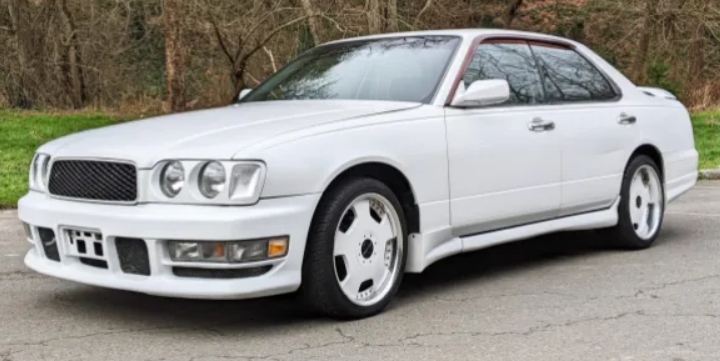
- Ninth and Final Generation (1991–2004): Built on an extended version of Nissan’s Y31/Y32 platform shared with the Cedric. Offered with a 2.0L, 2.5L, and 3.0L V6 (VQ30DE), the latter becoming one of Nissan’s most celebrated engines. Trim levels included GL, GLX, GXE, Brougham, and Brougham VIP. The Brougham VIP trim catered to chauffeur-driven buyers with enhanced rear-seat luxury, privacy glass, and executive seating.
Models and Trim Levels
Throughout its production life, the Nissan Gloria was offered in a wide array of trims and configurations tailored to different buyer preferences:
- GL (Grand Luxe): The base luxury model, offering essential comfort and styling upgrades over standard sedans.
- GLX: Added more equipment, including upgraded interior materials, enhanced sound systems, and additional convenience features.
- GXE: Offered a balanced mix of performance and luxury, often including the V6 engine as standard.
- Brougham: A higher-end trim emphasizing comfort and prestige, typically with wood-grain accents, leather upholstery, and advanced climate control.
- Brougham VIP: The pinnacle of the Gloria lineup, targeted at high-end users including corporate executives and government officials. It featured extended wheelbase options, rear executive seats with leg supports, rear sunshades, and advanced sound insulation.
In addition to trim levels, the Gloria was available in various powertrains, including inline-four, inline-six, and V6 engines, with both naturally aspirated and turbocharged variants. Transmission options included 4-speed and 5-speed manual transmissions early on, shifting to 4-speed automatics and later 5-speed automatics in later models.
Body styles were predominantly sedans and hardtops (pillarless designs), with select generations offering station wagon variants in the early years. The hardtop body style remained popular through the 1980s and early 1990s, offering a sleek, coupe-like profile with the practicality of a four-door sedan.
Technological Innovations and Features
The Gloria was consistently at the forefront of automotive innovation in Japan. Some standout features throughout its lifespan included:
- Electronic Fuel Injection (EFI): Adopted early in the 1970s, improving efficiency and power.
- Air Suspension: Offered on higher trims to ensure a smooth, adaptive ride.
- Four-Wheel Steering (HICAS): Introduced in the 1980s, enhancing stability and cornering.
- Digital Instrument Clusters: Featured in the 1980s and 1990s models, giving the interior a futuristic feel.
- Variable Induction Systems: Used on VQ V6 engines to optimize power across the RPM range.
- Advanced Safety Systems: Later models included anti-lock brakes (ABS), traction control, and airbags.
The Gloria was also one of the first Nissan models to offer integrated telematics and navigation systems in the Japanese domestic market, particularly in the Brougham VIP trims.
The Cultural Significance of the Gloria
In Japan, the Gloria achieved iconic status beyond its role as a luxury vehicle. It was commonly used as a taxi in the 1970s and 1980s, especially the Cedric/Gloria twin models, due to their durability, spacious interiors, and powerful engines. Additionally, the Gloria became a favorite among JDM (Japanese Domestic Market) enthusiasts, particularly for its smooth inline-six engines and elegant yet understated styling.
In pop culture, the Gloria appeared in numerous Japanese films, television dramas, and even video games. It was often associated with authority, sophistication, and subtle luxury—never flashy, but always dignified.
The Demise of the Gloria and Future Outlook
Production of the Nissan Gloria ceased in June 2004, marking the end of an era. The decision to discontinue the model was part of a broader consolidation strategy by Nissan following its alliance with Renault. The Gloria and its sibling, the Cedric, were merged into the Nissan Fuga (sold internationally as the Nissan Cima), which debuted in 2004. The Fuga continued the legacy of luxury and performance but adopted a more modern, globally-oriented design and platform.
While the nameplate has not returned, aspects of the Gloria’s spirit live on in Nissan’s current luxury offerings, including the Infiniti line. The VQ engine series, first introduced in the final generation Gloria, went on to power many high-performance Nissan models, such as the 350Z and Infiniti G35.
As of 2024, there are no official plans to revive the Gloria name. However, classic Glorias have gained cult status among collectors and restorers. Enthusiast clubs in Japan, North America, and Europe actively preserve and showcase these vehicles, celebrating their engineering excellence and timeless design.
Conclusion
The Nissan Gloria was more than just a luxury sedan—it was a benchmark of Japanese automotive engineering, a symbol of national pride, and a testament to the pursuit of quiet excellence. Spanning from 1959 to 2004 across nine generations, the Gloria offered a blend of comfort, performance, and sophistication that resonated with drivers across generations. From government officials riding in Brougham VIP sedans to enthusiasts tuning RB-series engines for spirited drives, the Gloria touched many facets of Japanese automotive culture.
Though production has ended, the legacy of the Gloria endures. In an age of electric vehicles and digital interfaces, the mechanical purity, craftsmanship, and understated elegance of the Gloria serve as a reminder of an era when luxury was measured not in screens and horsepower alone, but in the details: the hum of a smooth inline-six, the feel of hand-stitched leather, and the dignity of a well-engineered machine. For connoisseurs of automotive history, the Nissan Gloria remains a revered classic—worthy of its place in the pantheon of Japan’s greatest cars.