The Nissan Magnite: The Compact SUV That Redefined a Brand’s Fortunes
In the crucible of the world’s most competitive automotive markets, few vehicles have represented a brand’s revival quite like the Nissan Magnite. Launched at a time when Nissan’s market share in India was dwindling, this sub-4-meter compact SUV arrived not just as a new product, but as a statement of intent. It was a bold, feature-packed, and aggressively priced contender that punched well above its weight, single-handedly rejuvenating Nissan’s presence and fundamentally altering customer perceptions. This is the story of the Nissan Magnite, a vehicle born from a strategic pivot, engineered for value, and designed to win hearts globally.
A History Forged in Strategy: From Datsun to Nissan
The story of the Nissan Magnite is inseparable from the story of the Datsun brand in the 21st century. Originally, the vehicle codenamed EM2 was conceived as the flagship offering for Datsun, Nissan’s revived budget-friendly brand. It was intended to be the Datsun Magnite, a premium crossover that would elevate Datsun’s portfolio. However, by 2019-2020, it became apparent that the Datsun brand was struggling to gain traction globally, including in its key market, India.
Simultaneously, Nissan was undergoing a massive global restructuring under its “Nissan NEXT” transformation plan. The company needed surefire hits to regain profitability and market stability. In a moment of strategic brilliance, a crucial decision was made: the promising new compact SUV would be badged as a Nissan, not a Datsun. This move allowed the vehicle to leverage Nissan’s stronger brand equity, wider service network, and reputation for engineering prowess. The signature Datsun-esque grille on the final production model remains a subtle nod to its origins, but the shift to the Nissan badge was the masterstroke that set the stage for its success.
The Nissan Magnite made its global debut in concept form in July 2020 and the production version was unveiled in October 2020. It was officially launched in India on December 2, 2020, with production ongoing since then. Built on the Renault-Nissan-Mitsubishi Alliance’s CMF-A+ platform, which it shares with the Renault Kiger and Triber, the Magnite was designed with a “Make in India, Make for the World” philosophy, with India serving as its primary production hub for both domestic and international markets.
.
NO MORE dead batteries with this:

.
Design: Boldness in a Compact Package
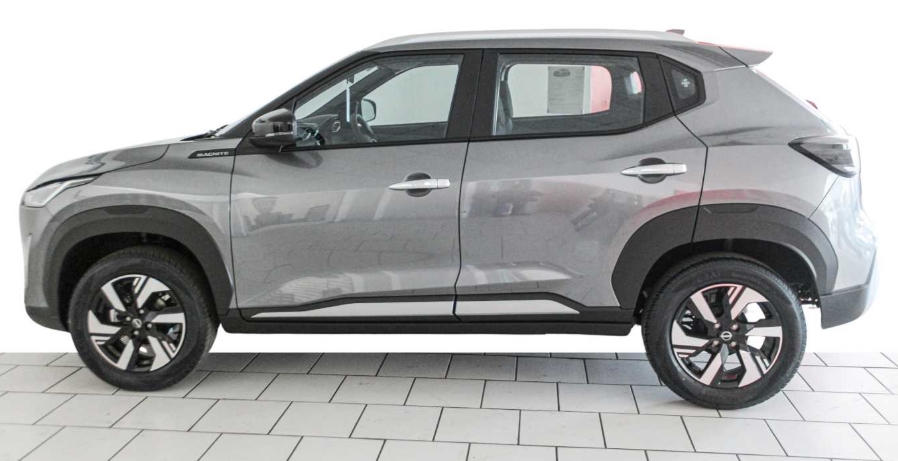
One of the Magnite’s immediate strengths was its design. In a segment crowded with conservative and derivative styling, the Magnite stood out with a confident and muscular design language. The front is dominated by a large, octagonal grille flanked by incredibly sleek, swept-back LED headlamps, which Nissan calls “J-lenses.” Below them, striking L-shaped LED Daytime Running Lights (DRLs) give the vehicle an unmistakable signature.
The side profile features squared-off wheel arches with thick plastic cladding, prominent character lines, and functional silver roof rails that can carry up to 50 kg. The 205 mm of ground clearance and 16-inch diamond-cut alloy wheels on higher trims lend it a proper SUV stance. The rear is equally distinctive, with wide, split-LED taillamps and the “MAGNITE” nameplate spelled out boldly across the tailgate. This combination of sharp lines, muscular proportions, and unique lighting elements ensured it looked more expensive than its price tag suggested.
Under the Hood: A Tale of Two Engines
The Nissan Magnite has been offered with two petrol engine options since its launch, catering to different priorities—efficiency for city commuters and performance for enthusiasts.
- 1.0-litre B4D Naturally Aspirated Petrol Engine: This is the entry-level powertrain, a three-cylinder unit designed for fuel economy and ease of driving in urban environments.
- Power: 72 PS @ 6,250 rpm
- Torque: 96 Nm @ 3,500 rpm
- Transmission: 5-speed Manual Transmission
- 1.0-litre HRA0 Turbo-Petrol Engine: This is the star of the show, a three-cylinder turbocharged engine that transforms the Magnite into a peppy and engaging vehicle to drive.
- Power: 100 PS @ 5,000 rpm
- Torque: 160 Nm (Manual) / 152 Nm (CVT) @ 2,800-3,600 rpm
- Transmissions: 5-speed Manual Transmission or X-TRONIC Continuously Variable Transmission (CVT)
Decoding the Variants: A Trim-by-Trim Breakdown
Nissan launched the Magnite with an incredibly competitive variant lineup, ensuring there was a model for nearly every budget. The core trim levels are XE, XL, XV, and XV Premium.
- XE (Base): The entry-point of the range, the XE trim was launched at an astonishingly low price, making headlines. It was a bare-bones model but covered the essentials. Key features include 16-inch steel wheels, dual-tone interiors, power windows, a 3.5-inch LCD instrument cluster, and standard safety features like dual front airbags, ABS with EBD, and rear parking sensors.
- XL (Mid): The XL trim adds a significant layer of convenience and is often considered the true value-for-money starting point. It builds upon the XE with features like a 6-speaker audio system with Bluetooth connectivity, steering-mounted audio controls, automatic climate control, and electrically adjustable & foldable ORVMs. The CVT transmission option begins from this trim level.
- XV (High): This popular trim level brings in the technology and premium feel. It adds an 8-inch touchscreen infotainment system with wireless Apple CarPlay and Android Auto (a segment-first feature at launch), a 7-inch fully digital instrument cluster, a rear-view camera, i-Key with push-button start/stop, and 16-inch diamond-cut alloy wheels.
- XV Premium (Top-of-the-Line): The flagship variant is loaded with cutting-edge features. Over the XV, it gets LED bi-projector headlamps, cruise control, a 360-degree Around View Monitor (AVM)—another segment-first—a tire pressure monitoring system (TPMS), and a premium interior finish with leather-wrapped steering wheel.
Optional Extras and Special Editions
To add another layer of customization and features, Nissan offers a Tech Pack for the XV and XV Premium trims. This optional package includes a wireless charger, a high-end JBL sound system, an air purifier, ambient mood lighting, and puddle lamps.
Over the years, Nissan has also introduced special editions to keep the lineup fresh:
- Magnite Red Edition (2022): Based on the XV trim, this edition added cosmetic enhancements like red accents on the grille, front bumper cladding, and body sides, along with special “Red Edition” badging, a wireless charger, and ambient lighting as standard.
- Magnite Kuro Edition (2023): Celebrating the spirit of the ICC Men’s Cricket World Cup 2023, the “Kuro” (Japanese for ‘black’) Edition is based on the XV trim. It features an all-black exterior and interior theme, with blacked-out grille, skid plates, roof rails, and alloy wheels, along with gloss black inserts inside the cabin.
Safety and Global Recognition
Safety was a key focus for the Magnite. It received a commendable 4-star safety rating for adult occupant protection from the ASEAN NCAP crash tests. Its standard safety kit includes dual front airbags, ABS with EBD, and rear parking sensors. Higher variants add Vehicle Dynamic Control (VDC), Hill Start Assist (HSA), Traction Control System (TCS), and the aforementioned TPMS and 360-degree camera, making it one of the safer vehicles in its segment.
Market Impact and Future Outlook
The launch of the Nissan Magnite was nothing short of a phenomenon. Its disruptive pricing, combined with its strong visual appeal and extensive feature list, generated massive interest. It garnered over 50,000 bookings within five months of its launch in India, clearing Nissan’s existing inventory and revitalizing its dealership network.
Beyond India, the Magnite has become a crucial export product. It is shipped to over 15 countries, including South Africa, Indonesia, Nepal, Bhutan, and other nations in the SAARC region, truly fulfilling its “Make in India, Make for the World” promise.
Looking ahead, the future of the Nissan Magnite seems bright but challenging. The subcompact SUV segment remains fiercely competitive, with frequent updates from rivals like the Tata Nexon, Maruti Suzuki Brezza, and Hyundai Venue. An impending mid-cycle facelift for the Magnite is widely anticipated, which will likely bring cosmetic tweaks, an updated interior, and possibly new features like a sunroof and ventilated seats to stay competitive.
There is also speculation about the introduction of new powertrain options. While Nissan has not confirmed anything, the global push towards electrification could see a hybrid or mild-hybrid system integrated into the Magnite’s platform in the future. The possibility of Nissan’s acclaimed e-POWER series hybrid technology, though a more expensive proposition, cannot be ruled out for the next generation.
Conclusion: More Than Just a Car
The Nissan Magnite (2020-Present) is far more than just another vehicle in a crowded segment. It is a case study in market strategy, product planning, and brand revival. By combining Japanese engineering with a deep understanding of the aspirational needs of emerging market customers, Nissan created a product that delivered on all fronts: style, performance, technology, safety, and, most importantly, unparalleled value. It proved that with the right product at the right price, a brand could not only survive but thrive. The Magnite didn’t just put Nissan back on the map in India; it redrew the map for what a compact SUV could and should be.