The Origin of Zoom-Zoom: A Deep Dive into the 1960 Mazda R360
In the grand tapestry of automotive history, certain vehicles are celebrated not just for their specifications, but for the bold statements they made. They represent a pivotal moment when a manufacturer stepped out of its comfort zone to challenge the established order. For Mazda, that vehicle was the R360. While often overshadowed by its later, more famous rotary-engined siblings like the Cosmo and RX-7, the R360 was the true genesis. It was the vehicle that transformed Mazda from a builder of mundane three-wheeled trucks into a creator of passionate, innovative automobiles. This is the story of the Mazda R360, a microcar with a macro impact.
The Post-War Imperative: A Nation on the Move
To understand the R360, one must first understand the Japan of the late 1950s. The nation was in the throes of a post-war economic miracle. Factories were humming, cities were being rebuilt, and a new sense of optimism was palpable. However, personal mobility remained a luxury for the few. The roads were clogged with bicycles and a hodgepodge of small, often flimsy vehicles known as Keijidōsha (light automobiles).
The Japanese government had established this class in 1949 with strict dimensions: a maximum length of 3 meters, a width of 1.3 meters, and an engine displacement no larger than 360cc. The most popular vehicle in this class was the Subaru 360, a utilitarian and rather spartan “people’s car” designed with a “body on frame” construction, much like a small truck.
Mazda, known then as Toyo Kogyo, was a company with a background in industrial machinery and three-wheeled trucks. By the mid-1950s, they knew they needed to enter the passenger car market to secure their future. But they didn’t want to simply copy the competition. They envisioned something different: a car that was not just affordable transportation, but a stylish, comfortable, and enjoyable vehicle.
.
THIS is GOOD stuff if your car is in need:

.
The Visionary: Tomiro Haraguchi and the Unibody Revolution
The driving force behind the R360 was Mazda’s young and ambitious chief engineer, Tomiro Haraguchi. He looked at the existing Keijidōsha market and saw a field full of compromises. He was determined to build a car that defied the segment’s conventions. His philosophy was simple yet revolutionary for its time: “We will not make a car that feels cheap.”
Haraguchi’s most significant decision was to reject the traditional body-on-frame construction. He insisted on a unibody design. This was a bold move for a company with no prior experience in passenger car manufacturing, as unibody construction required advanced stamping technology and engineering expertise to ensure rigidity and safety.
The project, internally designated as the KTA-1100, was a sink-or-swim moment for Toyo Kogyo. It was a high-stakes gamble that consumed the company’s resources and focus for years. The goal was to create a car that looked and felt more substantial than its size and displacement would suggest.
The Birth of the R360: A Rolling Showcase of Innovation
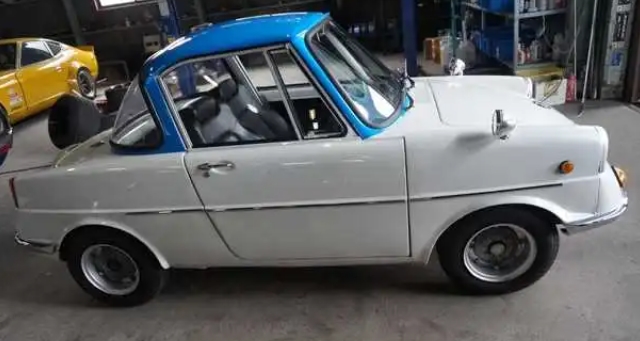
The Mazda R360 made its public debut in October 1960. At first glance, it was undeniably charming. Its design, often compared to a “rolling teardrop,” was characterized by smooth, flowing curves, a stark contrast to the boxy, utilitarian aesthetic of the Subaru 360. The R360 was a true coupe, with no B-pillar and doors that opened in a reverse “suicide” style (rear-hinged), granting easy access to the intimate cabin.
But the R360’s innovation went far beyond its skin. Here is what made it a true engineering marvel for the Keijidōsha class:
- Full Monocoque Unibody: As mentioned, this was the R360’s trump card. It provided superior ride quality, better handling, and a stronger safety cell compared to its rivals. The car felt solid and planted on the road, a quality that immediately set it apart.
- Fully Independent Suspension: The R360 featured a fully independent suspension system with torsion bars at the front and coil springs at the rear. This was unheard of in the budget-conscious microcar world. Competitors typically used rigid axles, which provided a much harsher ride. The R360’s setup allowed it to glide over road imperfections with a sophistication that belied its size.
- Vibrant V-Twin Engine: The heart of the R360 was its rear-mounted, air-cooled, 356cc V-twin engine. This compact, 90-degree V-twin produced a respectable 16 horsepower. While 16 hp doesn’t sound like much today, for a car weighing just 380 kg (838 lbs), it was enough to propel the R360 to a top speed of just over 100 km/h (62 mph). The engine was famously smooth and quiet for a twin, contributing to the car’s premium feel.
- Balanced Weight Distribution: By placing the engine in the rear, Mazda achieved a near-perfect 50/50 weight distribution. This gave the tiny R360 remarkably stable and predictable handling, making it a confident and fun car to drive.
- Comfortable and Spacious (Relatively) Interior: The cabin was designed for four passengers, a claim the R360 could nearly fulfill, unlike many of its 2+2 rivals. The seats were well-padded, the dashboard was clean and modern, and the fit and finish were of a quality that shocked the automotive press.
The R360 Coupe and its Automotive Family
The R360 was the star of the show, but in the world of Japanese microcars, a model line often expanded to serve different needs. While the R360 name is most famously associated with the coupe, the platform and engineering philosophy also gave birth to a slightly different body style.
- Mazda R360 Coupe (1960-1966): This was the primary model and the one that captured hearts. It was a two-door, four-seater (or 2+2) coupe with the signature reverse-hinged doors and sweeping curves. It was offered in a single, well-appointed trim level. Mazda focused on offering everything in one package rather than creating a complex hierarchy of models.
- Mazda P360 “Carol” (1962-1966): In 1962, Mazda introduced the P360, known as the Carol. This was technically a four-door sedan version of the R360. It shared the same chassis, suspension, and V-twin engine but featured a more upright, formal four-door body with a B-pillar. The Carol was aimed at families and taxi fleets who needed easier rear passenger access but still wanted the R360’s advanced mechanicals. In essence, the Carol was the practical, sensible sibling to the stylish R360 Coupe. A “de-luxe” version of the Carol was also offered, which included a heater and a clock as standard.
Throughout its production run from 1960 to 1966, the R360 Coupe and its P360 Carol sibling remained relatively unchanged. They did not receive the myriad of minor trim updates seen in longer-running models. The core philosophy was sound, and Mazda saw no need to alter it. The car was offered in a range of delightful, period-correct two-tone paint schemes, which further enhanced its cheerful and youthful image.
R360 vs. The World: A Sales Battle
The R360 was a critical success, but commercially, it faced an uphill battle. The undisputed king of the Keijidōsha market was the Subaru 360. The Subaru was cheaper, more established, and had a network of dealerships. It was the default choice for the Japanese public.
The R360, with its more complex engineering and higher-quality materials, commanded a higher price. Its launch price was ¥300,000, compared to the Subaru 360’s ¥230,000. This price premium was significant for the average consumer. While the R360 was a better car in almost every measurable way—smoother, faster, more comfortable, and better handling—many buyers were simply unwilling or unable to pay the extra cost.
Despite its quality, the R360 struggled to outsell the Subaru. It sold around 32,000 units in its six-year lifespan—a respectable number, but a fraction of the Subaru 360’s sales figures.
The End of an Era and a Glimpse of the Future
By 1966, the R360 and P360 were beginning to show their age. The Japanese Keijidōsha class was also evolving. The government was considering relaxing the regulations, which would allow for larger, more powerful vehicles (the next class up was 600cc, known as the “770cc class” for tax purposes).
Mazda made a strategic decision to move upmarket. The R360 was not updated or replaced by another 360cc car. Instead, Mazda launched the 1967 Carol 360, a completely new vehicle with a more modern chassis and body. Then came the game-changer later in 1967: the Mazda Cosmo Sport. The Cosmo, with its twin-rotor Wankel engine, was a world away from the humble R360, but its technological DNA was directly descended from the R360’s engineering ethos of innovation and defying convention.
The R360’s legacy is therefore twofold. First, it proved that Mazda could build a world-class passenger car. It was a statement of intent that announced the company’s arrival on the automotive stage. Second, it served as a vital learning platform. The skills and confidence gained from developing the R360’s unibody chassis and advanced suspension were indispensable when Mazda moved on to more complex vehicles. The rotary engine, for which Mazda is famous, was a massive gamble, but it was a gamble the company was only willing and able to take because it had already succeeded with the equally ambitious R360.
The R360 Today: A Cherished Classic
Today, the Mazda R360 is a highly sought-after classic, especially in Japan. Its combination of historical significance, charming design, and advanced engineering for its era makes it a beloved collector’s item. Finding an original in good condition is a rare treat. Its cheerful face and tiny dimensions bring a smile to the faces of onlookers, a rolling testament to a time of optimism and daring engineering.
In conclusion, the Mazda R360 was far more than just a small car. It was a declaration of Mazda’s identity. It was the first vehicle to embody the company’s long-held “Zoom-Zoom” philosophy—a belief that cars should deliver joy and excitement, not just basic transportation. While it may not have been a runaway commercial blockbuster, the R360 was the perfect start to Mazda’s incredible journey as one of the world’s most daring and innovative automakers. It was the small car that started a revolution, proving that big things truly do come in small, teardrop-shaped packages.