The People’s Subcompact: A Detailed History and Evolution of the Nissan Versa
In the pantheon of automotive history, few vehicles have embodied the philosophy of “transportation as a utility” as steadfastly as the Nissan Versa. Since its debut in 2006, the Versa has served as a critical entry point for first-time buyers, budget-conscious commuters, and fleet operators. While it may lack the flashiness of a sports car or the rugged capability of an SUV, the Versa’s evolution tells a compelling story of engineering adaptation, shifting consumer tastes, and the relentless pursuit of affordability without sacrificing modern safety.
This is the factual history of the Nissan Versa, tracing its journey from the early days of the subcompact sedan to its current status as one of the last bastions of the traditional entry-level car.
Phase I: The Tidal Wave Begins (2007–2011)
The Debut Nissan introduced the Versa to the North American market in 2007 for the 2007 model year. The name “Versa” was a portmanteau of “Versatile Space,” a promise the car would largely keep. Built on the Nissan B platform (shared with the global Note hatchback), the first-generation Versa was designed to be wider and taller than its competitors, specifically targeting the Honda Fit and Toyota Yaris.
The Sedan (2007–2011) The sedan arrived first, featuring a tall roofline that maximized headroom and a relatively long wheelbase that provided surprising rear legroom. It was powered by a 1.8-liter DOHC 4-cylinder engine (engine code HR16DE), producing 120 horsepower and 125 lb-ft of torque. Transmission options were a standard 5-speed manual or an optional 4-speed automatic.
- 2007–2008 Models & Trims:
- 1.8 S: The base model. It came standard with air conditioning, an auxiliary input for the stereo, and 60/40 split-folding rear seats. Notably, power locks and windows were optional on the absolute base trim, which was rare even at the time.
- 1.8 SL: The top-tier trim. It added alloy wheels, cruise control, keyless entry, and a higher-end sound system.
- 2009 Facelift and Updates: In 2009, Nissan made slight aesthetic tweaks (grille and bumper updates) and introduced the “Xtronic CVT” (Continuously Variable Transmission) as a replacement for the 4-speed automatic, improving fuel economy and smoothness.
- SR Trim: For the first time, Nissan introduced an “SR” sport trim. This model added a rear spoiler, fog lights, and sport-tuned suspension. It was visually distinct and aimed at younger buyers.
The Hatchback (2007–2011) Though released simultaneously with the sedan in some markets, the hatchback version of the first-generation Versa hit the U.S. market slightly later in 2007. Known globally as the Nissan Note, the Versa Hatchback utilized the same 1.8L engine but offered significantly more cargo versatility.
- Trims:
- 1.8 S Hatch: Base model with 15-inch steel wheels and cloth seating.
- 1.8 SL Hatch: Added 16-inch alloy wheels, Bluetooth connectivity (later years), and steering-wheel-mounted audio controls.
Phase II: The Subcompact Grows Up (2012–2019)
For the second generation, Nissan made a strategic decision to bifurcate the lineup. To keep prices low, the sedan and hatchback would now be different vehicles.
The Versa Sedan (2012–2019) The sedan was redesigned to look more upscale, borrowing styling cues from the larger Nissan Altima. It became a standalone model, distinct from the Versa Note hatchback. The chassis was stretched, offering even more rear legroom than the previous generation.
- Engine: The HR16DE 1.6L 4-cylinder engine was carried over but detuned slightly to 107 horsepower (up to 109 hp in later years). This was done to prioritize fuel efficiency, which became a primary selling point.
- Transmission: The heavy reliance on the Xtronic CVT defined this era.
- 2012–2014 Trims:
- S: The entry-level sedan. It came with a 5-speed manual transmission standard. Notably, automatic transmission availability was delayed on the base S trim for a year.
- S Plus: The volume seller. It included the CVT, cruise control, and keyless entry.
- SL: The luxury trim. It featured leatherette seating, a navigation system, and a premium Bose audio system—a rarity in the subcompact class.
- 2015 Mid-Cycle Refresh: Nissan updated the front fascia with a more aggressive V-Motion grille and reshaped headlights. The interior materials were upgraded from hard plastics to soft-touch surfaces on the dash.
- SR Trim Returns: Following the sedan’s refresh, the SR trim was added back to the lineup. It included 16-inch alloy wheels, a rear spoiler, and fog lights.
The Versa Note (2014–2019) While the sedan focused on size and efficiency, the hatchback was rebranded as the Versa Note to differentiate it from the sedan. The Note was built on a newer platform that prioritized interior volume and visibility.
- Design: The Note featured the “boomerang” taillights and a distinctive “floating roof” design.
- Engine: It utilized the same 1.6L HR16DE engine as the sedan (109 hp).
- Trims:
- S: Base model, usually equipped with a 5-speed manual (rare for the Note lineup).
- S Plus: The standard automatic model.
- SV: The volume leader, featuring the “Divide-n-Hide” adjustable cargo floor, Bluetooth, and push-button start (in later years).
- SR: Added sport styling, 16-inch alloys, and a leather-wrapped steering wheel.
- SL: Top-tier luxury trim with leatherette seats and navigation.
Phase III: The Return to Form (2020–Present)
By the late 2010s, the automotive market had shifted drastically toward SUVs and crossovers. Nissan discontinued the Versa Note hatchback after the 2019 model year. In 2020, the Versa sedan returned for a third generation, riding on the Nissan V platform (shared with the global Micra).
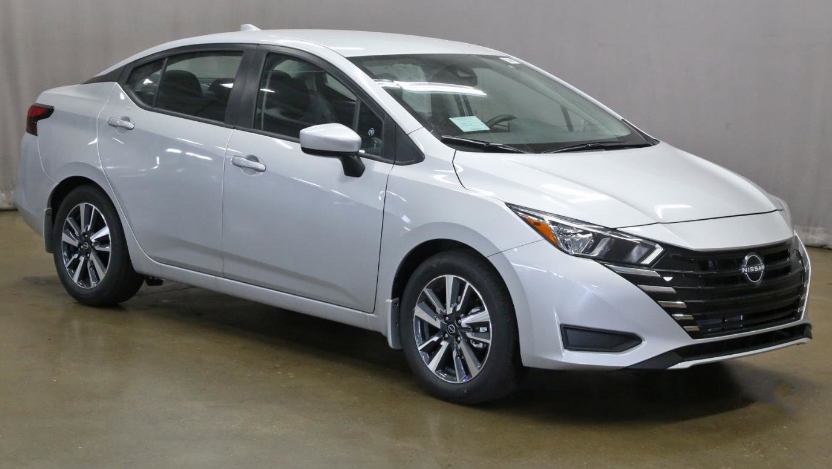
The Third-Generation Versa (2020–Present) This generation marked a significant turning point. It was larger, more powerful, and—most importantly—introduced high-end safety features previously reserved for luxury vehicles.
- Engine: The HR16DE engine received a boost, thanks to direct injection (replacing port injection). Power rose to 122 horsepower, giving the Versa a distinct advantage over the Honda Civic and Toyota Corolla base engines.
- Transmission: A 5-speed manual is still available on the base trim, paired with a 5-speed manual transmission (a rarity in the 2020s), while the Xtronic CVT handles the rest.
Safety Revolution: Nissan Safety Shield 360 The defining feature of the modern Versa is the inclusion of Nissan Safety Shield 360 as standard equipment on all trims since 2021. This includes Automatic Emergency Braking (AEB) with Pedestrian Detection, Blind Spot Warning, Rear Cross Traffic Alert, Lane Departure Warning, and High Beam Assist.
Trims (2020–2025 Model Years):
- S (Base):
- Engine: 1.6L HR16DE (122 hp).
- Transmission: 5-speed manual or CVT (CVT is optional on S, standard on higher trims).
- Features: 7-inch touchscreen infotainment with Apple CarPlay and Android Auto, automatic emergency braking, and 15-inch steel wheels with covers.
- SV (Mid-Tier):
- Features: Upgrades to 16-inch alloy wheels, push-button start, and a 60/40 split-folding rear seat. The interior adds premium cloth seating and a center console with armrest. Cruise control is standard here.
- SR (Top-Tier):
- Features: 16-inch aluminum-alloy wheels with dark finish, rear spoiler, LED headlights, and fog lights. The interior receives a leather-wrapped steering wheel and shifter knob, plus “Sport” cloth seating with orange stitching.
- Tech: Intelligent Cruise Control and Bose premium audio system are available options on the SR.
Competitive Landscape and Market Position
Throughout its history, the Versa has competed in the “subcompact” or “B-segment” class.
- 2006–2011: Fought against the Honda Fit, Toyota Yaris, Ford Fiesta, and Chevrolet Aveo. The Versa won on interior volume.
- 2012–2019: Competed against the Chevrolet Spark, Hyundai Accent, and Kia Rio. The Versa won on highway stability and rear seat room.
- 2020–Present: As competitors like the Ford Fiesta and Chevrolet Sonic exited the market, the Versa now battles the Mitsubishi Mirage (lower price, lower quality) and the Kia Rio (similar specs, slightly higher price). The Honda Fit was discontinued in the US after 2020, leaving the Versa as one of the few remaining subcompact sedans standing.
Technical Evolution and Engineering
Platform Changes:
- Gen 1 (B Platform): Shared with the Renault-Nissan alliance’s global small cars. It was boxy and utilitarian.
- Gen 2 (V Platform): Lower center of gravity, improved crash structure, but retained a torsion beam rear suspension.
- Gen 3 (V Platform): The most advanced iteration, utilizing high-strength steel to reduce weight while increasing rigidity.
Transmission Evolution: The Versa was an early adopter of the CVT in the mass market. While early CVTs (2007–2011) faced reliability concerns, the Xtronic CVT in the 2012 and newer models proved durable, though requiring strict adherence to fluid change intervals (every 60,000 miles).
.
RepairSurge Online Repair Manuals Replace Bulky Books With Reliable Digital Information!
Faster And Cheaper Than Traditional Printed Manuals, Users Get Instant Access To The Repair Information They Need For Any Car, Truck, Van or SUV:
.
Economic Impact and Cultural Significance
The Versa is often called the “Uber Car” or “Taxi Fleet Hero.” Its low cost of ownership, combined with a trunk space that exceeds many midsize cars, made it the dominant choice for ride-sharing services in the late 2010s. This ubiquity reinforced Nissan’s brand identity in the budget sector.
However, the Versa’s reputation was occasionally marred by the “Nissan CVT controversy.” In 2022, Nissan settled a class-action lawsuit regarding CVT failures in a wide range of their vehicles (though the Versa was less impacted than the Sentra or Altima). In response, Nissan extended warranties on the CVT for many models and improved the transmission cooling systems in the latest generation.
Future Outlook
As of 2025, the future of the Versa is somewhat uncertain but promising in the current market. With the automotive industry pivoting toward EVs, a fully electric Versa is a logical possibility, though Nissan has not confirmed a timeline. Currently, the “Santana” (a version of the Versa built in Mexico for global markets) remains the last traditional sedan in its class produced for the Americas.
The Versa remains the last “sub-$20,000” new car in the United States market (though the base price has crept up from its $9,990 launch price in 2007 to over $17,000 in 2025 due to inflation and safety mandates). As the market abandons the entry-level sedan, the Versa has evolved from a disposable economy car into a sophisticated, safety-laden machine. It proves that “cheap” doesn’t have to mean “unsafe” or “uncomfortable.”
Summary of Evolution
- 2007–2011: The “Tall Boy” era. 1.8L engine, focus on interior volume, introduction of the SR trim.
- 2012–2019: The “Commuter” era. 1.6L engine, distinct sedan and hatchback (Note) identities, refinement of the CVT, and improved styling.
- 2020–Present: The “Value Tech” era. Return of higher horsepower (122 hp), standard advanced safety features (Safety Shield 360), and a focus on styling and efficiency.
The Nissan Versa remains a testament to the idea that mobility should be accessible. By adapting to changing regulations and consumer demands without losing sight of its budget roots, the Versa has outlasted many rivals and continues to be a vital pillar of the automotive landscape.