The People’s Workhorse: History of the Lada 2105
In the vast landscape of automotive history, few vehicles embody the spirit of industrial resilience quite like the Lada 2105. Known in Russia as the “Lada Nova” (though it was hardly new by Western standards), this car became a ubiquitous symbol of Soviet and post-Soviet transportation. While the automotive world looked toward digital fuel injection and aerodynamic curves in the 1980s, the Lada 2105 remained steadfastly mechanical, simple, and rugged.
Produced for nearly three decades, the 2105 was not merely a car; it was a cultural artifact, a testament to the longevity of the Fiat 124 platform, and a canvas for customization that spanned from the austere garages of the Soviet Union to the sunny streets of Cuba. This article explores the evolution, trim levels, and enduring legacy of the Lada 2105.
Origins: The Rear-Engine Legacy
To understand the Lada 2105, one must look back to 1966, when the Soviet Union signed a deal with Fiat to produce the Fiat 124. This car became the Lada 2101 (or Zhiguli). While the 2101 was a front-engine, rear-wheel-drive (RWD) sedan, the Italians also provided a derivative design: the Fiat 127, which featured a rear-engine layout. The Soviets adapted this concept, creating the Lada 21011 (a slightly updated 2101) and eventually the 2103 and 2106.
However, by the late 1970s, the Soviet automotive industry needed a modernized, entry-level vehicle that was cheaper to produce than the 2106 but more refined than the aging 2101. The solution was to take the existing rear-engine architecture—already proven by the Lada 2102 station wagon—and apply a new, modern body shell.
The Birth of the 2105 (1980–1995)
The Lada 2105 was officially introduced in 1980. It was designed as a successor to the Lada 21011. While the chassis and mechanical components were heavily based on the previous models, the bodywork was a significant departure.
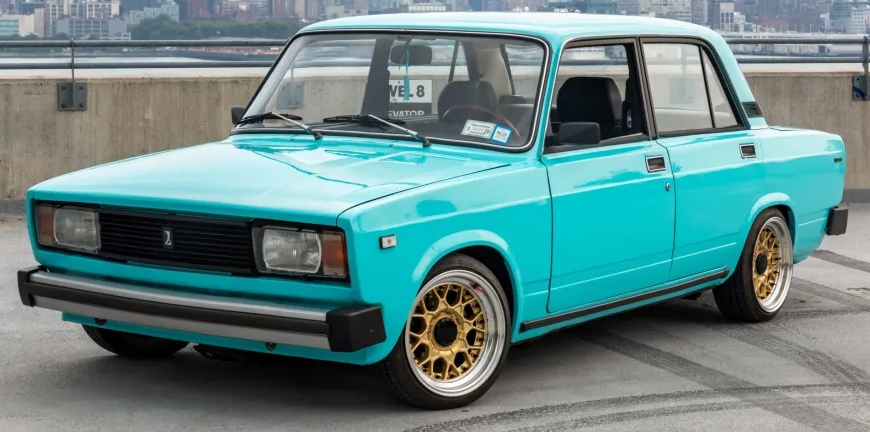
Design and Engineering The 2105 featured a distinct “three-box” design with a sharp, angular aesthetic that reflected the design trends of the late 1970s. Unlike the curvaceous 2101, the 2105 had flat glass, a vertical rear window, and a distinct “notchback” trunk. The front end featured rectangular headlights (a modernization over the round lights of the 2101), and the grille was a simple, horizontal slat design.
Mechanically, it retained the rear-engine, rear-wheel-drive layout. The engine was a 1.3-liter (1294 cc) OHV (Overhead Valve) four-cylinder, derived from the Fiat 124 unit. In the early 1980s, this engine produced approximately 64 horsepower (SAE gross), which was adequate for the lightweight chassis.
The VAZ-2105 “Nova” In export markets, particularly the UK and Western Europe, the car was marketed as the Lada Nova. It was sold as a budget alternative to the Ford Fiesta or VW Polo, offering more interior space and a larger engine than its European competitors.
.

.
Trim Levels and Variants (1980–1995)
Throughout its production run, the Lada 2105 was offered in several trim levels, often denoted by the specific model code. These trims ranged from bare-bones utility vehicles to relatively comfortable family cars.
1. Lada 2105 (Base Model)
- Production: 1980–1995
- Features: The standard 2105 was spartan. It featured a vinyl interior, rubber floor mats, and a rudimentary heating system. It lacked a tachometer, and the speedometer was mechanically driven. The rear windows on early models were fixed (non-opening), a cost-saving measure. It had no rear seat belts, and the chrome bumpers were eventually replaced by black plastic bumpers in the early 1990s to cut costs.
2. Lada 21053 (Luxury Trim)
- Production: 1983–1995
- Features: The 21053 was the “high-end” version of the 2105. It featured a more powerful engine (71 hp), often referred to as the “injector” engine, though early 21053s were still carbureted. This model included:
- Cloth upholstery (velour) instead of vinyl.
- Wood grain dashboard trim.
- Tachometer and additional warning lights.
- Opening rear quarter windows (ventilation).
- Improved sound insulation.
- Halogen headlights.
- Rear seat belts (in later years).
3. Lada 21050 (Export/Manual Transmission)
- This designation was often used for export models equipped with a 4-speed manual transmission. In the domestic market, the 21050 was sometimes used to denote the base model with the 1.2-liter engine, though this designation varied by year and factory.
4. Lada 21051 (1.2-Liter Engine)
- A less common variant equipped with the smaller 1.2-liter engine (1197 cc), producing 58 hp. This was primarily intended for markets with lower tax brackets based on engine displacement or for markets requiring lower octane fuel tolerance.
5. Lada 2105 “Taxi”
- While not a distinct model code, many 2105s were purchased by taxi cooperatives. These were typically base model 2105s painted in a distinctive beige or cream color. They were stripped of non-essential features to maximize durability and ease of repair.
The Facelift: The 21053 and the “Oka” Era
By the late 1980s, the 2105 was aging. However, rather than replacing the entire platform, AvtoVAZ continued to refine it. In 1991, a significant update was introduced, primarily for the 21053 trim.
The 1991 Update The 1991 model year brought aesthetic and mechanical changes:
- Bumpers: The chrome bumpers were replaced with black plastic bumpers with integrated impact strips.
- Lighting: The front indicators were enlarged and moved slightly.
- Wheels: The steel wheels were updated with a more modern design, and plastic wheel caps became standard.
- Interior: The dashboard received a slight redesign, and the seats were updated for better ergonomics.
- Engine: The 1.3L engine received an updated carburetor (DAAZ-2105-40) to meet stricter emission standards.
The VAZ-1111 “Oka” Connection It is worth noting that in the late 1980s, the 2105 platform served as the donor for the VAZ-1111 Oka, a microcar. The Oka utilized the 2105’s engine, transmission, and suspension components. While not a trim level of the 2105, the Oka’s existence extended the life of the 2105’s mechanical parts well into the 2000s.
Production Timeline and the “Frankenstein” Years (1995–2006)
The official production of the Lada 2105 sedan at the Togliatti plant ended in 1995. It was replaced by the Lada 2107 (a facelifted version with a more modern grille and better features). However, the story of the 2105 does not end there.
IzhAvto and Zaporizhzhia Following the collapse of the Soviet Union, the tooling for the 2105 was sold to other manufacturers.
- IzhAvto (Russia): The Russian manufacturer IzhAvto (based in Izhevsk) continued to produce the Lada 2105 and 2107 well into the 2000s. These cars were known for varying build quality and were often sold as budget fleet vehicles.
- ZAZ (Ukraine): In Ukraine, the Zaporizhzhia Automobile Building Plant (ZAZ) assembled CKD kits of the Lada 2105. These were sold as the Lada 2105 and remained in production until roughly 2006.
The “21053” as a Standalone Model Even after the 2105 sedan was discontinued, the 21053 (the luxury version) continued to be produced in limited numbers by IzhAvto. By the early 2000s, these cars were anachronisms. They lacked airbags, ABS, or modern catalytic converters, yet they were still being rolled off assembly lines for customers who wanted a simple, repairable car.
Technical Specifications (Typical 21053)
- Engine: 1.3L (1294 cc) OHV Inline-4
- Power: 64–71 hp (depending on the year and carburetor type)
- Torque: 94 Nm
- Transmission: 4-speed manual (early models) or 5-speed manual (later models)
- Drivetrain: Rear-engine, Rear-wheel drive (RR layout)
- Suspension:
- Front: Independent, torsion bars, anti-roll bar
- Rear: Dependent, coil springs, trailing arms
- Brakes:
- Front: Discs
- Rear: Drums
- Fuel Consumption: Approx. 8–10 liters per 100 km (city driving)
- Top Speed: 140–145 km/h
The Lada 2105 in Culture
The 2105 was the “thinking man’s” Lada. While the 2107 (the “Seven”) was seen as the more prestigious family car, the 2105 was often the choice of younger drivers and mechanics. Its boxy shape made it an ideal candidate for tuning.
In the 1990s and 2000s, the 2105 became a staple of Russian street racing culture (drifting). The rear-engine layout provided excellent traction on loose surfaces, and the simple chassis allowed for easy modification. It was common to see 2105s with widened arches, massive spoilers, and engine swaps (often using engines from the Lada Niva or even Japanese imports).
In Cuba, the 2105 (and its sibling, the 2107) remains a common sight. Due to the US embargo and limited imports, Cuban mechanics have kept these cars running for decades using improvised parts. The 2105 is prized there for its mechanical simplicity, which can be maintained with basic tools.
Future Outlook and Legacy
As of today, the Lada 2105 is a vintage vehicle. Production ceased entirely around 2006 (at ZAZ and IzhAvto), and the chassis was officially retired when Lada moved to the VAZ-2110 series (front-engine, front-wheel drive) in the late 1990s and early 2000s.
Current Status
- Classic Car Scene: In Russia and Eastern Europe, well-preserved 21053 models are becoming collectible. Restored examples with stock specifications are gaining value.
- Spare Parts: Due to the sheer volume of production (millions of units), spare parts remain incredibly cheap and available. The 2105 shares many components with the 2101, 2103, 2106, and 2107, ensuring a supply chain that will likely last for decades.
- Daily Drivers: In rural areas of Russia, Ukraine, and Belarus, the 2105 is still used as a daily driver. Its ability to withstand poor road conditions and ease of repair makes it practical, despite its age.
The Verdict The Lada 2105 was never the fastest, most comfortable, or most technologically advanced car of its time. However, its evolution tells the story of the Soviet automotive industry’s transition from the 1970s to the post-Soviet era of the 2000s.
It was a car designed for a specific purpose: to provide affordable, reliable transportation to the masses. It succeeded in that mission. The 2105 outlived many of its contemporaries, not through innovation, but through sheer stubborn durability. Today, it stands as a monument to the era of mechanical simplicity—a time when a car was just a engine, four wheels, and a box to keep the rain out.
Summary of Production Years and Models
- 1980: Launch of the Lada 2105 (Base) and 21051 (1.2L).
- 1983: Introduction of the Lada 21053 (Luxury).
- 1985: Introduction of the 5-speed manual transmission for export models; updates to the carburetor.
- 1991: Facelift: Plastic bumpers, new wheel design, updated interior.
- 1995: Official end of production at AvtoVAZ (Togliatti). Replaced by the 2107.
- 1995–2004: Continued production at IzhAvto (Russia).
- 1996–2006: Assembly at ZAZ (Ukraine).
- 2006: Final cessation of production.
The Lada 2105 remains a beloved icon of the automotive world—a testament to the idea that sometimes, the best technology is the technology that simply refuses to break.