The Quiet Achiever: Charting the Evolution of the Toyota Aurion
In the grand tapestry of automotive history, some vehicles are celebrated for their revolutionary design or earth-shattering performance. Others, however, earn their place through quiet competence, steadfast reliability, and by perfectly fulfilling a specific market need. The Toyota Aurion belongs firmly in the latter category. For just over a decade, this V6-powered sedan served as Toyota’s flagship in Australia and other key markets, offering a blend of power, comfort, and dependability that carved out a unique and respected niche. This is the story of its evolution, from a confident debutante to a refined and powerful swansong.
To understand the Aurion’s genesis, one must look at the Australian automotive landscape of the mid-2000s. The large family sedan market was dominated by the rear-wheel-drive, six-cylinder rivalry of the home-grown Holden Commodore and Ford Falcon. Toyota’s previous contender in this space, the Avalon, had struggled, often perceived as bland and underpowered. Toyota needed a more compelling offering: a car with the power to rival the local heroes but with the refinement, quality, and front-wheel-drive safety associated with the brand. The solution was to take the globally successful XV40 Camry platform and create a distinct, upmarket, V6-only model. Thus, in 2006, the Toyota Aurion was born.
The First Generation (XV40): 2006–2012
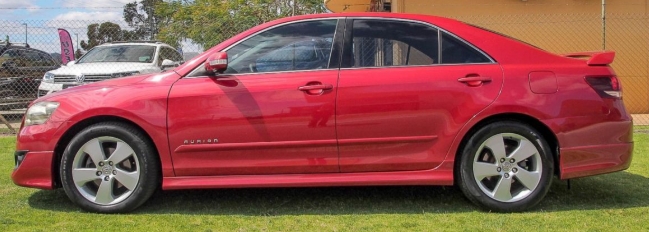
Launched in October 2006 for the Australian market, the first-generation Aurion was more than just a rebadged Camry. While it shared its core chassis, wheelbase, and door panels with its four-cylinder sibling, Toyota Australia invested significantly in creating a unique identity. The Aurion featured entirely different front and rear styling, with a bolder grille, more assertive headlamps, and a distinct boot lid and tail-light design that gave it a more premium and substantial presence.
The true heart of the Aurion, however, was its engine. Every model was equipped with the now-legendary 3.5-litre 2GR-FE V6 engine. Producing a formidable 200 kW (268 hp) and 336 Nm of torque, it was one of the most powerful naturally aspirated V6 engines on the market. Paired exclusively with a smooth six-speed automatic transmission, the Aurion offered effortless acceleration and refined cruising capabilities that immediately set it apart from its four-cylinder stablemate.
.

.
Pre-Facelift Model Line-up (2006–2009)
Toyota launched the Aurion with a well-defined, five-tier model range designed to cater to both fleet/family buyers and those seeking sportiness or luxury.
- AT-X: The entry-level model aimed at fleet and value-conscious private buyers. Despite its position, it was well-equipped for the era, featuring 16-inch alloy wheels, dual-zone climate control, cruise control, a six-speaker audio system, and a comprehensive safety package including six airbags, Vehicle Stability Control (VSC), and Traction Control (TRC).
- Prodigy: The mid-grade luxury variant. It built upon the AT-X by adding leather upholstery, a power-adjustable driver’s seat with memory, rear parking sensors, a premium six-disc CD changer, and unique 16-inch alloy wheels.
- Sportivo (SX6 and ZR6): This was Toyota’s direct answer to the sporty Commodore SV6 and Falcon XR6.
- Sportivo SX6: Based on the AT-X, it added a full body kit (front and rear spoilers, side skirts), a rear wing, 17-inch alloy wheels, sports-tuned suspension, and unique interior trim with sports seats.
- Sportivo ZR6: A higher-spec version that combined the SX6’s sporty aesthetics and suspension with the luxury features of the Prodigy, including leather seats, parking sensors, and dual-zone climate control.
- Presara: The flagship luxury model. The Presara came fully loaded with satellite navigation, a reversing camera, a sunroof, keyless entry and start, a premium JBL sound system, rain-sensing wipers, and Bluetooth connectivity—features often reserved for European luxury marques.
The Supercharged Anomaly: TRD Aurion (2007–2009)
In 2007, Toyota Australia’s newly formed Toyota Racing Development (TRD) division unleashed a high-performance version that remains the most powerful Aurion ever built. The TRD Aurion took the standard 2GR-FE V6 and fitted it with an Eaton supercharger, boosting power to a thrilling 241 kW (323 hp) and 400 Nm of torque. This power was still sent through the front wheels, managed by the six-speed auto. TRD also added upgraded brakes, a bespoke sports suspension, a distinctive body kit, quad exhaust tips, and 19-inch wheels. It was offered in two trims: the 3500S (based on the Sportivo) and the more luxurious 3500SL (based on the Presara). While critically acclaimed for its straight-line speed, its high price and the onset of the Global Financial Crisis led to slow sales, and the TRD program was discontinued in 2009.
Mid-Life Facelift (2009–2012)
In September 2009, the Aurion received a cosmetic and equipment update. The styling was refreshed with a new grille, revised front bumper, and updated tail-lights. Inside, the key upgrade was the standardization of Bluetooth and USB/iPod connectivity across the entire range. The model line-up was simplified, with the Prodigy and Sportivo ZR6 being absorbed into the top-tier Presara, which now effectively combined luxury and sporty features. The range for the latter half of its life was: AT-X, Sportivo SX6, and the all-encompassing Presara.
The Second Generation (XV50): 2012–2017
Unveiled in April 2012, the second-generation Aurion was based on the new XV50 Camry. This time, the design divergence was even more pronounced. The XV50 Aurion featured a bold, chrome-heavy front grille and a completely different rear end with horizontal tail-lights connected by a chrome strip, giving it a more imposing and formal look than its Camry counterpart.
Mechanically, Toyota adhered to the successful “if it ain’t broke, don’t fix it” philosophy. The 2GR-FE V6 engine returned, now producing a slightly higher 200 kW, though torque remained at 336 Nm. It was mated to the same six-speed automatic transmission, but refinements to the engine and aerodynamics resulted in improved fuel efficiency. The interior was completely redesigned, featuring a more modern dashboard layout, higher-quality materials, and updated technology. A knee airbag was added, bringing the total to seven.
Pre-Facelift Model Line-up (2012–2015)
The model range was re-established with a clear hierarchy similar to the original launch.
- AT-X: The base model continued to be well-appointed, now featuring a 6.1-inch touchscreen display audio system, a reversing camera, dual-zone climate control, 16-inch alloy wheels, and an electric driver’s seat.
- Prodigy: This luxury-focused model returned, upgrading to 17-inch alloys, leather-accented upholstery, satellite navigation, front and rear parking sensors, keyless entry/start, and a power rear sunshade.
- Presara: The top-of-the-line model added a sunroof, a premium JBL audio system with a 7-inch touchscreen, blind-spot monitoring, auto-dipping high beams, and rain-sensing wipers.
- Sportivo (SX6 and ZR6): The Sportivo badge once again denoted the performance-oriented models. Both featured a unique sports mesh grille, a full body kit, paddle shifters, and firmer sports suspension.
- Sportivo SX6: Based on the AT-X, it added the sporty visual and handling package.
- Sportivo ZR6: This variant was the ultimate fusion of sport and luxury. It combined the Sportivo body kit and suspension with the Presara’s high-end features like blind-spot monitoring, leather sports seats, and keyless entry/start. It also featured unique 17-inch dark-finish alloy wheels.
The Final Facelift (2015–2017)
In mid-2015, the Aurion received its final and most significant visual update. The front end was completely redesigned with a much more aggressive, Lexus-inspired lower grille, flanked by new headlights (LED on higher trims). The rear bumper was also restyled. The interior received minor trim updates and technology enhancements.
This facelift also saw a rationalization of the model range. The Prodigy and Sportivo SX6 were discontinued, streamlining the offering for the final years of production.
- AT-X: Remained the entry point, gaining front parking sensors as standard.
- Sportivo: Effectively replaced the old ZR6. It now came standard with 18-inch gloss black alloy wheels, satellite navigation, and a sporty leather-accented interior.
- Presara: Continued as the luxury flagship, gaining new-look 17-inch alloy wheels and further active safety technology like Lane Departure Alert and Rear Cross Traffic Alert.
The End of an Era and a Lasting Legacy
The final Toyota Aurion rolled off the Altona production line in Melbourne in August 2017, marking the end of Toyota’s manufacturing in Australia. The decision to discontinue the Aurion was part of a broader global strategy by Toyota to streamline its model platforms. With the all-new, fully imported XV70 generation of the Camry, Toyota decided to once again offer a powerful V6 engine option in the Camry itself, rendering the separate Aurion nameplate redundant.
The Toyota Aurion’s evolution reflects a car that always understood its purpose. It was never designed to be a track-day monster or a stylistic trailblazer. Instead, it was engineered to be a powerful, comfortable, and supremely reliable V6 sedan for the real world. From the competent AT-X to the high-tech Presara and the genuinely potent TRD, the Aurion consistently delivered on its promise of refined performance. It was the quiet achiever, a Camry in a business suit with the heart of a sprinter, and it remains a highly regarded vehicle on the second-hand market—a testament to its engineering excellence and enduring appeal.