The Quiet Revolution: History of the Datsun 310
In the automotive landscape of the late 1970s and early 1980s, a seismic shift was occurring. The Oil Crisis of 1973 had fundamentally altered consumer priorities, forcing manufacturers to abandon the “bigger is better” ethos that had dominated the post-war era. In this new environment of fuel scarcity and economic uncertainty, a tiny, unassuming sedan began to carve out a quiet legacy. It was a car that lacked the sporty flair of the Z-Car or the rugged reputation of the pickups, yet it became a critical player in Datsun’s (and later Nissan’s) dominance in the North American market. This is the history of the Datsun 310.
The Context: A Changing Market
By the mid-1970s, Datsun had established itself as a formidable force in the United States. The Datsun 510 was a legend, the 240Z was a sensation, and the pickups were gaining traction. However, Datsun lacked a true subcompact to compete with the emerging wave of small cars from Detroit—such as the Chevrolet Chevette and the Ford Pinto—let alone the Honda Civic and Toyota Corolla.
Datsun needed a car that was economical, reliable, and affordable. They found their solution in Japan with the Nissan B11 platform. When this platform was adapted for the American market, it emerged as the Datsun 210 in 1973. By 1977, the car had evolved into the 310, a vehicle designed specifically to meet the stringent new fuel economy standards of the era.
The First Generation: The Birth of the 310 (1977–1979)
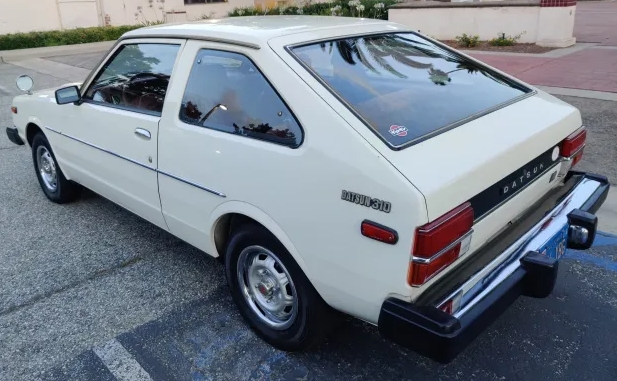
The Datsun 310 made its debut in the North American market in the fall of 1976 as a 1977 model. It effectively replaced the Datsun 210, sharing its predecessor’s chassis but featuring a new, slightly larger engine and updated styling to differentiate it in a crowded field.
Body Styles: The 310 was offered in three primary body styles, all built on a wheelbase of 89.3 inches:
- 2-Door Sedan: The baseline model.
- 4-Door Sedan: Aimed at small families.
- 2-Door Hatchback: A versatile, sporty option that utilized a liftgate rear.
Engines and Performance: Power came from a 1.4-liter (1379cc) A14 inline-four engine. This four-cylinder engine was a significant upgrade over the 1.2-liter found in the previous 210. It featured an overhead cam (OHC) design, which was relatively sophisticated for an entry-level American car at the time.
- Output: The standard carbureted version produced approximately 65 horsepower at 5,600 rpm and 77 lb-ft of torque at 3,600 rpm.
- Transmission: Buyers could choose between a 4-speed manual transmission (standard on most trims) or a 3-speed automatic.
Trim Levels: The 1977–1979 310 came in three distinct trim levels, each adding a layer of comfort and style:
- Base (310): Stripped down and utilitarian. It included vinyl seating, a heater, and basic AM radio, but lacked much else. It was the definition of an economy car.
- Deluxe (310 GL): This trim added carpeting, upgraded upholstery, a clock, and often a tachometer. The GL (Grand Luxury) featured woodgrain accents on the dashboard and door panels, giving the small cabin a more upscale feel.
- Sport (310 GX): The GX was the enthusiast’s choice. It featured rally-style side stripes, sport wheels, and often a 5-speed manual transmission (though the 4-speed was more common in the earlier years). The GX also included a tachometer and a high-output version of the A14 engine, pushing horsepower to around 70.
Styling: The 310’s styling was utilitarian and boxy, adhering to the safety regulations of the 1970s which required bumpers to withstand 5-mph impacts without damage. This resulted in the ubiquitous 5-mph bumpers, which added visual weight to the front and rear. The car was aerodynamically blunt but featured a surprising amount of glass area, giving it an airy cabin feel.
The B210 Confusion: It is important to note the distinction between the 310 and the B210. While the 310 was a distinct model line in North America, in other markets (and occasionally in marketing materials), the B210 (produced 1973–1978) overlapped with the 310. However, for the American market, the 310 was strictly a 1977–1979 phenomenon. The B210 was known for its “Bogie” suspension and distinct styling, whereas the 310 moved toward a more refined, compact sedan architecture.
.
THIS might be a great place to get your new car from!
Or for those who are into the “car flipping” business, here’s an excellent resource for you!

.
The Second Generation: The 1980 Model Year and the “310 GX”
The most significant evolution of the 310 occurred for the 1980 model year. Datsun was in the midst of a massive branding overhaul, preparing to transition to the “Nissan” moniker. The 310 underwent a facelift and mechanical refresh that elevated it from a basic economy car to a serious competitor in the compact segment.
Styling Changes: The 1980 310 lost the boxy, upright profile of its predecessor. It received a sloped, aerodynamic front end and integrated headlights (quad sealed beams hidden behind a plastic grille overlay on some trims). The rear taillights were reshaped, and the overall silhouette became more rounded, reducing drag. The 5-mph bumpers remained but were integrated more smoothly into the bodywork.
Mechanical Upgrades:
- Engine: The A14 engine carried over but was retuned. The 1980 model also saw the introduction of an electronic carburetor system in some trims, designed to improve fuel metering and reduce emissions.
- Suspension: The suspension setup remained a MacPherson strut front and leaf spring rear (coil springs on some hatchbacks), but the geometry was tweaked for better handling and ride comfort.
Trim Levels for 1980: The trim hierarchy was streamlined for the 1980 model year. While the base model remained, the focus shifted heavily toward the GX.
- Base 310: The entry-level sedan and coupe. It was the cheapest new car sold by Datsun in 1980.
- 310 GL: The luxury-oriented sedan. It added velour seats, a center console (on automatic models), and upgraded sound insulation.
- 310 GX (The Star of the Line): The GX became the flagship of the 310 range in 1980. It was marketed aggressively toward young professionals and college students. The GX trim included:
- Standard 5-Speed Manual: A sporty addition that maximized fuel economy.
- Cloth Sport Seats: High-bolstered seats with checkerboard or striped patterns.
- Tachometer and Warning Lights: Oil pressure and brake warning lights were standard.
- Sport Steering Wheel: A three-spoke vinyl wheel.
- Rally Equipment: Front and rear spoilers (a rarity in this class at the time), body side moldings, and blacked-out window trim.
The 1980 310 GX was available in vibrant colors, including “Phoenix Red,” “Lime Yellow,” and “Glacier White.” The car was marketed with slogans emphasizing its economy and agility, directly challenging the Honda Civic and Toyota Corolla Tercel.
The Datsun 310 in the Marketplace
The 310 faced stiff competition. The Volkswagen Rabbit (Golf) was the benchmark for handling and build quality. The Honda Civic was the king of packaging efficiency. The Chevy Chevette was the price leader.
The Datsun 310’s selling points were:
- Reliability: The A14 engine was legendary for its longevity. With proper maintenance, these engines could easily surpass 200,000 miles.
- Value: The 310 offered more standard features (like the 5-speed in the GX) than its rivals at a competitive price point.
- Simplicity: The car was mechanically simple, making it easy for owners to perform their own repairs.
However, the 310 was not without faults. The chassis was susceptible to rust, particularly in the rear wheel arches and floor pans—a common ailment for Japanese cars of the era. Additionally, while the 1.4-liter engine was reliable, it was underpowered by modern standards, struggling to maintain highway speeds in mountainous terrain.
The End of the Line and Legacy
The Datsun 310 had a short lifespan, lasting only three model years (1977–1979 for the first gen, 1980 for the second gen). In late 1980, Datsun announced that the 310 would be discontinued in favor of a new model: the Nissan Sentra.
The 1982 Nissan Sentra (B12 chassis) was a larger, more refined vehicle that succeeded the 310. However, the 310’s DNA lived on. The 310 served as a bridge between the rudimentary Datsun 1200 and the more sophisticated Sentra. It proved to Datsun that American buyers were ready for small cars that didn’t feel “cheap,” paving the way for the Sentra’s massive success in the 1980s.
The “310” Misnomer: It is worth noting a piece of automotive trivia: In the early 2000s, Nissan revived the “Versa” nameplate (Tiida) in some markets. In Mexico, a version of the Nissan Tiida was sold as the “Nissan 311,” leading some to confuse it with the classic 310. However, the original Datsun 310 remains a distinct entity of the late 70s.
The Future Outlook: A Cult Classic
Today, the Datsun 310 is a rare sight on the road. Most succumbed to rust or were scrapped during the fuel crises of the early 80s when they were seen as disposable transportation. However, a dedicated subculture of Datsun enthusiasts has begun to preserve and restore the 310, particularly the 310 GX models.
Modifications and Culture: The A14 engine shares many components with the A12 engine found in the Datsun 1200, which is a popular platform for SCCA autocrossing. As a result, 310s are increasingly sought after as donors for engine swaps or as lightweight project cars. Their simple rear-wheel-drive layout and minimal electronic interference make them ideal for modification.
Value: While not as valuable as the Datsun 510 (which now commands six figures for pristine examples), clean 310s are appreciating. A 1980 310 GX in excellent condition can fetch between $5,000 and $10,000, a significant increase from the sub-$500 prices of a decade ago.
Restoration: Restoration parts are becoming more available through specialist suppliers in Japan and niche online retailers. The enthusiast community, primarily found on forums like Datsun1200 .com and niche Facebook groups, keeps the technical knowledge alive, allowing these vehicles to be maintained indefinitely.
Conclusion
The Datsun 310 was not a revolutionary car, nor was it a halo car. It did not win major endurance races, nor did it star in Hollywood blockbusters. It was, however, a critical evolutionary step in the history of the Japanese automotive industry in America. It represented the maturation of the subcompact class, moving from bare-bones transport to a vehicle that offered style, reliability, and a touch of sportiness.
For the few who owned them, the 310 is remembered as a “pocket rocket”—a car that you could thrash on back roads during the week and rely on to get to work on Monday morning. It was the right car at the right time, embodying the resilience and ingenuity of Datsun during one of the most challenging decades in automotive history. As the 310 fades further into the annals of automotive history, it stands as a testament to the era when small cars began to make a big impact.