The Resurrected Marque: The Definitive History of the De Tomaso P72
In the annals of automotive history, few names carry the weight of Italian passion, racing pedigree, and tragic romance quite like De Tomaso. For decades, the marque was defined by the wedge-shaped, American-powered mad cow of the 1970s—the Pantera, the Longchamp, the Giugiaro-styled Giuna. However, in recent years, a new chapter has been written, one that reaches back to the brand’s earliest roots rather than its supercar heyday.
The vehicle at the center of this renaissance is the De Tomaso P72. More than just a car, the P72 represents a stylistic and engineering pivot for the brand, blending the pre-Existing 1960s racing heritage with modern hypercar technology. This article explores the evolution of the De Tomaso P72, from its conception as a revival concept to its current status as a low-volume production hypercar.
A Brief History: From P7 to P72
To understand the P72, one must understand the original De Tomaso P7. In 1965, Argentine-born Alejandro de Tomaso, a former motorcycle racer and husband of Italian socialite Isabella, unveiled the P7. Designed by sports car engineer Gianpaolo Dallara, the P7 was a purebred Formula One car powered by a 2.0-liter V8 engine. While it showed promise, it never achieved the success of its contemporaries like the Ferrari 312 or the Lotus 49.
Decades later, in the 2010s, the De Tomaso brand underwent a tumultuous series of ownership changes, moving from the Ford era to various investment groups. In 2019, a new era began under the guidance of Norman I. Choi, who acquired the brand with a vision to return it to its roots. Rather than reviving the Pantera (which had been attempted multiple times with mixed results), the new management looked to the 1965 P7 for inspiration.
This led to the creation of the De Tomaso P72.
The 2019 Debut: A Retro-Concept Disruptor
The De Tomaso P72 made its global debut at the 2019 Goodwood Festival of Speed. At a time when hypercar design was dominated by aggressive angles, active aerodynamics, and sci-fi aesthetics (think the Lamborghini Aventador SVJ or the Koenigsegg Jesko), the P72 arrived as a stunning antithesis.
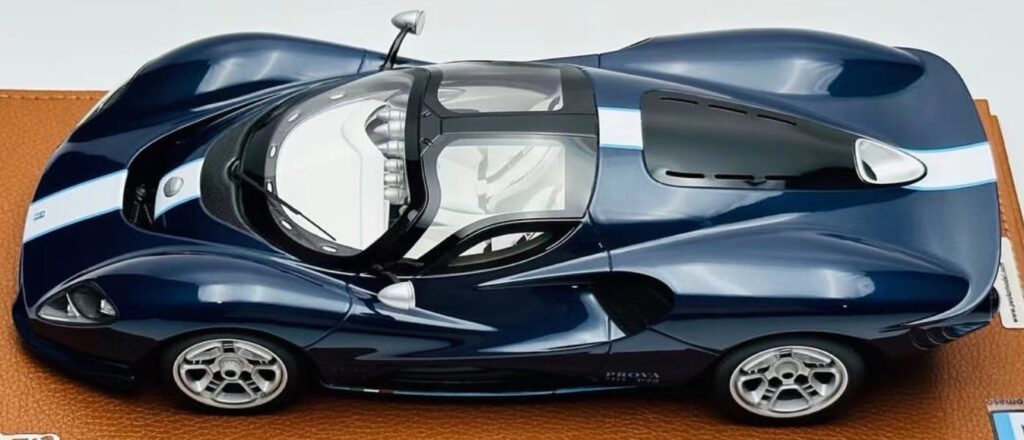
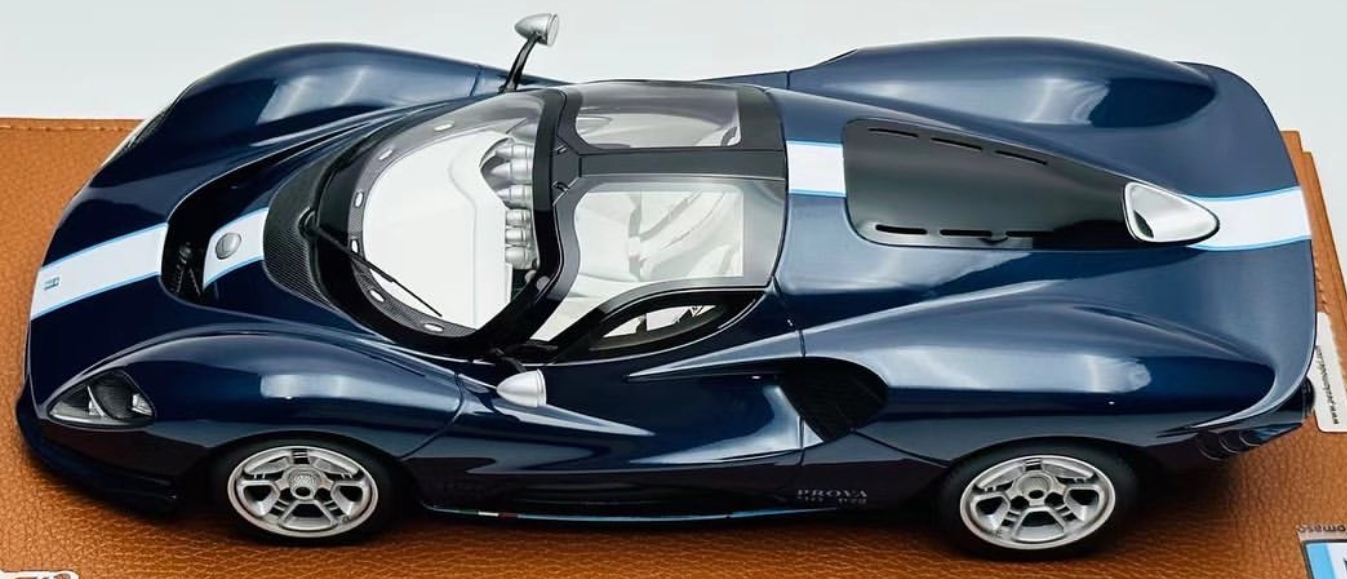
- Design Philosophy: Designed in collaboration with Jowyn Wong (previously of the Hennessey Venom F5), the P72 was a deliberate homage to the mid-1960s sports car. It featured a teardrop silhouette, a long tail, and a prominent rear diffuser. The body was crafted from exposed carbon fiber, but unlike modern supercars, the weave was finished in a deep, lustrous blue (or red/gold depending on the show car), giving it a classic GT feel.
- Powertrain (Prototype Era): The initial concept was powered by a 5.0-liter supercharged V8, a nod to the American V8 heritage that powered the Pantera, but tuned for a more refined, European character. It produced approximately 700 horsepower and 715 Nm of torque.
While the 2019 model was technically a “concept,” it was a rolling, driving prototype. Unlike many modern concepts that exist only as static clay models, De Tomaso intended for the P72 to be built. The reaction at Goodwood was overwhelmingly positive, validating the decision to move away from the “modern Pantera” trope and embrace vintage styling.
.

.
Evolution to Production: The 2023–Present Era
Following the success of the concept, De Tomaso moved into the production phase. This period marked significant technical changes, evolving the P72 from a retro-styled concept into a compliant, road-legal hypercar.
1. The Engine Transition (Ford to Toyota)
The most significant evolution in the P72’s journey concerned its heartbeat. Originally, the car was slated to use a Ford-based engine. However, due to changing emissions regulations and supply chain logistics, De Tomaso announced a partnership with Toyota Gazoo Racing (GR) in 2022.
The production P72 is now powered by a 3.5-liter twin-turbocharged V6 engine, derived from the Toyota GR architecture (similar to that found in the LC 500 and the Supra, but heavily modified).
- Specifications:
- Displacement: 3498 cc
- Configuration: 90-degree V6, twin-turbo
- Power Output: 700 horsepower (710 PS) at 6,800 rpm
- Torque: 700 Nm (516 lb-ft) from 3,000 to 5,600 rpm
- Redline: 7,800 rpm
While some purists initially lamented the lack of a V8, the move to the Toyota unit provided a lighter, more compact powerplant with a broader power band. It also ensured the car could meet strict Euro 6d and EPA emissions standards, a feat that a pushrod V8 would have struggled to achieve without extensive re-engineering.
2. Mechanical and Chassis Evolution
The P72 is built on a bespoke tubular steel space frame, which is then wrapped in a carbon fiber monocoque. This construction method was chosen to offer the tactile feedback and vibration characteristics of classic 1960s sports cars, contrasting with the sterile rigidity of carbon tubs found in cars like the McLaren Senna.
- Transmission: The P72 utilizes a 6-speed manual transmission sourced from a Toyota GR Supra (Getrag F23), but it is entirely bespoke in its tuning and housing. The decision to mandate a manual transmission is the car’s defining feature in the modern hypercar landscape. It reinforces the “driver-focused” ethos and pays direct homage to the analog feel of the original P7 racer.
- Suspension: Double wishbones with push-rod operated spring/damper units (front and rear), adjustable in height and damping.
- Brakes: Carbon ceramic discs (410mm front, 380mm rear) with 6-piston calipers (front) and 4-piston calipers (rear).
3. Aerodynamics
Unlike modern hypercars that rely on massive wings, the P72 utilizes “hidden” aerodynamics. The body shape creates natural downforce, and the rear diffuser is the primary aerodynamic device. A small, deployable carbon fiber lip at the rear assists with stability at high speeds without ruining the car’s classic lines.
Trim Levels and Models
Unlike mass-produced vehicles (such as the Porsche 911), the De Tomaso P72 is hand-built in limited numbers. As such, it does not have “trim levels” in the traditional sense (e.g., LX, EX, GT). Instead, it is offered as a single, highly customizable configuration with “Heritage” packages.
However, there are distinct variations based on production years and customer specifications:
1. The Launch Specification (2023–2024) The initial batch of 28 units (planned) reflects the closest to the 2019 concept.
- Power: 700 hp
- Transmission: 6-speed manual only.
- Exterior: Available in the signature “Blue Tourmalet” (a specific heritage blue), “Rosso Corsa,” or full exposed carbon fiber.
- Interior: Features extensive use of analogue dials, magnesium paddle shifters (for the electronic actuator of the manual gate), and leather from Italian tannery pp. This specification emphasizes the “old-school” driving feel.
2. The “Anniversary” Specification (Future/Optional) While not a separate model, early production units are designated as “Anniversary” cars to celebrate the brand’s return. These include:
- Bespoke livery stripes inspired by the 1965 P7 racing car.
- Gold or bronze-colored wheel finishes.
- Engine bay lighting and custom luggage sets.
- Carbon Fiber Pack: An optional upgrade that replaces standard body panels with exposed weave, reducing weight by approximately 50kg.
3. Future Variant: The P72 Spyder (Projected 2025/2026) De Tomaso has confirmed that a Spyder (convertible) variant is in development. While the P72 is a coupe, the Spyder will likely feature a removable carbon fiber roof panel or a soft-top mechanism. The chassis is being reinforced to accommodate the open-air design without compromising rigidity. The powertrain is expected to remain identical to the coupe, though weight distribution may shift slightly.
Production, Pricing, and Exclusivity
The evolution of the P72 has been strictly controlled to maintain exclusivity.
- Production Volume: Total production is capped at 72 units (a nod to the model name). This is a significant reduction from the initial announcement, which hinted at higher numbers. The reduction is due to the hand-crafted nature of the build process.
- Manufacturing Facility: Production takes place in Modena, Italy, at a facility formerly associated with the brand. The assembly is a mix of modern robotic welding for the chassis and hand-assembly for the body and interior.
- Pricing:
- 2020-2022 (Pre-Production): Approximately $750,000 USD (concept pricing).
- 2023-Present (Production): Approximately $1.1 to $1.3 million USD. The price hike reflects the switch to the Toyota GR engine development, bespoke manual transmission engineering, and rising material costs.
- Current Status: As of late 2023/early 2024, the first customer deliveries are being scheduled. The production line is active, but due to the small scale, build slots are reserved through 2025.
The Driving Experience
Although limited, early test drives and media previews of the production P72 highlight a specific evolution in character. The car is not a track weapon in the vein of a Ferrari F80 or a McLaren Artura; it is a “GT Sport.”
- 0-60 mph: 3.0 seconds (claimed).
- Top Speed: 217 mph (350 km/h).
The defining experience is the manual gearbox. In an era of lightning-fast dual-clutch transmissions, the P72’s manual requires effort and engagement. The gear throws are long, the clutch is heavy, and the sound of the supercharger whine (derived from the V6 configuration) provides an acoustic character that feels both modern and vintage.
Future Outlook: The Legacy of the P72
The De Tomaso P72 is currently the brand’s halo car, but its role extends beyond immediate sales. It serves as a proof-of-concept for the marque’s future.
1. The Platform Strategy De Tomaso has indicated that the steel space frame and V6 powertrain developed for the P72 will underpin future models. This includes the rumored return of the Pantera (a 2+2 GT) and a smaller, more affordable sports car.
2. Cultural Impact The P72 has successfully re-established De Tomaso as a boutique Italian manufacturer. By avoiding the trap of cloning the Pantera and instead reviving the earlier P7 heritage, the brand has carved out a unique niche: the “Retro-Modern” hypercar. It sits alongside competitors like the GMA T.50 and the Aston Martin V12 Speedster in prioritizing driver connection over lap times.
3. Long-Term Value Given the cap of 72 units and the brand’s complex history, the P72 is viewed as a strong investment for collectors. As the last of the analogue-styled, manual hypercars, its value is expected to appreciate as the automotive industry shifts toward electrification.
Conclusion
The evolution of the De Tomaso P72 is a story of automotive resurrection. It began as a nostalgic sketch in 2019 and evolved into a production-ready hypercar by 2023. Through a change in powertrain—from a theoretical V8 to a practical, high-revving Toyota V6—and a rigorous dedication to manual mechanics, the P72 has bridged the gap between the 1960s and the 2020s.
It is a car that defies the current trend of digital isolation in supercars. The P72 does not have a touchscreen infotainment system; it does not offer an autonomous driving mode. Its evolution has stripped away the unnecessary, leaving only a steering wheel, three pedals, and a gear stick—the same formula Alejandro de Tomaso championed nearly 60 years ago. In doing so, the P72 ensures that the De Tomaso name, once destined for the history books, is now firmly written into the future.