The Rugged Ascent: The Complete History and Evolution of the Geo Tracker
In the automotive landscape of the late 1980s and 1990s, few vehicles captured the zeitgeist of youthful adventure quite like the Geo Tracker. It was a time when the utilitarian boxiness of the 1980s was giving way to curvier designs, yet the desire for open-air freedom remained strong. The Tracker was not just a vehicle; it was a statement. It bridged the gap between the rugged, mechanical feel of a Jeep Wrangler and the refined, economical nature of a Japanese compact.
For a decade, the Geo Tracker—and its twin, the Suzuki Sidekick—dominated the burgeoning “cute ute” market. It offered the promise of conquering trails with the ease of parallel parking in the city. While its history is relatively concise, its impact on the subcompact SUV segment was profound. This article traces the evolution of the Geo Tracker from its inception, detailing every model, trim level, and the legacy it left behind.
Genesis: The GM-Suzuki Alliance
To understand the Geo Tracker, one must understand the geopolitical landscape of the American auto industry in the mid-1980s. General Motors (GM), facing stiff competition from Japanese automakers, sought to enter the subcompact market without developing a platform from scratch. The result was a series of joint ventures.
In 1989, GM launched the “Geo” division as a marque for import-based vehicles. The lineup included the Prizm (a Toyota Corolla), the Metro (a Suzuki Swift), and the Spectrum (a Isuzu i-Mark). However, the missing piece of the puzzle was a compact, four-wheel-drive vehicle. For this, GM turned to Suzuki.
Suzuki had been making waves in the off-road community with the Samurai, a rugged, Spartan 4×4. However, the Samurai faced safety scrutiny in the early 90s regarding its rollover propensity. Suzuki needed a more stable, wider, and more refined successor. They found the solution in the 1988 Suzuki Escudo (known as the Sidekick in export markets).
GM and Suzuki struck a deal: the Escudo/Sidekick would be manufactured at a new joint-venture plant in Ingersoll, Ontario, Canada (CAMI Automotive). GM would sell the vehicle under a new name, distinct from Chevrolet or Pontiac. Thus, the Geo Tracker was born, debuting in the 1989 model year as a 1990 model.
.
THIS might be a great place to get your new car from!
Or for those who are into the “car flipping” business, here’s an excellent resource for you!

.
The First Generation (1989–1998): The Square Era
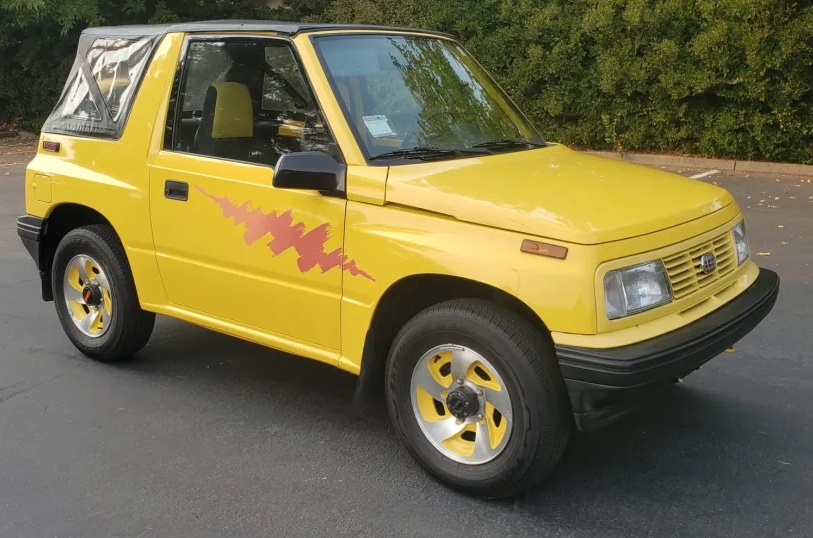
The first generation Geo Tracker is the most recognizable iteration, defined by its angular, “retro-cool” aesthetic. It shared its chassis and mechanical components with the Suzuki Sidekick, featuring a ladder-frame construction, solid axles, and a high tCOG (center of gravity), though it was wider and more stable than the Samurai.
1989–1995: The “Square” Body
The early models (1989–1995) featured a distinct boxy design. They were offered in two body styles: a 2-door convertible and a 3-door hardtop (hatchback).
- Engine: Initially powered by a 1.6-liter SOHC inline-4 carbureted engine (G16A), producing a modest 80 horsepower. In 1991, fuel injection was added, bumping horsepower to 95.
- Drivetrain: The vehicle was offered in both Rear-Wheel Drive (2WD) and Four-Wheel Drive (4WD) configurations. The 4WD system was a part-time system operated by a manual floor shifter, engaging the front wheels for off-road use.
Trim Levels and Models (1989–1995):
- Base (1990–1995): The entry-level model. It was spartan, featuring vinyl seating, manual windows, manual locks, and a manual transmission. It rode on 13-inch steel wheels. However, even the base model came with a surprisingly generous standard package that included a fold-down tailgate and a rear window defroster (on hardtops).
- LS (1990–1995): The mid-tier trim. The LS added significant comfort features, including cloth upholstery, a center console, and optional automatic transmission. It also featured upgraded interior trim and body-side moldings. The LS was often the bridge between utilitarian and comfortable.
- LTS (1990–1994): The “Luxury Touring Sport.” This was the top-tier trim, often compared to the Suzuki Sidekick JX. It included almost every available option: power windows, power locks, power mirrors, a tachometer, an upgraded stereo, and alloy wheels. The LTS was the “posh” off-roader.
- Tracker “T-Top” (1991–1994): A special edition of the convertible, the T-Top featured removable glass panels above the driver and passenger, offering an open-air experience without the full wind buffeting of a full convertible.
1995–1998: The “Facelift” Era
In late 1994, for the 1995 model year, the Geo Tracker received a significant aesthetic update, though the mechanicals remained largely unchanged. The square edges were smoothed over into rounded contours, giving it a more modern, SUV-like appearance rather than a utilitarian truck look.
Exterior Changes:
- The front fascia was updated with a more aerodynamic hood and a grille that integrated better with the body.
- The headlights became flush-mounted and larger.
- The taillights were reshaped to wrap around the rear fenders.
- The spare tire was moved from the rear swing-away carrier (on hardtops) to an undercarriage mount, cleaning up the rear profile.
Trim Levels (1995–1998):
GM streamlined the naming convention slightly during this period to align with the Chevrolet branding (the Geo division was being phased out).
- Base/2WD: Offered primarily as a 2-door convertible or hardtop with the 1.6L engine. It remained the budget-friendly option.
- LS: The popular choice, available with 2WD or 4WD. It now included the rounded aesthetic updates and optional automatic transmission.
- LTS: Continued as the premium trim, featuring full power amenities and alloy wheels. By 1997, the LTS included a digital dashboard cluster on certain models.
- Conversion Models (1996–1998): In the later years, independent coachbuilders (like ASC) created “Dakar” editions. These were often LS or LTS models converted into 4-door vehicles. While rare, they were factory-supported conversions, stretching the wheelbase to accommodate a second row of seating, making the Tracker a family vehicle.
The “Chevrolet” Era and the End of Production
In 1998, GM officially dissolved the Geo brand. All Geo vehicles were re-badged as Chevrolets. The Tracker became the Chevrolet Tracker for the 1999 model year.
However, the writing was on the wall. The market was shifting. The compact SUV segment was becoming crowded with competitors like the Honda CR-V, Toyota RAV4, and Ford Escape. These competitors offered unibody construction (softer ride), more interior space, and advanced safety features.
The Geo/Chevrolet Tracker, while capable off-road due to its truck-like frame, suffered from a cramped interior, a noisy cabin, and a relatively primitive suspension on pavement. By 1998, the design was nearly a decade old.
Production of the Geo/Chevrolet Tracker in North America ceased in 1998. GM and Suzuki parted ways in North America regarding this model, though they continued to collaborate in other markets. The final North American Tracker was the 1998 model year, sold as a 1999 Chevrolet Tracker.
Technical Specifications and Performance
Throughout its lifecycle, the Tracker underwent minor mechanical changes:
- Engine Evolution:
- 1989–1990: 1.6L SOHC Carburated (80 hp).
- 1991–1995: 1.6L SOHC Multi-Point Fuel Injection (95 hp). Torque was approximately 97 lb-ft.
- 1996–1998: 2.0L V6 option introduced (briefly). Correction: Actually, the 1990-1998 4-cylinder remained the 1.6L. In 1996, a 2.0L V6 was offered for a short time in the Chevrolet version, but it was complex and expensive. The primary engine remained the 1.6L inline-4. In 1999 (Chevy only), the engine was bored out to a 2.0L inline-4 (127 hp).
- Transmission:
- 5-speed Manual (Standard on all trims except Base 2WD automatic).
- 3-speed Automatic (Optional on LS/LTS). The 3-speed auto was notoriously dated by the mid-90s, hurting highway fuel economy.
- Drivetrain:
- 2WD: Rear-wheel drive, highway tires.
- 4WD: Part-time shift-on-the-fly transfer case. Low range gearing was 2.30:1 (early models) or 2.60:1 (later models), providing excellent crawling ability for off-roading.
- Suspension:
- Front: Independent double-wishbone with coil springs.
- Rear: Leaf springs (solid axle). This setup provided durability for off-roading but resulted in a bouncy ride on paved roads compared to competitors with coil-spring rear suspensions.
Market Position and Cultural Impact
The Geo Tracker was marketed heavily toward younger demographics. Commercials featured active lifestyles: mountain biking, camping, and beach cruising. It was marketed as “The Vehicle That Can Go Anywhere.”
The Tracker’s success was bolstered by its affordability. In the early 90s, a fully loaded LTS convertible could be purchased for under $15,000. This undercut the Jeep Wrangler and the Toyota 4Runner significantly.
The convertible model, in particular, became an icon. It offered the thrill of a Jeep Wrangler or Land Rover Defender but with a tighter seal against the elements and a more refined interior. The “T-Top” models were especially popular in sunny climates like California and Florida.
However, the vehicle was not without controversy. Like the Suzuki Samurai, the Tracker had a high center of gravity. While it performed better in IIHS (Insurance Institute for Highway Safety) tests than the Samurai, it was still prone to tipping if driven aggressively in turns, particularly the convertible models with less structural rigidity.
Future Outlook: The Legacy
The Geo Tracker has seen a resurgence in interest in the 2020s, similar to the “YJ” Jeep Wrangler and the original Toyota RAV4. As the automotive world pivots toward massive, heavy electric SUVs and crossovers, the lightweight, analog nature of the Tracker appeals to a new generation.
Current Status:
- Collector Market: Pristine, low-mileage 1990–1994 Geo Tracker Convertibles (especially in bright colors like Electric Blue, Sunburst Red, or Kahiki Tan) command high prices on the used market. They are considered “cult classics.”
- Aftermarket Support: Because the Suzuki Sidekick continued internationally long after the Geo Tracker died (until 2015 in some markets), parts availability remains surprisingly good. Companies like Rocky Road Outfitters offer suspension lifts, roof racks, and armor, allowing modern owners to build capable overland vehicles on the Tracker platform.
The “New” Tracker: It is important to note a naming revival. In 2015, Suzuki released the Vitara (a crossover SUV) and sold a rebadged version in India as the Chevrolet Tracker. In 2020, GM launched the Chevrolet Tracker (based on the Buick Encore GX platform) for the Chinese and Latin American markets. However, this vehicle is unrelated to the original—it is a unibody, front-wheel-drive crossover with no mechanical or design lineage to the 1990s square-nosed icon.
Conclusion
The Geo Tracker’s production run from 1989 to 1998 was relatively short, but its legacy is enduring. It democratized off-roading. Before the Tracker, open-air motoring was largely the domain of expensive roadsters or rough military-surplus Jeeps. The Tracker made it accessible to the average consumer.
It represented a perfect convergence of Japanese reliability, American marketing, and utilitarian design. While it eventually succumbed to the march of automotive progress—being replaced by more modern, comfortable crossovers—the original Geo Tracker remains a beloved icon of the 90s. For those who owned one, the distinct sound of the manual transmission engaging 4WD and the feeling of the canvas top being rolled back remains a nostalgic benchmark for adventure. Today, on the used market, it stands as a testament to an era when cars were simpler, lighter, and perhaps, a little more fun.