The Scuderia’s Return to Glory: The Evolution of the Ferrari 499P Le Mans Hypercar
In the annals of motorsport, few announcements have ever resonated with the seismic intensity of Scuderia Ferrari’s return to the FIA World Endurance Championship (WEC) in 2023. For decades, the world’s most famous Prancing Horse had dominated Formula One, but it had been absent from the pinnacle of endurance racing—Le Mans—since the legendary 333 SP retired in 1999.
The vehicle that orchestrated this return is the Ferrari 499P. It is not merely a car; it is a technological marvel designed under the hyper-regulated, performance-balanced rules of the Le Mans Hypercar (LMH) class. Since its unveiling, the 499P has defied expectations, winning on its debut at the 24 Hours of Le Mans and challenging the established order of prototypes.
This article explores the technical evolution, racing pedigree, and competitive history of the Ferrari 499P from its inception to the present day.
Part I: The Genesis (2020–2022)
The Regulatory Landscape To understand the 499P, one must understand the LMH regulations introduced by the Automobile Club de l’Ouest (ACO) and the Fédération Internationale de l’Automobile (FIA). These rules were designed to control costs while allowing diverse manufacturers to compete. They mandated a closed cockpit, a specific weight limit (approx. 1,030 kg), and a maximum power output of 500 kW (671 hp). Crucially, the rules allowed for hybrid all-wheel-drive systems, a feature Ferrari chose to utilize.
The Decision to Return In late 2020, Ferrari announced its intention to return to the top class of endurance racing. This was a factory-backed effort, distinct from the privateer GT teams that had carried the Ferrari banner for decades. The project was shrouded in secrecy, codenamed “Project 191,” a tribute to the year the Scuderia was founded.
Development and Testing The 499P’s development was rapid. By 2021, prototypes were testing at Ferrari’s Fiorano test track. The car’s architecture was unique among the LMH grid. While competitors like Toyota and Peugeot opted for bespoke V6 and V8 engines respectively, Ferrari looked to its road car lineage, selecting a 3.0-liter twin-turbo V8—a derivative of the engine found in the 296 GT3 and SF90 Stradale—mated to a hybrid system.
The chassis was a brand-new carbon-fiber monocoque developed in-house by Ferrari’s Corse Clienti division, distinct from the F1 team’s operations but utilizing the same rigorous manufacturing standards.
The Unveiling: January 2023 On February 17, 2023, at the Ferrari Museum in Maranello, the 499P was officially revealed. The name itself was significant:
- 499: Denotes the engine displacement in cubic centimeters per cylinder (499cc x 5 cylinders = 2.99 liters), adhering to the “500cc rule” tradition in Ferrari’s engine nomenclature (seen previously in the 312B and 312T).
- P: Stands for Prototipo, the designation for Le Mans prototypes.
Part II: Technical Specifications and Design
The Ferrari 499P is a “hybrid hypercar” that marries cutting-edge aerodynamics with Ferrari’s road-car philosophy.
The Powertrain
- Internal Combustion Engine (ICE): A 90-degree twin-turbocharged V8. It is highly efficient, running at temperatures optimized for endurance reliability rather than peak qualifying power.
- Electric Motor: An electric motor is integrated into the front axle, providing all-wheel-drive capability. This system is active during acceleration only (limited to 270 km/h) to prevent the car from becoming a “quattro” on all corners, which would violate the Balance of Performance (BoP).
- Total Output: Initially capped at 671 hp (500 kW), the BoP adjusts this figure race-by-race to equalize performance against rivals.
- Battery: A 1.74 kWh battery pack sits low in the chassis for center of gravity optimization. The energy is recovered via braking and is deployed in short, aggressive bursts out of corners.
Aerodynamics The 499P features a highly sculpted body with active aerodynamics. The rear wing is massive but designed to minimize drag on the Mulsanne Straight at Le Mans. The car features “S-duct” channels at the front to reduce pressure buildup, a feature derived from Ferrari’s F1 experience.
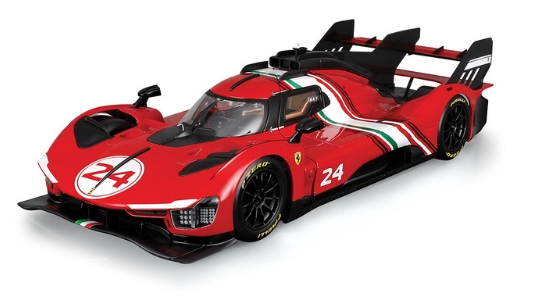
Livery and Trim Levels Unlike road cars, the 499P does not have “trim levels” (like LX, EX, or Sport). However, it does have distinct visual identities based on the racing team and year of competition. These are effectively the “models” of the 499P on track:
- The #51 and #50 Factory Cars (2023-2024):
- These are the primary factory-run vehicles under the Ferrari AF Corse banner.
- Visuals: They feature the classic Rosso Corsa (Racing Red) with prominent white stripes and the number plates in white circles.
- Trim Differentiation: The #51 (piloted by Alessandro Pier Guidi, James Calado, and Antonio Giovinazzi) is often the benchmark car, having won Le Mans in 2023. The #50 (Antonio Fuoco, Miguel Molina, and Nicklas Nielsen) serves as the sister car.
- The #83 Factory-Affiliated Car (2023-2024):
- A third factory-supported car entered by AF Corse.
- Visuals: Distinguished by a striking yellow and red livery (reminiscent of the Yellowbird), featuring prominent Chinese sponsorship.
- Trim: Designed to appeal to a global audience and support the 24 Hours of Le Mans entry list.
- The Glickenhaus and Privateer Variants (Rumored/Conceptual):
- While there are no official privateer 499Ps currently racing (unlike the GT3 296s), Ferrari has sold customer 499Ps to private teams for the 2024/2025 season (such as the Vista Wealth Management team). These cars are mechanically identical but carry unique, non-Ferrari factory liveries (often blue, gold, or black).
Part III: The Racing Evolution (2023–Present)
The 499P’s history is short but dense with success. Here is the chronological evolution of its competitive performance.
2023: The Dream Debut The 2023 season was the 499P’s rookie year, and expectations were measured.
- Sebring 6 Hours: The car’s WEC debut. The #51 car qualified on pole but suffered a hybrid system failure early in the race. However, the #50 car finished 2nd, proving the chassis was competitive.
- Monaco & Spa: The cars showed flashes of speed but struggled with reliability and Balance of Performance (BoP) adjustments, which handicapped the Ferrari with less fuel allowance compared to Toyota.
- The 24 Hours of Le Mans (June 2023): This was the defining moment. The #51 Ferrari 499P, driven by Pier Guidi, Calado, and Giovinazzi, drove a masterful race. In the final 30 minutes, Pier Guidi executed a historic overtake on the leading Toyota GR010 Hybrid at the Dunlop Chicane to take the lead. Ferrari secured a 1-2 finish on the car’s very first attempt at Le Mans, ending Toyota’s winning streak.
2024: Refinement and Resilience For the 2024 season, the 499P underwent homologation updates and software revisions.
- Performance Upgrades: Ferrari introduced updates to the hybrid mapping and suspension geometry to improve tire wear—a weakness in 2023.
- Season Opener (Qatar): The BoP was adjusted to slow the Ferrari slightly, but the car remained competitive. The #51 car finished 2nd after a penalty.
- Imola and Spa: The 499P demonstrated superior straight-line speed, a hallmark of the Ferrari aerodynamic package. The #50 car secured a podium at Imola, showing the team’s home-race dominance.
- Le Mans 2024: The #51 car aimed for back-to-back wins but was involved in an accident during heavy rain, ending its race early. The #50 car finished on the podium (3rd), proving the car’s durability despite the changing conditions.
Current Status (2025 Season Outlook) As of the 2025 season, the Ferrari 499P remains the primary challenger to the dominant Toyota and the rising Porsche and BMW LMH entries. The car has evolved from a “rookie” surprise into a mature, championship-contending machine.
.
THIS might be a great place to get your new car from!
Or for those who are into the “car flipping” business, here’s an excellent resource for you!

.
Part IV: Technical Evolution and Updates
While the 499P has not undergone a full model year change (like a road car), it has seen continuous development through “Evolution” packages, typical in motorsport.
- The Gearbox: The 499P utilizes a transverse gearbox, a departure from the longitudinal gearboxes used by many competitors. In 2024, Ferrari introduced reinforced gear teeth to handle the increased torque of the hybrid system without adding significant weight.
- Tire Management Software: One of the biggest evolutions has been in the Electronic Control Unit (ECU). Ferrari developed a proprietary software update in late 2023 that better balances the torque delivery from the front electric motor to the rear V8, specifically to reduce understeer in medium-speed corners—a key factor in preserving tire life during stints.
- Hybrid Reliability: The initial 2023 car had intermittent issues with the front-axle kinetic energy recovery system (KERS). By 2024, the system was resealed and cooled more effectively, resulting in zero hybrid-related retirements in the first half of the 2024 season.
Part V: The “Road Legal” Question
A frequent question among enthusiasts is whether a road-legal version of the 499P exists or is planned. Ferrari has a history of creating “XX” models (like the FXX K) for wealthy track-day enthusiasts.
Current Status: As of 2025, there is no road-legal Ferrari 499P. The LMH regulations make converting the 499P to road use nearly impossible. The car lacks headlights, a windshield wiper, and the suspension travel required for public roads. Furthermore, the hybrid system is designed for track deployment, not street cruising.
However, Ferrari has signaled that the technology from the 499P—specifically the 3.0-liter V8 hybrid architecture—will trickle down to future road hypercars, likely influencing the replacement for the LaFerrari or a future halo car due around 2027-2028.
Part VI: The Competition
To appreciate the 499P’s evolution, one must view it in the context of its rivals:
- Toyota GR010 Hybrid: The benchmark. The Ferrari is the only car that consistently matches the Toyota’s top speed.
- Peugeot 9X8: Ferrari’s aerodynamic philosophy is similar to Peugeot’s (rearward-swept rear wing), but the 499P’s V8 is more compact than Peugeot’s V6.
- Porsche 963: While Porsche dominates the IMSA series, the Ferrari has proven superior in WEC’s specific Mulsanne configuration.
- Cadillac V-Series.R: The 499P and Cadillac have traded blows at Le Mans, with the Ferrari generally holding an aerodynamic advantage in the corners.
Part VII: Future Outlook
What does the future hold for the Ferrari 499P?
Regulatory Stability The LMH regulations are set to remain stable until at least the end of 2027. This means the 499P will not be replaced by a “500P” or similar until this cycle ends. The evolution will instead focus on reliability and aerodynamic fine-tuning.
Customer Racing Program Ferrari is slowly expanding the 499P program to privateers. Currently, only the factory AF Corse teams run the car. However, rumors persist of a “Clienti” program launching in 2026, allowing private teams to purchase 499Ps directly from Maranello, similar to the F1 Clients program.
Target: The 24 Hours of Le Mans The 499P was built for one reason: Le Mans. Having won in 2023, the goal for 2025 and beyond is consistency. The car has proven it has the raw speed; the evolution now lies in the team’s strategy and the car’s ability to survive 24 hours of relentless punishment without mechanical failure.
Conclusion
The Ferrari 499P is more than just the sum of its carbon fiber and electronics. It represents the reclamation of a heritage. For 50 years, Ferrari’s endurance legacy was frozen in time, preserved in the memories of the 312 PB and the 333 SP. The 499P thawed that legacy instantly.
In a mere two years of production and competition, the 499P has evolved from an unknown quantity into a Le Mans winner and a perennial contender. It marries the brute force of a twin-turbo V8 with the precision of electric all-wheel drive, wrapped in a design that is unmistakably Ferrari.
As the 2025 season unfolds, the 499P stands as a testament to Maranello’s ability to adapt. It is a bridge between the past and the future, proving that even in the hybrid era, the Prancing Horse can still gallop at the front of the pack.