The Storm Petrel: How the Jaguar XK120 Redefined the Post-War Grand Tourer
In the autumn of 1948, the automotive world gathered at the Earls Court Motor Show in London. The industry was still reeling from the devastation of World War II, with rationing still in effect in Britain and production lines struggling to pivot from military hardware to consumer goods. Into this austere atmosphere drove a vision of chrome, leather, and speed: the Jaguar XK120.
Seventy-five years later, the XK120 remains a singular achievement in automotive history. It was not merely a car; it was a statement of intent. It announced that Britain was back, and that the future of motoring would be fast, beautiful, and technologically advanced. This article explores the evolution of the Jaguar XK120, tracing its journey from a limited-production hand-built show car to the world’s fastest production vehicle, and its eventual transformation into a racing legend.
The Genesis: A Show Car That Demanded Production
The story of the XK120 begins not with a sketch of a sports car, but with an engine. During the war, Jaguar (then known as SS Cars Ltd) had been developing a new twin-cam, inline-six engine for military use. By 1944, with victory in sight, company founder William Lyons turned his attention to civilian applications. He envisioned a new engine that would be smooth, powerful, and durable—perfect for a luxury saloon.
However, the design team, led by William Heynes (chief engineer) and Walter Hassan (engineer), created an engine that was too good to be hidden under the hood of a sedan. The 3.4-liter XK engine featured hemispherical combustion chambers and twin overhead camshafts, technologies that were cutting-edge at the time. It produced 160 brake horsepower (bhp), a remarkable figure for a 3.4-liter engine in 1948.
Lyons decided to showcase this engine in a new sports car. The design was entrusted to a young aerodynamicist named Malcolm Sayer. Unlike the flowing, hand-sculpted curves of rivals like Aston Martin or Ferrari, Sayer used principles of aerodynamics derived from his work on aircraft fuselages. He calculated the car’s shape mathematically, resulting in a teardrop profile that was both functional and strikingly modern.
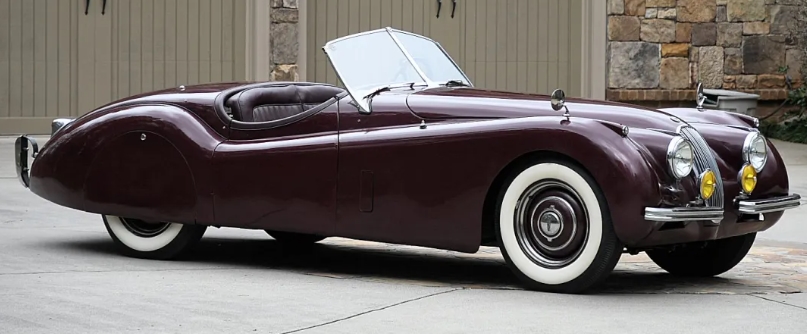
When the prototype XK120 was unveiled at Earls Court, the reaction was overwhelming. The public expected a conservative tourer; they were greeted with a low-slung, aggressive machine featuring a distinctive upright grille and wire wheels. William Lyons, intending only to build 200 units to secure homologation for racing, was forced by the public response to put the car into full production.
.

.
The Early Years: The Aluminum Hand-Builds (1948–1950)
Because the XK120 was originally intended as a limited run, the early cars were constructed using labor-intensive methods that would soon become obsolete.
- Production Years: November 1948 – 1950
- Body Material: Aluminum over a ash wood frame
- Chassis Configuration: Ladder frame with independent front suspension and a live rear axle.
The Open Two-Seater (OTS) The initial model was strictly an open-top roadster. These early “Aluminum Bodies” are the most coveted by collectors today. They featured a flat dashboard, 16-inch wire wheels, and a distinct lack of weather protection. The interior was spartan but luxurious, finished in high-quality leather. Because the body panels were hand-formed, tolerances varied, and panel gaps were inconsistent—a hallmark of craftsmanship rather than mass production.
The Fixed Head Coupe (FHC) In 1949, Jaguar introduced the Fixed Head Coupe. While the roadster was the romantic ideal, the coupe offered a permanent roof, better visibility, and a more rigid chassis. It retained the same aluminum construction but featured a lower roofline that emphasized the car’s sleek profile. The coupe was often considered the best-looking of the XK120s, balancing the long hood with a fastback rear that echoed the aerodynamic theories of Malcolm Sayer.
The Drophead Coupe (DHC) Also introduced in 1949, the Drophead Coupe offered a compromise between the open OTS and the closed FHC. It featured a power-operated soft top that tucked away behind the rear seats, along with roll-up windows and side doors (unlike the OTS, which often had sliding side curtains). The DHC was the most luxurious of the early cars, often specified with wind-up windows and better insulation.
The Transition: The Steel Bodies (1950–1954)
By 1950, the demand for the XK120 had outstripped Jaguar’s ability to hand-form aluminum bodies. Furthermore, aluminum was in short supply and expensive to work with. Jaguar switched to a more conventional manufacturing process: pressed steel bodies built by the Pressed Steel Company. This transition marked the XK120’s shift from a boutique sports car to a mass-produced grand tourer.
While the external dimensions remained largely the same, the steel bodies were more rigid and easier to repair. The interior also saw upgrades, moving from the early flat dashboards to a more ergonomic design with a full set of Jaeger instruments.
The XK120 SE (Special Equipment) In 1951, Jaguar introduced the XK120 SE. This was not a separate model but a trim level that signaled the car’s growing performance focus. The SE featured:
- Higher Compression Ratio: Raised from 7.0:1 to 8.0:1, boosting power from 160 bhp to 180 bhp.
- Dual Exhausts: A visual and auditory signature of the performance models.
- Racing Camshaft: Available as an option, pushing output to nearly 200 bhp.
- Badging: Distinct “SE” scripts on the bonnet and boot lid.
The SE quickly became the model to own. It was capable of sustaining speeds well over 100 mph for hours, making it the ultimate Autobahn stormer of its era.
The Competition Models: The C-Type and the “Lightweight”
While the road-going XK120 evolved, its racing counterpart underwent a radical transformation. To compete at Le Mans, Jaguar needed to reduce weight and improve aerodynamics.
The Jaguar C-Type (1951–1953) The C-Type (for Competition) was essentially an XK120 stripped of its road car skin and clothed in a lightweight, aerodynamic aluminum shell designed by Malcolm Sayer. It utilized the XK120’s engine and suspension but featured a tubular space frame chassis.
- Performance: The C-Type won Le Mans in 1951 and 1953.
- Evolution: The 1953 C-Type introduced disc brakes to motorsport, a technology that would soon become standard on all cars.
The XK120 “Lightweight” (1952) For privateer racers who couldn’t afford a full C-Type, Jaguar produced a limited run of approximately 25 “Lightweight” XK120s. These cars featured aluminum body panels (reverting from the steel production cars), a stripped-out interior, and the high-output “SE” engine. These are the direct ancestors of the modern “factory lightweight” cars and are incredibly rare today.
The Late Models: The M-Cage and the End of an Era (1953–1954)
As the XK120 reached the end of its lifecycle, Jaguar made continuous improvements to keep it competitive against the likes of the Mercedes-Benz 300SL and the Ferrari 250 GT.
The M-Cage In 1953, Jaguar introduced a modification to the rear suspension, known as the “M-Cage” (named after Moss, the gearbox manufacturer, though it was a suspension improvement). This device improved the rear axle location, reducing axle tramp (wheel hop) under hard acceleration. This was a critical upgrade for the increasingly powerful cars.
The 1954 Model Year The final year of XK120 production saw the introduction of the 3.4-liter engine with 8.0:1 compression as standard on all models (previously only on the SE). The cars were now capable of 125 mph in stock form. By this time, the XK120 was aging; the chassis design, dating back to the pre-war SS 100, was reaching its limits.
In the summer of 1954, the last XK120 rolled off the production line. It had been replaced by the Jaguar XK140, which featured a revised engine, better brakes, and a more spacious interior.
Technical Specifications and Performance
To understand the XK120’s dominance, one must look at the numbers.
- Engine: 3.4-liter (3442cc) DOHC Inline-6
- Valvetrain: Twin camshafts, 12 valves
- Carburetion: Twin SU carburetors (standard); triple Weber or Stromberg carbs (racing)
- Transmission: 4-speed manual (Jaguar synchromesh on top three gears). Overdrive was a popular option.
- Top Speed: The “120” in the name was a promise. In 1949, a stock XK120 roadster, driven by Stirling Moss and Norman Dewis on the Jabbeke highway in Belgium, officially recorded a two-way average speed of 126.4 mph (203 km/h). With the windscreen down and a fairing behind the headrest, it hit 132 mph.
- 0-60 mph: Approximately 8.0 seconds for the early OTS, dropping to around 7.0 seconds for the later SE models.
Ownership Experience and The “Jaguar grin”
Driving an XK120 today is a visceral experience. The steering is heavy (unassisted) and the brakes require a firm foot (drum brakes were standard until disc brakes became an option in 1952). The gearshift is long-throw but precise.
However, these mechanical quirks are overshadowed by the engine. The XK unit is one of the greatest internal combustion engines ever built. It is silky smooth at low revs but develops a metallic snarl as it approaches its 5,000 rpm redline. The torque is abundant, allowing the driver to pull away in high gear at little more than idle speed.
The cabin is intimate. The seats are low, the steering wheel is large, and the dashboard is a sea of chrome bezels. The smell of leather and Castrol R oil (a common lubricant for the era) permeates the cabin. It is a car that demands engagement; you don’t just drive an XK120, you wrestle with it, listen to it, and eventually, dance with it.
Racing Pedigree
The XK120’s competition history is vast. In 1950, three XK120s were entered in the Le Mans 24 Hours. While they did not finish, they showed promise. The following year, the C-Type (derived from the XK120) won.
However, the road-going XK120s were also successful in their own right. They dominated the SCCA (Sports Car Club of America) races in the United States. Drivers like Phil Hill and Bob Sharp piloted XK120s to victories against Ferrari 250 MM and Mercedes-Benz 300 SLs. The car’s long wheelbase made it stable at high speeds, and the robust engine could withstand hours of abuse.
Market Evolution and Collectibility
When new in 1948, an XK120 cost approximately £1,000 ($4,000 USD at the time). Today, the market is stratified based on model and condition.
- The Aluminum Bodies (1948–1950): These are the “Holy Grail” of the XK range. Values for pristine examples can exceed $300,000. Their rarity and hand-built nature make them museum pieces.
- The Steel OTS (1950–1954): The most common model, yet still highly desirable. Prices generally range from $80,000 to $150,000 depending on restoration quality.
- The Fixed Head Coupe: Often undervalued compared to the roadsters, offering the best driving dynamics and aesthetics for the price. Good examples can be found in the $70,000–$120,000 range.
- The Drophead Coupe: The rarest of the steel-body models, often commanding a premium over the FHC due to its open-air versatility.
Restoration and Parts Availability
One of the XK120’s greatest strengths is the support network. Unlike obscure marques, the XK120 benefits from a massive global community. The Jaguar Drivers’ Club and the Jaguar Enthusiasts’ Club provide resources, and nearly every mechanical part—from pistons to door handles—is available through specialists like SNG Barratt or Classic Jaguar.
Restoration is a significant undertaking. A full “body-off” restoration can cost upwards of $100,000, but the result is a car that is mechanically superior to how it left the factory, thanks to modern metallurgy and machining techniques.
Future Outlook
As the automotive world pivots toward electrification and autonomous driving, the XK120 stands as a monument to the analog era. Its future is secure in the hearts of collectors, but its role is changing.
The Electric Conversion Debate A growing trend in the classic car world is the EV conversion. Several companies now offer “E-Type” and XK conversions, replacing the inline-six with electric motors. While this offers reliability and instant torque, purists argue that it strips the car of its soul. The XK120 is defined by its engine; removing the mechanical symphony of the DOHC six changes the car’s fundamental character. For now, originality remains the gold standard, but as emissions zones tighten in European cities, electric conversions may become a practical necessity for some owners.
The Generational Shift The XK120 is transitioning from a “drivable classic” to a “showpiece.” As values rise, fewer owners are willing to risk stone chips on public roads. However, the rise of “gentleman driver” events—such as the Goodwood Revival and the Mille Miglia—ensures that these cars are still exercised. They are not static museum exhibits; they are living history.
Conclusion
The Jaguar XK120 was a car born of post-war optimism and engineering brilliance. It took the aerodynamic theories of the aircraft industry and applied them to the road, wrapped in a package that offered performance previously reserved for racing cars. It evolved from a hand-built curiosity to a steel-bodied production car, from a road tourer to a Le Mans winner.
Today, the XK120 remains a benchmark for what a sports car should be: a perfect synthesis of beauty, sound, and speed. It proved that a car could be both a work of art and a precision instrument. As we look toward a future of silent, autonomous vehicles, the XK120 reminds us of the joy of mechanical engagement—the thrill of a revving engine, the feel of a leather-wrapped wheel, and the open road ahead. It is not just a piece of history; it is a timeless icon.