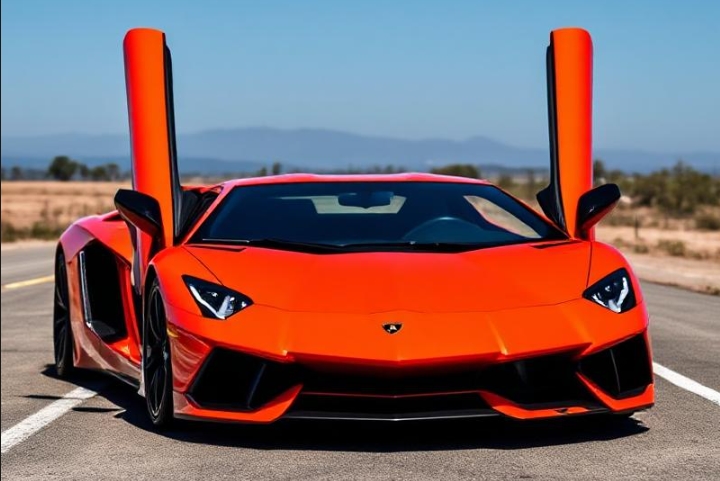
The Swedish Singularity: The Evolution and Legacy of the Koenigsegg Regera
In the pantheon of hypercars, few vehicles manage to bridge the gap between raw mechanical terror and serene, electric luxury. The Koenigsegg Regera is one such machine. Debuting in 2015, the Regera was not merely a new model for the Swedish boutique manufacturer; it was a technological manifesto. It represented a radical departure from the traditional combustion-only lineage of its predecessor, the Agera, and introduced a powertrain architecture that challenged the very definition of a supercar.
To understand the evolution of the Regera, one must look beyond a simple timeline of production years. The Regera’s lifecycle was not defined by annual facelifts or drastic trim changes, but rather by a relentless pursuit of a singular goal: to create the world’s fastest, most powerful, and most luxurious hybrid grand tourer.
The Genesis: A Hybrid Vision (2015)
The Regera made its global debut at the 2015 Geneva Motor Show. The name “Regera,” a Swedish verb meaning “to reign” or “to rule,” was a bold declaration of intent. At the time, the industry was grappling with the viability of electrification. While competitors like Ferrari and Porsche were utilizing hybrid systems for torque-fill and efficiency, Koenigsegg founder Christian von Koenigsegg envisioned a different application: sheer, unadulterated acceleration.
The standard Regera was powered by a twin-turbocharged 5.0-liter V8 engine, derived from the Ford Mustang GT but heavily modified by Koenigsegg. This engine alone produced 1,100 horsepower. However, the true magic lay in its integration with three electric motors: one on the crankshaft and two on the rear axle. Combined, the system generated a staggering 1,500 horsepower and 1,475 lb-ft of torque.
The defining feature of the Regera’s evolution was its transmission. Koenigsegg abandoned the traditional dual-clutch transmission (DCT) used in the Agera. Instead, they developed the KDD (Koenigsegg Direct Drive). This system removed the gearbox entirely, replacing it with a hydraulic coupling and a single gear ratio. The electric motors provided low-speed maneuverability and instant torque, while the combustion engine took over at higher speeds. This reduced weight and mechanical complexity, creating a powertrain that was both brutally efficient and surprisingly smooth.
The Production Era: Limited Exclusivity (2016–2022)
Koenigsegg announced that the Regera would be strictly limited to 80 units globally, a number chosen to maintain exclusivity while allowing for a viable production run. Unlike mass-market manufacturers, Koenigsegg does not operate on model years in the traditional sense. Instead, the Regera evolved through a continuous process of refinement and bespoke customization.
The Early Builds (2016–2017) The first customer deliveries began in late 2016. Early units were focused on validating the KDD system and the thermal management of the hybrid components. These models featured the standard Regera configuration: a fixed rear wing (unlike the active wing of the Agera RS) and a focus on aerodynamic drag reduction rather than extreme downforce. The interior of these early models was a showcase of Swedish craftsmanship, featuring diamond-stitched leather, carbon fiber exposed surfaces, and the proprietary infotainment system.
The Evolution of Aerodynamics and Cooling (2018–2019) As customers began to push the Regera to its limits, Koenigsegg introduced subtle but crucial updates. While the exterior silhouette remained unchanged, the engineering team focused on cooling and aerodynamic stability.
A significant development during this period was the introduction of more aggressive aerodynamic packages available as options. While the standard Regera was designed for high-speed stability rather than track dominance, Koenigsegg offered the “Regera Hard Core” specification. This was not a separate trim level sold as a base model, but rather a package that customers could opt for. It included lightweight carbon fiber seats, removal of some luxury sound-deadening material, and a focus on weight reduction to improve the power-to-weight ratio.
Furthermore, Koenigsegg began offering extended lower side skirts and a reworked front splitter to manage the airflow around the wide rear tires more effectively. These updates were driven by data gathered from the initial fleet of vehicles.
The Apex: The “Ghost Squadron” and Bespoke Iterations (2020–2022) By 2020, the Regera had cemented its status as a collector’s item. Production was steady but slow, dictated by the painstaking hand-assembly process in Ängelholm, Sweden. During this period, the “evolution” of the Regera was less about mechanical changes and more about the expression of its owners.
Koenigsegg introduced the “Ghost Squadron” livery, a throwback to the company’s early days, which became a popular option among buyers. However, the most significant “trim” developments were bespoke commissions. Because Koenigsegg operates on a low-volume, high-customization model, no two Regaras were exactly alike.
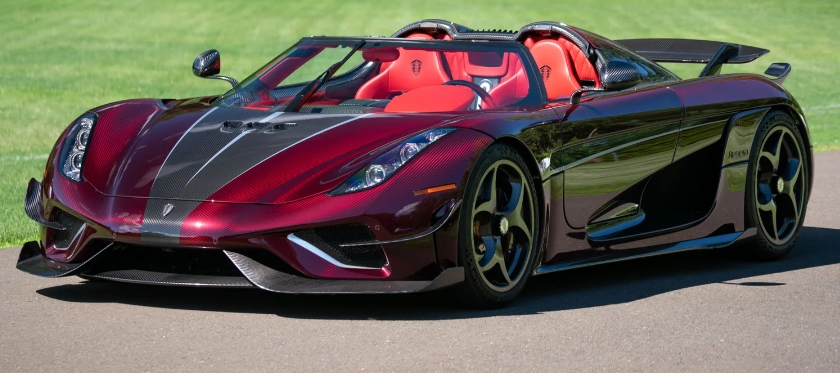
For example, specific iterations featured exposed carbon fiber in unique weaves (such as the “Blue Carbon” or “Trevor” carbon patterns), custom gold leaf applications, and interior color palettes ranging from minimalist black to vibrant yellows and blues. While the mechanical specifications remained consistent—1,500 horsepower—the visual and material evolution of the car was vast.
One notable development was the refinement of the battery pack. Early Regeras utilized a 4.5 kWh lithium-ion battery. While the capacity did not change significantly throughout the production run, the battery management software and thermal conditioning systems were updated in later builds to improve durability and consistency during high-performance runs.
.

.
Technical Mastery: The KDD and Powertrain
The core evolution of the Regera lies in the refinement of its Direct Drive system. Traditional hypercars rely on gear shifts to keep the engine in its power band. The Regera, however, uses the electric motors to fill the torque gap between the engine’s rev range and the single gear ratio.
In “Regera mode,” the car accelerates from 0 to 60 mph in 2.8 seconds, but the true spectacle begins at higher speeds. From 50 mph to 186 mph (300 km/h), the Regera is unmatched, often completing the sprint in under 10 seconds—faster than a Formula 1 car. This capability was a result of continuous software tuning. The throttle mapping became more aggressive in later models, sharpening the response of the electric motors to match the spooling turbos.
The Regera in Context: Agera vs. Regera
To understand the Regera’s place in Koenigsegg’s history, one must contrast it with the Agera RS, which was produced concurrently for a time. The Agera RS was the track-focused weapon, featuring a DCT, active aerodynamics, and higher top speed capabilities (holding the production car top speed record at 277.9 mph). The Regera, conversely, was the “hyper-GT.” It prioritized acceleration, luxury, and a more isolated driving experience.
As the Agera line concluded in 2018, the Regera remained the sole combustion-hybrid flagship until the arrival of the Jesko in 2020. However, the Regera did not bow out; it continued production alongside the Jesko, serving a different niche. While the Jesko focused on high-revving, multi-gear performance, the Regera remained the king of low-end to mid-range violent acceleration.
The End of Production and Legacy
In late 2022, Koenigsegg officially announced the completion of the Regera production run. The 80th and final unit was delivered in 2023. This marked the end of an era for the brand’s first hybrid production car.
The Regera’s evolution was unique because it was largely static in its core architecture but dynamic in its execution. There were no “Series 2” facelifts or engine displacements changes. Instead, the car evolved through software, aerodynamic tweaks, and an ever-expanding palette of bespoke materials. It proved that a hypercar could be electrically assisted without losing its soul, and that a single-speed transmission could outperform a seven-speed dual-clutch in a straight line.
Future Outlook
With the Regera now sold out, its future is one of appreciation and historical significance. It serves as a bridge between the analog era of the Agera and the future of Koenigsegg’s electric ambitions, such as the Gemera.
For owners, the Regera is a “blue-chip” asset. Its value has consistently appreciated, with examples often trading for well over their original $2 million price tag. Mechanically, the car is robust, but Koenigsegg has committed to supporting the Regera indefinitely, offering software updates and parts availability to ensure these vehicles remain operational for decades.
The Regera also paved the way for the Gemera, Koenigsegg’s upcoming 4-seater hypercar. The lessons learned from the Regera’s Direct Drive system and the integration of the Tiny Friendly Giant (TFG) engine are direct descendants of the Regera’s powertrain philosophy.
Conclusion
The Koenigsegg Regera was never just a car; it was a physics-defying experiment that happened to be street-legal. Its evolution from the debut model in 2015 to the final 80th unit in 2023 was a testament to the power of focused engineering. By eschewing the traditional multi-gear transmission in favor of a hybrid direct-drive system, Koenigsegg created a vehicle that remains, in many metrics, unmatched.
In the history of automotive evolution, the Regera will be remembered not for how it changed over time, but for how it changed the conversation around what a hybrid hypercar could be. It reigned, just as its name promised.