The Toyota Publica: A Pioneering Chapter in Compact Automotive History
In the annals of automotive innovation, the Toyota Publica holds a special place. As Toyota’s first small car designed for the mass market, the Publica not only symbolized the company’s ambition to compete on a global scale but also laid the groundwork for its rise as a leader in the automotive industry. Introduced in 1966, the Publica was a trailblazer in Japanese and international markets, blending affordability, practicality, and reliability in a compact package. This article delves into the history, design, trim levels, and legacy of the Toyota Publica, offering a comprehensive look at its significance and enduring influence.
Origins and Historical Context
The 1960s marked a pivotal era for Japanese automakers. As post-war economic growth spurred demand for personal transportation, companies like Toyota sought to expand their reach beyond luxury and commercial vehicles. The Publica emerged in 1966 as the successor to the Toyota Crown, which had positioned the brand as a producer of premium cars. However, the Publica was a different beast altogether: a no-frills, fuel-efficient commuter designed to appeal to the everyday buyer.
Toyota’s strategy was twofold. Domestically, the Publica aimed to capture the burgeoning Japanese market for small cars. Internationally, it was marketed under the “Corolla” name from the outset in 1966, a decision that would unify Toyota’s global brand identity. The Publica, as it was known in Japan, and the Corolla, abroad, shared the same platform and specifications, enabling Toyota to streamline production while tailoring branding to regional preferences. This dual naming strategy allowed the company to establish a presence in export markets without alienating local buyers who associated the Crown with luxury.
Production Years and Generations
The Toyota Publica was produced from 1966 to 1973, with a significant redesign in 1969 that extended its relevance amid evolving automotive trends. The model spanned two generations, each reflecting Toyota’s commitment to efficiency and gradual technological advancement.
- First Generation (1966–1969):
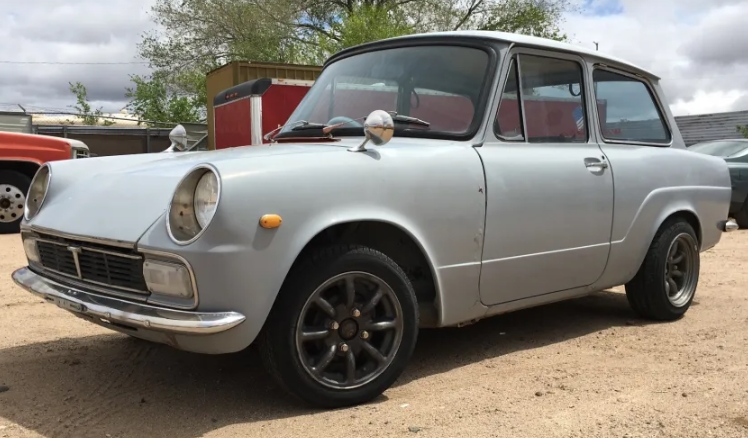
The original Publica debuted with a 974cc inline-four engine, producing 46 horsepower. It was paired with a 4-speed manual transmission, though a 3-speed automatic option was available for added convenience. The car’s boxy, upright design prioritized practicality, with a 2,200 mm wheelbase and a length of approximately 3.5 meters. Its fuel efficiency—around 15 km per liter—made it a hit in a market increasingly conscious of running costs. - Second Generation (1969–1973):
In 1969, Toyota updated the Publica with a larger 1,197cc engine, boosting power to 63 horsepower. This change coincided with the introduction of the Publica Wagon, a station wagon variant aimed at families and those needing extra cargo space. The new generation also featured improved suspension for better ride quality and minor aerodynamic tweaks to reduce drag. Despite these updates, the Publica retained its utilitarian charm, exemplified by its high-mounted windshield and upright seating position.
The Publica’s production in Japan officially ended in 1971, when the second-generation Corolla replaced it in the domestic market. However, in select international markets like Indonesia, Thailand, and the Middle East, the Publica (or Corolla) continued to be sold until 1973, reflecting its enduring appeal in regions where compact, durable vehicles were in demand.
.
NO MORE dead batteries with this:

.
Model Variants and Trim Levels
The Publica offered a range of models and trim levels to cater to diverse buyer needs. These included:
- Toyota Publica (Base Model):
The entry-level model featured simple, no-nonsense design. Cloth upholstery, a standard-speedometer, and mechanical simplicity characterized this version. It was ideal for budget-conscious buyers and urban commuters. - Toyota Publica Deluxe (1966–1971):
The Deluxe trim elevated the Publica’s appeal with features such as reclining front seats, a tachometer, and a basic radio as standard. Some variants also included a padded dashboard and improved interior materials, offering a more refined experience without sacrificing practicality. - Toyota Publica Wagon (1969–1973):
The station wagon variant was a response to growing family needs. With a rear hatch and extended cargo area, the Wagon retained the 1,197cc engine and added convenience features like a glovebox and fold-down rear seats. This model was particularly popular in markets like Australia and Southeast Asia, where space was a priority.
Design and Engineering Innovations
The Publica’s design was a product of its time, characterized by a high glass-to-body ratio, which enhanced visibility, and a lightweight frame that optimized fuel efficiency. Its dimensions—compact yet spacious enough for four adults—mirrored the Fiat 500 and Mini, but the Publica’s upright stance and boxy silhouette gave it a uniquely Japanese identity.
Technologically, the Publica was a minimalist’s dream. The 974cc and 1,197cc engines, though modest by today’s standards, were reliable and designed for longevity. The car’s independent front suspension and semi-independent rear setup balanced cost and comfort, while disc brakes on the front wheels (a rarity in its class at the time) boosted safety.
Global Market Presence
The Publica’s affordability and reliability made it a cornerstone in Toyota’s export strategy. In the UK, it was marketed as the Corolla and faced stiff competition from the Austin Mini and Hillman Imp. In Southeast Asia, its ruggedness and low maintenance costs made it a workhorse for small businesses. However, the Publica’s success was not universal; in the U.S., where larger cars dominated, it struggled to gain traction.
Despite these regional disparities, the Publica sold over 1 million units worldwide by 1971. Its export success fueled Toyota’s expansion into new markets and provided critical insights into global consumer preferences, shaping the development of future models like the Corolla and Celica.
Legacy and Future Outlook
The Toyota Publica was more than a car—it was a catalyst for change. By proving that a small, fuel-efficient vehicle could compete in a world dominated by American and European giants, the Publica helped establish Toyota as a global automotive leader. It also laid the foundation for the Corolla, which would go on to become the best-selling car in history.
Today, the Publica is a rare sight on roads, but it has gained cult status among classic car enthusiasts. Its utilitarian design and historical significance make it a prized find at vintage car shows and auctions. As electric vehicles and sustainability shape the future, the Publica’s emphasis on efficiency and simplicity resonates with modern principles—proving that innovation is not always about power and size.
Conclusion
The Toyota Publica may seem unassuming by today’s standards, but its impact on the automotive industry is profound. From its role in Toyota’s global expansion to its pioneering approach to compact design, the Publica embodies the spirit of Japanese ingenuity and resilience. As we look to the future, the lessons learned from this small yet revolutionary car remain timeless, reminding us that sometimes, the simplest solutions leave the biggest legacies.