The Trojan Horse: History of How a Tiny Isuzu Helped The Chevrolet LUV Conquer the Small Truck Market
In the landscape of American automotive history, the pickup truck is an undisputed king. For decades, its domain was ruled by rugged, body-on-frame workhorses powered by burly inline-six and V8 engines. But in the early 1970s, a seismic shift began to rumble from the East. The 1973 oil crisis sent fuel prices soaring and consumer priorities scrambling, suddenly making the lumbering gas-guzzlers of the day seem less like icons and more like liabilities.
Detroit’s response was initially slow. While American Motors Corporation (AMC) was developing the Gremlin-based Spirit, and Ford was in the final stages of birthing the Pinto-based Ranchero, a more immediate solution was needed. For General Motors, the answer came not from a Detroit design studio, but from a partnership with a Japanese company named Isuzu. This collaboration would result in a vehicle that became known as the Chevrolet LUV—a “Light Utility Vehicle” that was, in reality, a Trojan horse. It introduced the compact, efficient, and surprisingly capable small pickup to the Chevrolet lineup, paving the way for an entirely new segment of the American truck market.
First Generation (1972-1974): The Japanese Secret
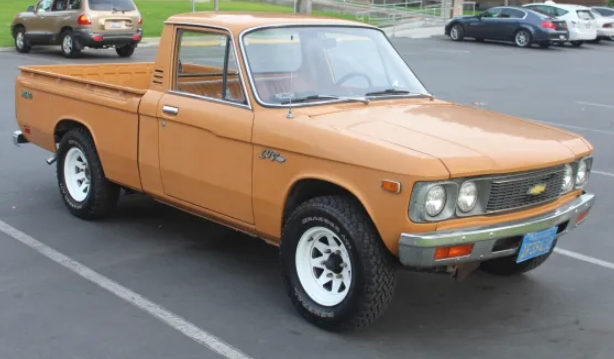
The Chevrolet LUV debuted in the United States for the 1972 model year. It was a resounding success, selling nearly 50,000 units in its first full year. To the casual observer, it was simply a new Chevrolet. But a closer look revealed its true origins. The LUV was, almost entirely, an Isuzu Faster (known as the Bellett 1600 GT-R in Japan), featuring a redesigned front end with Chevrolet’s signature golden bowtie and a simple, squared-off grille.
Powered by a 1.8-liter OHV four-cylinder engine producing a modest 75 horsepower, the LUV was not built for speed. Its strength lay in its efficiency and utility. The engine was paired with a four-speed manual transmission, sending power to the rear wheels. Its ladder-frame chassis and leaf-spring rear suspension were traditional truck underpinnings, scaled down to a manageable size that made it easy to maneuver and park.
The first-generation LUV was offered in three distinct trim levels, each catering to a specific need:
- Standard: The base model was a no-frills work vehicle. It came with a 1,100-pound payload capacity, a 7.5-foot Styleside bed, vinyl upholstery, and a rubber floor mat. It was basic transportation for tradesmen and small business owners.
- Custom: This mid-level trim added a degree of comfort and style. It typically included a slightly more upgraded interior, chrome bumpers, and trim, making it more suitable for personal use.
- Wideside: The top-of-the-line model, the Wideside, was the LUV’s answer to Chevrolet’s own step-side beds. It featured distinctive fender flares over the rear wheels, a chrome grille, and an upgraded interior with a color-keyed dash and more comprehensive sound insulation. It was the “dressed-up” version of the small truck.
In a move that would be repeated decades later with the SSR, Chevrolet even offered a dealer-installed “Electric Car” conversion kit for the LUV in California to meet early emissions regulations, though only a handful were ever produced. This first generation firmly established the LUV as a viable, economical alternative to its larger brethren.
.
THIS might be a great place to get your new car from!
Or for those who are into the “car flipping” business, here’s an excellent resource for you!

.
Second Generation (1975-1980): The LUV Gets a Pulse
For the 1975 model year, the LUV received a complete and dramatic redesign. This was not just a facelift; it was an entirely new truck, again based on the latest Isuzu Faster platform. The staid, squared-off look was gone, replaced by a futuristic and aerodynamic body featuring a steeply raked front end, aerodynamic rectangular headlights, and a prominent “power bulge” hood. This generation was all about style, and it made a bold statement.
The most significant mechanical upgrade was the introduction of an alternator, which replaced the older, less efficient generator, and, most importantly, an available four-wheel-drive system. This was a game-changer. The LUV was now one of the smallest 4x4s on the market, offering unparalleled off-road capability in a compact and fuel-efficient package. The four-wheel-drive models featured a two-speed transfer case and a live front axle, making them genuinely capable workhorses.
The engine also received a boost. The 1.8-liter unit was now rated at 80 horsepower. While not a huge increase, it was enough to keep the nimble LUV competitive.
The trim levels for the second generation were reorganized to reflect its new focus on lifestyle and capability:
- Standard: The base model remained the utilitarian choice, but it now looked far more modern. It still featured a 7.5-foot bed and a basic interior.
- Custom: The Custom trim continued as the mid-range option, adding niceties like chrome window surrounds, a dome light, and upgraded interior materials.
- Wideside: The flashy Wideside model returned, its flared fenders looking right at home on the new, curvy body. It was now the top choice for buyers who wanted their small truck to make a big impression.
- 4×4: The four-wheel-drive system was available on both the Standard and Custom trims, creating two distinct off-road models. The 4×4 was an instant hit with outdoorsmen, farmers, and anyone who needed to tackle rough terrain.
This generation of LUV was a massive success. It proved that a small truck didn’t have to be purely utilitarian; it could be stylish, adventurous, and a reflection of its owner’s personality.
Third Generation (1981-1982): The End of the Line
The final iteration of the Chevrolet LUV arrived for the 1981 model year. Once again, it was a reskin of the latest Isuzu Faster. The futuristic curves of the previous model were replaced with a more angular, “folded-edge” design that was in line with the styling trends of the early 1980s. The front end was dominated by a wide, ribbed grille flanked by quad rectangular headlights.
This generation saw significant engineering changes aimed at improving performance and efficiency. The 1.8-liter engine was bored out to 1.9 liters, bumping horsepower to 85. The most notable addition was the optional Isuzu 4ZD1 2.2-liter engine, which produced a more robust 96 horsepower and 121 lb-ft of torque. This engine made the LUV a much more formidable hauler.
Perhaps the most celebrated and sought-after feature was the optional “Super-Drive” four-speed manual transmission. This transmission featured a overdrive fourth gear, allowing the driver to achieve much better fuel economy on the highway—a crucial feature during the lingering fuel-conscious era.
The trim levels remained consistent, but the mechanical options expanded the LUV’s appeal:
- Standard: Still the workhorse.
- Custom: The popular all-around choice.
- Wideside: The premium model.
- 4WD: Available with either the 1.9L or the more powerful 2.2L engine, solidifying its status as the “big engine, small package” choice.
By 1982, GM’s own homegrown solution, the Chevrolet S-10, was already in the pipeline and would debut for the 1983 model year. The LUV had served its purpose perfectly: it had given Chevrolet a foothold in the exploding small truck market, kept competitors at bay, and generated significant sales and brand loyalty. After the 1982 model year, the LUV was quietly retired, its mission accomplished.
The Legacy and Future Outlook
The Chevrolet LUV was far more than just a re-badged Isuzu. It was a strategic masterstroke that introduced an entire generation of American buyers to the concept of a compact pickup. It proved that a truck could be both a capable tool and an affordable, efficient daily driver. The LUV’s success paved the way not only for the S-10 but for an entire market segment that includes today’s Chevrolet Colorado and GMC Canyon.
Its legacy lives on in the hearts of enthusiasts who cherish its simple mechanics, surprising off-road prowess (especially the 4×4 models), and unique 70s styling. Finding a clean, original LUV today is a rare treat, a reminder of a time when ingenuity and partnership could create a vehicle that punched far above its weight class.
Looking to the future, the concept of the small, efficient pickup is being reborn. Vehicles like the Ford Maverick and Hyundai Santa Cruz have rekindled the flame that the LUV first lit. They offer the same blend of utility, efficiency, and maneuverability that made the original LUV so popular. In a way, these modern unibody hybrids are the spiritual successors to the little truck from Isuzu. While the automotive world continues to evolve towards electrification and high-tech crossovers, the simple, honest appeal of a small pickup remains. The Chevrolet LUV was the original pioneer, the Trojan horse that changed the game, and its influence can still be felt on the roads toda