The TVR Sagaris: Evolution of a British Sports Car Icon
The TVR Sagaris is one of the most exhilarating and distinctive sports cars ever produced by the British manufacturer TVR. Produced between 2004 and 2006, the Sagaris represented the pinnacle of TVR’s traditional approach to building lightweight, high-performance cars with aggressive styling and an uncompromising focus on driving thrills. It was one of the last models produced by the company before financial troubles led to the closure of TVR’s production in 2006. Despite its short production run, the Sagaris is now a beloved and rare collector’s car, revered for its raw power, unique design, and driving dynamics.
This article traces the evolution of the TVR Sagaris, including its development, technical specifications, trim levels, and legacy.
Origins and Development of the TVR Sagaris
The TVR Sagaris was launched in 2004 at the Birmingham Motor Show, signaling the end of an era for the British automaker. TVR, founded by Trevor Wilkinson in 1947, was known for producing cars that were raw and unfiltered in their approach to performance. Throughout the 1990s and early 2000s, TVR’s models, such as the Chimaera and Cerbera, continued to offer aggressive styling paired with high-performance engineering.
By the early 2000s, TVR’s strategy had evolved toward a more radical direction, culminating in the Sagaris. The new car took the lessons learned from TVR’s earlier models and dialed them up to a level of extremity that appealed to purists and driving enthusiasts. The Sagaris was not designed for comfort or luxury; instead, it prioritized speed, handling, and pure driving excitement.
Key Design Goals
The Sagaris was designed to be a completely new kind of TVR — a car that was light, incredibly agile, and ready for track days. Some of the main design principles included:
- Lightweight Construction: The car’s body was made from fiberglass, keeping weight down and contributing to its agility on the road.
- Aerodynamic Styling: The Sagaris was designed with a focus on aerodynamic efficiency, with a sloping roofline, large rear wing, and a functional front splitter to enhance downforce.
- Power and Performance: TVR opted for a straight-six engine, choosing the same engine used in the TVR Cerbera but with upgrades for more power. This was paired with a relatively light, compact body to produce a car that was truly fast and responsive.
TVR Sagaris (2004–2006)
Launch and Initial Reception
The TVR Sagaris was produced from 2004 to 2006, and during this period, only around 1,000 units were built, making it an extremely rare and sought-after car today. The car was positioned above the TVR Tamora and TVR Cerbera in the lineup, competing with high-performance sports cars from brands such as Porsche, Ferrari, and Aston Martin.
When it was first introduced, the Sagaris received a positive reception for its dramatic styling, aggressive stance, and bold engineering. The design, penned by TVR’s designer Peter Wheeler, was a major departure from the more conservative designs of earlier models. The Sagaris was unmistakably a TVR — low-slung, muscular, and loud.
Technical Specifications and Features
The Sagaris was powered by a 4.0-liter straight-six engine (also known as the Speed Six engine) developed in-house by TVR. This unit was capable of producing around 380 horsepower and 400 Nm (295 lb-ft) of torque, making the Sagaris incredibly fast, with a 0–60 mph time of 3.7 seconds and a top speed of around 180 mph (290 km/h). These performance figures were exceptional for its time and placed the Sagaris in the league of some of the fastest cars on the market.
The engine was mated to a 6-speed manual gearbox, and the car featured rear-wheel drive for optimal driving dynamics. The Sagaris was also equipped with independent suspension at both the front and rear, contributing to its excellent handling characteristics. One of the defining features of the car was its lightweight fiberglass body, which helped it achieve an incredibly low weight of around 950 kg (2,091 lbs), which was crucial in achieving such performance figures.
The Sagaris’ chassis was developed specifically to maximize rigidity and stability while keeping weight as low as possible. In addition to its lightweight construction, the car featured a host of performance-oriented components, including AP Racing brakes, adjustable coilover suspension, and aqua-laminated body panels to reduce wind resistance.
Styling and Design
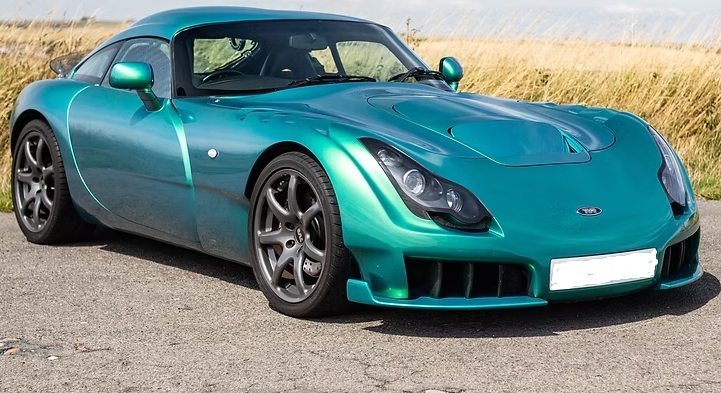
The styling of the TVR Sagaris was one of its most polarizing aspects. While many admired its bold, futuristic look, others were less enthusiastic. The car featured a bulging rear wheel arch, large scoops on the hood, and a large rear wing that gave the car a race-inspired appearance. The car’s aggressive front end, with its wide air intakes and sharp, angular headlights, gave the Sagaris a menacing presence on the road.
One of the most distinctive aspects of the design was the rear end, which had a unique, three-exhaust setup integrated into the rear bumper. The double exhaust pipes came out of each side of the rear, giving the car a distinctive auditory signature, one that only a few high-performance sports cars can match.
Inside, the Sagaris was minimalist, as was typical of TVR. The interior focused purely on driving pleasure, with bucket seats, a minimalist dashboard, and carbon fiber accents throughout. The cabin was focused entirely on the driving experience, with no excessive luxury appointments, making it a true sports car for those who wanted nothing but speed and handling.
.

.
Trim Levels and Variants
During its production run, the TVR Sagaris was available in a single trim level: the standard Sagaris, which included the full range of performance-oriented features. There were no formal trim levels or package variations as is often the case with more mass-market sports cars. However, a limited edition was released, offering slightly higher performance figures and cosmetic enhancements, such as unique paint colors and interior finishes.
Despite this, there were some optional features and customizations available for the Sagaris, including:
- Paint options: TVR offered a range of colors, with a particular emphasis on bright, eye-catching hues, such as Vermillion, Mango, and Racing Green.
- Wheel options: Different lightweight alloys were available for customers looking to personalize the look of their Sagaris.
- Interior trim: Options for leather upholstery and carbon fiber accents in the cabin were offered to suit a more personalized style.
- Sportier suspension setup and performance tires were also available for customers who wanted a more track-focused version of the car.
Legacy and Influence
The TVR Sagaris was among the last models produced by TVR before the company ceased production of new vehicles in 2006 due to financial difficulties. The company’s collapse left a huge void in the British sports car world, as TVR had been one of the few manufacturers still producing low-volume, high-performance cars by hand.
Despite the relatively short production run, the TVR Sagaris left a lasting impression on the automotive world. It remains an icon of the early 2000s for its combination of extreme performance, distinctive styling, and the raw, unfiltered driving experience that TVR fans crave.
One of the key elements of the Sagaris’ legacy is its pure driving focus. While many modern sports cars have become increasingly refined, featuring electronic assistance, comfort features, and a heavier focus on daily usability, the Sagaris is a reminder of the era when raw performance and driving pleasure were the sole focus of a sports car.
As of today, the TVR Sagaris is considered a collector’s car, and its rarity and unique characteristics have ensured that prices for well-maintained examples have risen over time. Given the limited number of cars produced and the brand’s decline, the Sagaris is likely to remain a rare gem in the world of British sports cars.
The Future Outlook
With TVR re-entering the market with new models, including the TVR Griffith and TVR Tuscan, there is a sense of nostalgia and reverence for the brand’s classic models like the Sagaris. The TVR Griffith, which shares many of the brand’s design principles, could usher in a new era for the marque, and perhaps even a modern interpretation of the Sagaris. However, with a modern focus on electric powertrains and more refined designs, it’s unlikely that a car like the Sagaris — as raw and uncompromising as it was — will ever be built again.
Conclusion
The TVR Sagaris stands as one of the most daring and exciting British sports cars of the early 21st century. Produced from 2004 to 2006, it represented the last of TVR’s unfiltered, high-performance models before the company faced financial difficulties. With a 380-horsepower V8 engine, aggressive styling, and a lightweight design, the Sagaris continues to be celebrated for its unapologetically raw driving experience. Its short production run has only added to its appeal, and it remains one of the most desirable modern TVRs on the market today, with an enduring legacy as a true driver’s car.