The Two-Seater Titan: A Complete History of the AMC AMX
In the pantheon of American muscle cars, certain names echo with thunderous authority: Mustang, Camaro, GTO, Charger. Yet, amidst these titans of torque, there exists a unique, angular, and often overlooked legend—the AMC AMX. While Ford and General Motors were building pony cars based on compact sedans, American Motors Corporation (AMC) took a different path. They built a dedicated two-seater sports car, lightweight and powerful, that defied convention and challenged the status quo.
The story of the AMX is a tale of engineering ingenuity born from corporate necessity. It is a history of a car that evolved from a pure-bred interceptor to a grand touring cruiser, and eventually, to a high-performance package on a family coupe. This is the definitive history of the AMC AMX.
The Genesis: The Project Alpha (1966–1968)
By the mid-1960s, AMC was in a precarious position. The “compact car” wars were heating up, and the company needed a vehicle to compete with the Ford Mustang, which had launched in 1964 to massive success. However, AMC lacked the deep pockets of the “Big Three.” They couldn’t simply re-skin a sedan and call it a sports car. They needed something radical.
The project began as “Project Alpha.” AMC’s engineers, led by the visionary Dick Teague, looked at the existing Rambler American platform but decided to drastically shorten it. The result was a wheelbase of just 96 inches—significantly shorter than the Mustang. To save weight and improve handling, they utilized a revolutionary concept for a production American car: an all-new, fully independent rear suspension (IRS) derived from the internal “Project 1222.”
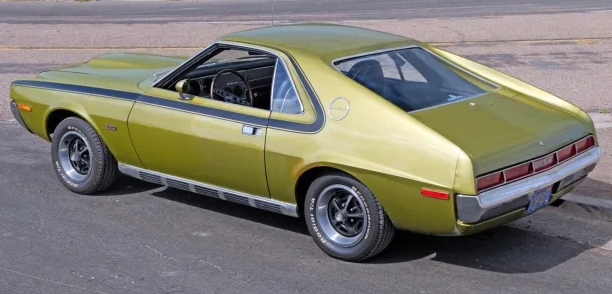
On May 22, 1966, AMC unveiled the 1968 AMX. It was a shock to the industry. Here was a car with a 96-inch wheelbase, a fiberglass front clip, and a steel unibody construction. It was officially classified as a two-seater, a rarity in the American market since the 1955 Thunderbird. This classification was a strategic move; by certifying the AMX as a two-seater, AMC avoided the expensive safety regulations applied to passenger sedans, keeping costs down.
1968 AMX The inaugural model was a masterpiece of simplicity and power. It was offered with two engine options:
- The 360 V8: A 3.25-inch bore version of AMC’s 401 V8, producing 280 horsepower and 365 lb-ft of torque.
- The 390 V8: A 3.75-inch bore engine, producing 315 horsepower and 425 lb-ft of torque.
The 1968 AMX was available in three distinct trim levels, identified by their paint schemes:
- AMX 360: The base model, often dressed in “Big Bad” colors (Blue, Green, or Orange).
- AMX 390: The mid-level performance trim.
- The “Go Package”: This was the ultimate performance option for the 390. It included a heavy-duty cooling system, a limited-slip differential (Trak-Lok), dual exhausts, power front disc brakes, and the iconic “Matte Black” hood with a functional scoop. Inside, it featured a floor console with a tachometer and an 8,000-rpm oil pressure gauge.
1969 AMX For 1969, the AMX received a cosmetic refresh. The most noticeable change was the addition of two “nostrils” or vents on the hood, which helped extract heat from the engine bay. The fiberglass front end was redesigned to look more aggressive, and the taillights were changed from a single unit to three distinct lenses.
Mechanically, the 390 V8 was bored out to 401 cubic inches (though still marketed as the “390” for insurance purposes), now producing 325 horsepower and 430 lb-ft of torque. The 360 remained available, but the 401 became the engine of choice for enthusiasts.
The trim levels remained largely the same, but the paint schemes evolved. The “Big Bad” colors were still popular, but new options like “Big Bad Blue” and “Big Bad Orange” became staples. The “Go Package” remained the most desirable configuration, adding the matte black hood, sport suspension, and wider E70x14 tires.
1970 AMX The 1970 model year was short-lived due to AMC’s early introduction of the 1971 models in September 1970. However, the 1970 AMX is often considered the pinnacle of the two-seater’s design. The front end underwent a significant redesign, featuring a new grille with a honeycomb pattern and flush-mounted headlights. The rear was squared off, giving the car a more muscular, European-inspired stance.
Engine options were simplified to the 360 and the 401. The 401 was now rated at 325 hp, while the 360 produced 245 hp. The “Go Package” was still available, but it was now often bundled with the “Super Stock” suspension package, which included heavy-duty shocks and springs, and staggered rear shocks to combat axle hop.
.
THIS might be a great place to get your new car from!
Or for those who are into the “car flipping” business, here’s an excellent resource for you!

.
The Grand Tourer: The AMX/GT (1971)
In 1971, AMC made a controversial decision. The market was shifting; insurance rates for two-seaters were skyrocketing, and the public was demanding more practicality. AMC responded by stretching the AMX chassis by 10 inches to create the four-seat AMC Javelin.
However, they didn’t want to abandon the AMX name entirely. The solution was the AMC AMX/GT.
The AMX/GT was essentially a Javelin with an AMX-style front end and a unique, bolt-on fiberglass rear section that mimicked the fastback profile of the original two-seater. It was marketed as a “personal luxury” muscle car.
Trim Levels:
- Standard GT: Featured the 360 V8 (210 hp due to lower compression ratios mandated by new emissions standards).
- GT 401: Offered the 401 V8 (255 hp) with the “Go Package” options.
The AMX/GT was a stopgap measure. It looked aggressive, especially with the “Ram-Air” hood, but it lacked the purity of the original two-seater. It was heavier and handled less precisely. Production numbers were low (approximately 4,116 units), making it a rare footnote in the AMX lineage.
The Transformation: The Spirit AMX (1972–1974)
By 1972, the pure two-seater AMX was gone, replaced by the Javelin as AMC’s primary performance car. But the AMX name was too valuable to discard. AMC decided to apply it to their compact car, the Gremlin, creating the Spirit AMX.
This was a significant departure. The Spirit was a subcompact hatchback based on the Gremlin X, but with aggressive “hockey stick” graphics, a matte black hood, and a revised interior. It was no longer a sports car; it was a hot hatch before the term existed.
1972 Spirit AMX The launch model featured the 304 V8 (210 hp) as the only engine option. It came standard with a floor shifter, bucket seats, and the signature AMX side stripes. The “Go Package” was available, adding power front disc brakes, a rear spoiler, and wider wheels.
1973 Spirit AMX In 1973, the AMX received a new front end with a 5-mph impact bumper (a federal requirement). The 304 V8 remained the sole engine, but horsepower dropped to 150 hp due to new emissions equipment. Despite the power loss, the car was still quick due to its light weight (under 2,500 lbs).
1974 Spirit AMX The final year of the Spirit AMX saw the introduction of the “Spirit AMX/401” package. This was a dealer-installed option that allowed buyers to drop the 401 V8 (now rated at 220 hp) into the tiny hatchback. With the 401, the Spirit AMX became one of the fastest accelerating cars of the era, capable of 0-60 mph in under 6 seconds, despite the smog-strangled engine.
However, the 1974 model year marked the end of the line. Rising insurance costs for high-performance vehicles and the onset of the oil crisis forced AMC to discontinue the AMX designation on the Spirit.
The Revival: The 1990s Concept and Limited Production
After AMC was acquired by Chrysler in 1987, the rights to the AMX name lay dormant for years. However, in the 1990s, there was a resurgence of interest in retro-styled performance cars.
1993 AMC AMX Concept At the 1993 North American International Auto Show, Chrysler unveiled the AMC AMX Concept. It was a two-seater convertible based on the Jeep platform (sharing underpinnings with the Grand Cherokee), powered by a 4.0-liter inline-six. It featured retro styling cues from the 1968 AMX, including the dual nostrils on the hood and the side vents. While it never made it to production, it sparked rumors of a revival.
2006-2007 Javelin AMX Concept In the mid-2000s, Chrysler (under DaimlerChrysler at the time) teased the public with the Javelin AMX Concept. This was a modern interpretation of the classic muscle car, featuring a 4.0-liter V6 or a 6.1-liter HEMI V8. It was displayed at various auto shows, generating significant buzz. However, due to the 2008 financial crisis and the restructuring of Chrysler, the project was shelved.
2020s: The “Spirit” of AMX In recent years, the AMX name has appeared in a different context. In 2020, a company called AMC Global (a licensing entity) announced plans for a limited run of “new” AMX vehicles. These were not full-scale production cars but rather modified vehicles (often based on existing platforms like the Dodge Challenger) with AMX branding. While these vehicles pay homage to the original, they are essentially custom builds rather than a true continuation of the lineage.
Technical Innovations and Legacy
The AMX’s legacy is defined by its engineering firsts. The 1968-1970 models were the first American production cars to feature a fully independent rear suspension as standard equipment. This setup, which utilized a torque tube and a rear transaxle, gave the AMX a 48/52 front/rear weight distribution, making it incredibly balanced for a V8 car.
The AMX also pioneered the use of extensive weight-saving measures. The 1968-1970 models used a fiberglass front clip to reduce nose weight. The interior featured lightweight bucket seats made from a composite material. Even the bumpers were aluminum to save pounds.
The car’s racing pedigree further cemented its status. In 1968, an AMX driven by Roger West set 23 stock car records at the Bonneville Salt Flats. In Trans-Am racing, the AMX (often running in the under-2.5-liter class) proved competitive against the Ford Mustang and Chevrolet Camaro.
Future Outlook
Today, the AMC AMX is a highly sought-after collector’s item. The 1968-1970 two-seaters command the highest prices, particularly the 1970 models with the 401 V8 and the “Go Package.” The Spirit AMX is gaining a cult following as a “sleeper” muscle car.
As for the future of the nameplate, the outlook is uncertain but hopeful. With the automotive industry pivoting toward electric vehicles (EVs), there is potential for the AMX name to return as a high-performance electric coupe. The AMX was always about innovation and defying convention—values that could translate well to the EV era.
Imagine an electric AMX: a two-seater, lightweight coupe with independent rear suspension, instant torque, and retro-futuristic styling. It would be a fitting tribute to the original concept: a car built for the driver, unburdened by the constraints of a sedan platform.
Conclusion
The AMC AMX was a car ahead of its time. It was a bold gamble by a smaller automaker to compete with giants. It began as a pure, two-seater sports car, evolved into a grand touring machine, and eventually became a spirited compact. While the nameplate has been dormant for decades, its spirit lives on in the memories of enthusiasts and the rising values at auction houses.
The AMX proved that you didn’t need to be the biggest player to make the biggest impact. With its unique blend of American muscle and European handling, the AMX remains a testament to the golden age of American automotive ingenuity. Whether it’s the roar of the 390 in a 1968 coupe or the quirky charm of a 1974 Spirit hatchback, the AMX continues to captivate, reminding us that sometimes, the best things come in small packages.