The Unassuming Legend: How the Humble Ford Festiva Conquered the World
In the pantheon of automotive history, some cars are celebrated for their breathtaking design, others for their earth-shattering power. Then there are the quiet achievers—the cars that simply got the job done, day in and day out. For millions of people across the globe, that car was the Ford Festiva. Known by a dozen different names and sold on nearly every continent, the Festiva was not just a car; it was a global phenomenon, a testament to the power of smart, efficient, and unpretentious engineering.
Its story is one of collaboration, adaptation, and a surprising second act that cemented its legacy as one of the most beloved budget cars of the late 20th century.
Part I: The First Generation (1986-2002) – The Global commuter
The Genesis: A Kia by any other Name
The Festiva’s story doesn’t begin in a Ford boardroom, but in South Korea. In the early 1980s, the fledgling automaker Kia, looking to enter the small car market, developed a new front-wheel-drive platform powered by a small Mazda engine. The result was the 1986 Kia Pride (or Ford Festiva in some markets).
Ford, seeking an affordable subcompact to compete with the likes of the Chevrolet Spectrum and Honda Civic, saw potential in the Korean-built car. Through its “World Car” program, Ford collaborated with Mazda (in which it held a significant stake) and Kia to create a globally sourced, low-cost vehicle. The first-generation Festiva was born.
North American Models and Trim Levels (1988-1993)
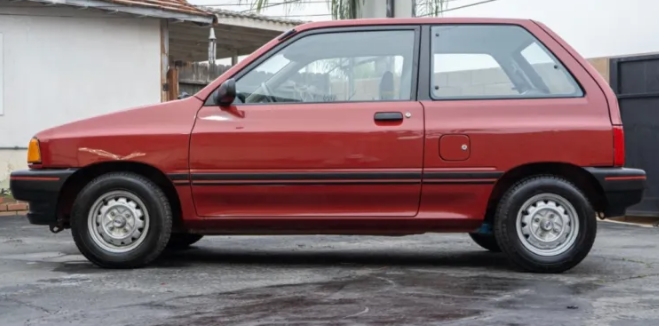
The Ford Festiva debuted in the United States and Canada for the 1988 model year. It was a tiny, upright, and simple car, offered exclusively as a three-door hatchback. Under the hood was a 1.3-liter Mazda B3 engine producing a modest 63 horsepower.
The trim levels were straightforward, reflecting its budget-friendly mission:
- Festiva L: The base model. Spartan but functional, it came with a four-speed manual transmission, cloth seats, and steel wheels with chrome hubcaps. It was the definition of a no-frills economy car.
- Festiva LX: The slightly more upscale version. The LX added an automatic transmission option, tachometer, body-side moldings, upgraded cloth, and a rear window defroster. For many, it was the perfect balance of price and comfort.
- Festiva LX 5-speed: A notable option for the LX, this model paired the 1.3-liter engine with a five-speed manual transmission, offering slightly better fuel economy and a more engaging driving experience.
In 1990, a new base model called the Festiva F was introduced. It was even more basic than the L, effectively becoming the new entry point.
International Variants: A Name for Every Land
The first-generation Festiva’s genius was its adaptability. The same basic car was sold worldwide under different monikers:
- Ford Festiva (Australia/New Zealand/South Africa/Canada/US): The primary name in Ford-centric markets.
- Kia Pride (South Korea and other Asian markets): The original home-market name. It was also sold with an Aspiration trim level.
- Ford Festiva (Japan): Sold through the Jidōsha division in Japan, where it was a kei-car-sized hit.
- Ford Festiva (Europe): Known simply as the Festiva, it faced stiff competition from the Ford Fiesta and other European superminis.
This first generation, with its peppy engine (the B3 was famously derived from the Mazda 323’s engine), nimble handling, and legendary fuel economy (often exceeding 40 MPG on the highway), sold in the millions. It was the perfect first car, the ideal commuter, and a reliable companion for students and young families.
.
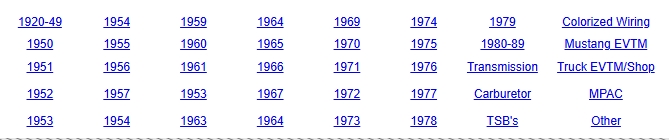
SEARCHING for those hard to find FORD manuals, guides & books?
This place has you covered! SEE All FORD Manuals From 1920 – 1989.
CHOOSE the year of your vehicle:
.
Part II: The Second Generation (1993-2002) – The Aspire to Greatness
By the early 1990s, the original Festiva was beginning to look and feel dated. To replace it, Ford and Kia again collaborated on a new, more modern platform. For most of the world, this car would be known as the Kia Pride or the Aspire, but in North America, it once again wore the Festiva badge, though it was often marketed alongside a new sister car, the Ford Aspire.
The second-generation Festiva was a significant departure. It was smoother, more rounded, and featured a taller body that prioritized interior space over the original’s compact footprint.
North American Models and Trim Levels (1994-2002)
The second-generation Festiva arrived for the 1994 model year. The engine was updated to a 1.5-liter Mazda B5 engine, producing a much-improved 88 horsepower. It was offered as a three-door hatchback (1994-1997) and a four-door sedan (1994-2002), providing unprecedented versatility for the platform.
The trim levels evolved to offer more choice:
- Festiva L (3-door & 4-door): Still the base model, but now with more standard features. It included a five-speed manual transmission, dual airbags, and basic AM/FM stereo.
- Festiva LX (3-door & 4-door): The premium trim. The LX added a four-speed automatic transmission, power steering, air conditioning, a cassette player, and upgraded wheel covers. The 4-door LX was a particularly compelling package for small families.
- Festiva LX 5-speed: Similar to the first gen, this was the enthusiast’s choice, pairing the stronger 1.5L engine with the five-speed manual for a peppy and efficient driving experience.
For 1997, the Festiva received a mild facelift, including a new grille, clearer taillights, and a revised interior. The three-door hatchback was discontinued after the 1997 model year, leaving the four-door sedan to soldier on until 2002.
International Variants and the Rise of the Aspire
The second generation had an even more complex international identity:
- Ford Aspire (North America, 1994-1997): This was Ford’s name for the five-door hatchback version of the same car. It was positioned as a slightly sportier, more European-styled alternative to the four-door Festiva. The Aspire had its own trim levels: Aspire LX and Aspire SE, with the SE adding sport seats, a rear spoiler, and alloy wheels.
- Kia Pride (South Korea/Asia): This name continued on the new platform and became a hugely popular car in its home market, offered in a variety of trim levels including the sporty “PRIDE 1.5i” and luxurious “PRIDE 1.5i EX.”
- Ford Verona (Brazil): In Brazil, this four-door sedan was sold as the Ford Verona, a name that would have a long and interesting life of its own.
This generation proved to be incredibly robust and reliable, continuing to sell well into the late 1990s as an affordable and practical transportation solution.
Part III: The Festiva’s Surprising Second Act – The Rio’s Rise
While the second-generation Festiva/Aspire platform was officially discontinued in North America by 2002, its story was far from over. In 1999, Kia (by now a subsidiary of Hyundai) decided to give the platform a final, major overhaul. The result was the first-generation Kia Rio.
The Rio, which debuted in 2001, was fundamentally a heavily re-engineered Festiva. It featured a redesigned front and rear end, a completely new interior, and significant mechanical updates. The biggest change was under the hood, where the venerable Mazda 1.5-liter engine was replaced by a new, more efficient 1.6-liter Hyundai Alpha engine.
Though the Ford badge was gone from this final evolution, the DNA of the Festiva—the core chassis, the layout, the simple, reliable ethos—lived on. The Kia Rio went on to become one of Kia’s most successful models, building on the foundation laid by the Festiva decades earlier.
Legacy and Future Outlook
The Ford Festiva was discontinued in most markets by the early 2000s, replaced in Ford’s lineup by the larger and more refined Ford Focus. But its legacy is undeniable.
The Festiva’s primary contribution to Ford was twofold. First, it was a massive commercial success, providing Ford with a low-cost, high-volume entry in the critical subcompact segment in dozens of countries. Second, the partnership with Kia was a crucial part of Ford’s strategy in Asia and helped lay the groundwork for Kia’s own meteoric rise as a major global automaker.
Today, the Festiva is a beloved “grey import” in countries like Australia and New Zealand, and a common sight at grassroots motorsports events like autocross and rallycross, where its light weight and peppy engine make it a giant-killer. Its reputation for durability is legendary; finding a first-generation Festiva with over 200,000 miles on the clock is not uncommon.
The future of the Festiva name itself is non-existent. The automotive world has moved on to crossovers, EVs, and more sophisticated platforms. However, the spirit of the Festiva—providing honest, affordable, and reliable transportation for the masses—is alive and well in the Kia Rio, the Hyundai Accent, and the Ford EcoSport. The humble Ford Festiva may no longer be in showrooms, but its DNA is still on the road, quietly and efficiently conquering the world, one mile at a time.