The Unassuming Overachiever: A Deep Dive into the Toyota Echo
In the twilight of the 20th century, as the world braced for Y2K and the dot-com bubble reached its zenith, the automotive landscape was dominated by burgeoning SUVs and ever-larger sedans. Fuel was relatively cheap, and efficiency, while important, often took a backseat to size and power. It was into this climate that Toyota, a brand synonymous with pragmatism and reliability, launched a car that was a complete non-sequitur: a quirky, tall, and unapologetically basic subcompact called the Echo. It was a vehicle that defied convention, prioritized function over form, and ultimately built a legacy of durability that far outlasted its brief production run.
A New Genesis: The Birth of a Global Car
The Toyota Echo’s story begins not in North America, but in Japan. In the late 1990s, Toyota developed the “New Basic Car” (NBC) platform, a forward-thinking architecture designed to underpin a new generation of small, efficient, and surprisingly spacious vehicles for a global market. The first and most influential product of this platform was the Toyota Vitz, a smartly-packaged hatchback that debuted in Japan in 1999 and won the coveted Car of the Year Japan award.
For markets that preferred a traditional trunk, Toyota created a sedan version of the Vitz, called the Platz. It was these two vehicles, the Vitz and the Platz, that would form the basis for the car North America would come to know as the Echo.
In the United States, Toyota was simultaneously embarking on a new marketing strategy called “Project Genesis.” The goal was to shed the brand’s somewhat staid image and attract younger, first-time car buyers. Three vehicles were chosen to spearhead this initiative: the sporty seventh-generation Celica, the nimble MR2 Spyder roadster, and a new entry-level economy car. That car was the Echo, which was essentially a rebranded and slightly restyled Toyota Platz. It arrived in North American showrooms for the 2000 model year, replacing the long-serving, but utterly forgettable, Toyota Tercel.
Years, Models, and Trims: The Spartan Ethos (2000-2005)
The Toyota Echo was sold in North America from the 2000 to the 2005 model year. Unlike its global siblings, the Echo lineup in the United States and Canada was streamlined and focused on affordability.
Models Offered:
Throughout its entire six-year run, the Echo was available in two distinct body styles:
- Two-Door Coupe: This model was aimed squarely at young, single buyers or couples. Its shorter wheelbase and two-door configuration gave it a slightly sportier, more personal appearance, though it retained the characteristic tall roofline of its sedan counterpart.
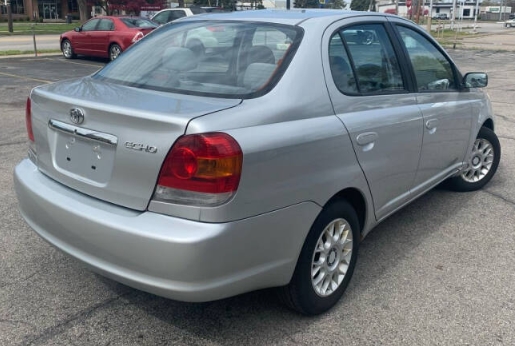
- Four-Door Sedan: The more practical of the two, the four-door sedan offered easier access to the surprisingly roomy rear seats, making it a viable option for small families, commuters, or students who frequently carpooled.
Notably, the hatchback version (the Vitz) was not offered under the Echo nameplate in North America. This was a curious decision, as the hatchback body style was proving increasingly popular globally. It wasn’t until the Echo was replaced by the Yaris for the 2006/2007 model year that North American buyers would officially get the celebrated hatchback from Toyota.
Trim Levels and Options:
The Echo’s approach to trim levels was a masterclass in minimalism. Toyota eschewed the traditional DX, LE, and SE hierarchy. Instead, for its entire production, there was essentially one base trim level for both the coupe and sedan. The real differentiation came from a sparse à la carte options list and a few bundled packages, which allowed buyers to build a car to their exact (and usually minimal) needs.
A standard, base-model Echo from the early 2000s was a true throwback to a simpler era of motoring. Standard equipment included:
- A 1.5-liter four-cylinder engine.
- A five-speed manual transmission.
- 14-inch steel wheels with hubcaps.
- Manual windows, manual door locks, and manual side mirrors.
- A simple AM/FM radio with two speakers.
That was largely it. Crucial features that were becoming standard elsewhere were optional extras. If a buyer wanted any creature comforts, they had to pay for them. Key options included:
- Air Conditioning: A must-have in most climates, but an extra cost on the Echo.
- Power Steering: The base model came with unassisted steering. While the car was light enough to make it manageable, the power steering option was highly recommended.
- Four-Speed Automatic Transmission: A popular choice for those not wanting to row their own gears.
- Upgraded Audio: A cassette player or, later, a CD player could be added.
- Tachometer: The base instrument cluster did without a rev counter, reinforcing its utilitarian nature.
- Power Package: This bundled popular options like power windows, power door locks, and power mirrors.
- Safety Features: Anti-lock brakes (ABS) and side-impact airbags were available as standalone options.
- Appearance Items: A rear spoiler, alloy wheels, and mudguards could be added for a touch of personalization.
This spartan philosophy meant that the Echo’s starting price was incredibly low, making it one of the most affordable new cars on the market. However, a fully-loaded Echo with an automatic transmission, A/C, and the power package could see its price climb significantly, pushing it closer to the territory of the larger and better-equipped Toyota Corolla.
.
NO MORE dead batteries with this:

.
Under the Skin: The Genius of Simplicity
What truly defined the Toyota Echo was not what it lacked, but what it possessed. Its brilliance lay in its engineering and clever design.
The 1NZ-FE Engine: The heart of every Echo was Toyota’s now-legendary 1.5-liter 1NZ-FE DOHC 16-valve inline-four engine. Featuring Variable Valve Timing with intelligence (VVT-i), it was a remarkably advanced and efficient powerplant for an economy car of its era. It produced a modest but effective 108 horsepower and 105 lb-ft of torque. When paired with the Echo’s featherlight curb weight of just over 2,000 pounds, this engine provided surprisingly peppy acceleration, especially around town. More importantly, it was incredibly fuel-efficient, regularly achieving mileage in the high 30s and often exceeding 40 MPG on the highway—figures that are respectable even by today’s standards.
Unconventional Interior: The Echo’s most discussed design feature was its interior, specifically the instrument cluster. Instead of sitting behind the steering wheel, the speedometer, fuel gauge, and digital odometer were housed in a pod located in the center of the dashboard, angled toward the driver. Toyota’s rationale was that this placement required less eye refocusing from the road to the gauges. While some drivers found it innovative, many found it distracting and bizarre. Below this central pod was a vast, deep storage bin, one of many clever storage solutions scattered throughout the cabin.
The car’s “tall-boy” design, while aesthetically awkward to some, was a packaging marvel. The high roofline created an airy cabin with immense headroom. The seats were mounted higher than in a typical sedan, providing excellent visibility and making ingress and egress remarkably easy. Rear-seat passengers enjoyed surprising legroom for a subcompact, thanks to the efficient packaging of the NBC platform.
The End of an Echo, The Dawn of a Yaris
Despite its practical brilliance, the Toyota Echo was never a runaway sales success in North America. Its quirky styling and stripped-down nature failed to capture the youth market as Project Genesis had intended. To many, it looked less like a cool, modern car and more like a transportation appliance. By 2005, its unconventional design felt dated, and Toyota decided it was time for a change.
The Echo was discontinued after the 2005 model year, but its spirit and platform lived on. Its direct successor was the Toyota Yaris, which arrived in North America for the 2007 model year (2006 in Canada). The Yaris was, in essence, the second generation of the global Vitz/Platz family. It brought with it a more conventional and stylish design, a modernized interior (though it initially kept the central instrument cluster), and, most importantly, the long-awaited three-door and five-door hatchback body styles that North America had been missing. The Yaris was an immediate success, proving that Toyota’s concept for a world-class subcompact was sound; the Echo had simply been the quirky, pioneering first draft.
Future Outlook and Lasting Legacy
Today, more than two decades after its debut, the Toyota Echo has cultivated an incredible posthumous reputation. While largely forgotten by the general public, it is revered by those in the know as one of the most reliable and cost-effective vehicles ever made.
Its legacy is threefold. First, it is a testament to durability. The 1NZ-FE engine is known to be virtually indestructible, with countless examples running well past 200,000 or even 300,000 miles with only basic maintenance. The simple mechanics, with fewer power accessories and complex electronics to fail, mean there is very little that can go wrong. This has turned the Echo into a “cockroach of the road”—a term of endearment for a car that simply refuses to die.
Second, it has a cult following among hypermilers and budget-conscious enthusiasts. Its light weight and efficient engine make it an ideal platform for those aiming to squeeze every last drop of fuel from a gallon of gas. For students or anyone needing cheap, dependable transportation, a well-maintained Echo remains one of the smartest used car buys on the market.
Finally, the Echo’s design philosophy—maximizing interior space on a minimal footprint—was ahead of its time. The principles of a tall roofline, high seating position, and clever packaging are now commonplace in the modern crossover and subcompact segments.
The Toyota Echo may have been a commercial disappointment, a quirky footnote in the annals of automotive history. But for those who owned one, and for those who still see them silently and faithfully plying the roads today, it stands as a monument to unassuming excellence—a simple, honest car that delivered far more than it ever promised.