The Unassuming Underdog: Tracing the Evolution of the Daihatsu Charmant
In the vast and often crowded automotive landscape of the 20th century, some cars become legends, their names synonymous with performance, luxury, or revolution. Others, however, lead a quieter existence, serving their purpose diligently before fading into relative obscurity. The Daihatsu Charmant belongs firmly in the latter category. Its name, French for “charming,” perfectly encapsulates its character: a pleasant, well-mannered, and ultimately unassuming family car. Yet, beneath its conventional exterior lies a fascinating story of corporate partnership, clever engineering, and an unexpected legacy as a cult classic. This is the evolution of a car that was always more than the sum of its parts: the Daihatsu Charmant.
To understand the Charmant, one must first understand the relationship between Daihatsu and Toyota. By the early 1970s, Daihatsu was a well-established specialist in kei cars and small commercial vehicles. However, it lacked a competitive entry in the crucial compact family sedan segment, a market dominated by giants like Toyota and Nissan. Developing an entirely new platform from scratch was a costly and time-consuming endeavor. The solution came through its burgeoning partnership with Toyota, which had held a controlling stake in Daihatsu since 1967. Toyota granted Daihatsu access to one of its most successful platforms: that of the world-beating Toyota Corolla. The Charmant was born not as a pure Daihatsu, but as a thoughtfully re-skinned and re-engineered Corolla, designed to give Daihatsu a foothold in a new market without the prohibitive development costs.
.
NO MORE dead batteries with this:

.
The First Generation (A35/A55): European Flair on a Japanese Foundation (1974–1981)
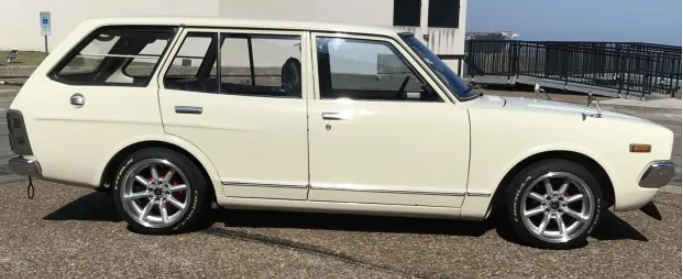
The first-generation Daihatsu Charmant made its debut in late 1974, positioned as a more luxurious and slightly more European-styled alternative to its Toyota sibling. It was based on the chassis and running gear of the E20-series Toyota Corolla, a car already renowned for its rugged reliability. However, Daihatsu was careful to ensure the Charmant was not merely a rebadged clone.
Design and Styling: Daihatsu invested in unique sheet metal for the entire body. The Charmant had a distinct visual identity, characterized by a more formal, upright grille and, most notably, quad round headlamps on many models, a feature that gave it a surprisingly premium look reminiscent of contemporary European sedans from BMW or Fiat. The rear featured different tail-light clusters and trim, further distancing it from its Corolla donor. The overall impression was of a car aiming for a slightly more mature and affluent buyer than the everyman Corolla. It was available primarily as a four-door sedan, though a two-door sedan and a five-door station wagon were also produced for certain markets.
Models and Trim Levels: The first-generation Charmant was offered in a variety of trim levels that evolved throughout its production run. These were designated to cater to different budgets and tastes:
- L: The base model, offering the essentials. It was spartan but functional, with vinyl seating and minimal chrome trim.
- LC: A step up, this trim often added features like a radio, a clock, and more comprehensive interior fabric choices.
- LE: The mid-range luxury model, featuring plusher cloth upholstery, additional sound deadening, and more exterior brightwork.
- Hi-Custom: The top-of-the-line trim. This model was generously equipped with features like a tachometer, a wood-rimmed steering wheel, simulated woodgrain on the dashboard, and often a 5-speed manual transmission as standard.
Powertrains: The engines were sourced directly from Toyota’s venerable K-series and T-series families. The primary engine initially was the 1.2-litre (1,166 cc) Toyota 3K-H OHV inline-four, a simple and incredibly durable unit. This was soon joined by larger options to broaden the car’s appeal:
- 1.3-litre (1,290 cc) 4K-U: A slightly larger displacement version that offered a minor bump in torque.
- 1.4-litre (1,407 cc) T-U: This engine provided a noticeable improvement in performance for those wanting more power.
- 1.6-litre (1,588 cc) 2T-U: The largest engine offered, this T-series motor gave the Charmant respectable performance for its era and was often paired with the higher trim levels.
Transmission choices were a standard 4-speed manual gearbox, with a 5-speed manual available on sportier or higher-end models. A 2-speed “Toyoglide” automatic, later upgraded to a 3-speed, was also an option for those seeking convenience. The first-generation Charmant successfully established the nameplate. It was a well-built, reliable, and comfortable car that filled its intended niche perfectly, offering Corolla dependability with a dash of unique style.
The Second Generation (A35/A60): The Eighties Icon and Unlikely Legend (1981–1987)
As the 1980s dawned, automotive design shifted towards sharper, more angular aesthetics. To keep pace, Daihatsu introduced a completely redesigned second-generation Charmant in October 1981. Once again, it was built upon a Toyota foundation, but this time it was the E70-series Corolla platform. This decision, seemingly conventional at the time, would be the key to the Charmant’s enduring cult status decades later. The E70 was the last generation of the Corolla to feature a rear-wheel-drive layout across its entire sedan and wagon range, a layout famous for its balanced handling and beloved by driving enthusiasts.
Design and Modernization: The second-generation Charmant embraced the crisp, “three-box” design language of the early 1980s. The quad round headlamps of its predecessor were replaced with large, rectangular units flanking a clean, slatted grille. The lines were sharp and uncluttered, giving the car a much more modern and substantial appearance. Daihatsu designers again worked to give it a distinct identity, aiming for a “mini-Cressida” look that projected an air of junior executive luxury. The interior was also completely revamped, with a more ergonomic dashboard, clearer instrumentation, and significantly improved materials, especially on higher-end models.
Models and Trim Levels: The trim hierarchy was revised and expanded, reflecting the market’s growing demand for comfort and convenience features.
- LC: The entry-level model remained, typically equipped with the 1.3-litre engine and a 4-speed manual. Interiors were durable but basic, often with vinyl seats and manual windows.
- LE: This popular mid-range trim added more comfortable cloth upholstery, a digital clock, a rear window defroster, and often came with the option of a 5-speed manual or automatic transmission.
- LGX: This was the flagship luxury model and represented the best Daihatsu could offer. The LGX was lavishly equipped for its class, featuring deep-pile velour upholstery, power steering, electric windows, air conditioning, and sometimes alloy wheels. It was designed to compete with well-appointed European and Japanese rivals.
- Altair: Offered in many markets, the Altair often sat alongside the LGX as a premium model, sometimes with a sportier flavor. The name itself evoked a sense of modern, technological sophistication.
Powertrains and the Birth of a Legacy: The engine lineup was a mix of old and new, and it is here that the Charmant’s connection to performance history was forged.
- 1.3-litre (1,290 cc) 4K: The dependable OHV Toyota 4K engine carried over as the base powerplant, prized for its economy and simplicity.
- 1.6-litre (1,588 cc) 2T: The OHV 2T engine also continued, providing solid mid-range performance.
- 1.6-litre (1,587 cc) 4A-L: In some later models and markets, the Charmant was equipped with the far more modern SOHC Toyota 4A engine. This was a significant upgrade, offering better refinement and efficiency. Crucially, this engine belonged to the same family as the legendary 4A-GE DOHC engine found in the iconic AE86 Corolla GT-S.
- 1.8-litre Diesel: For fuel-conscious European markets, a 1.8-litre diesel engine was also offered, emphasizing the Charmant’s role as a practical, economical workhorse.
The Charmant’s use of the E70 Corolla platform meant it shared its entire rear-wheel-drive layout, including the front MacPherson strut and rear four-link coil spring suspension with a live axle. This simple, robust, and tuneable setup was identical in principle to that of its legendary coupe cousin, the AE86 Corolla Levin/Sprinter Trueno.
The End of Production and an Unexpected Afterlife
By the mid-1980s, the automotive world was rapidly transitioning to front-wheel drive for mainstream family cars. FWD offered better packaging, interior space, and manufacturing efficiencies. When Toyota moved the Corolla sedan to a front-wheel-drive platform (the E80 series) in 1983, the writing was on the wall for the rear-wheel-drive Charmant. It soldiered on for a few more years, a remnant of a previous engineering era.
Production of the Daihatsu Charmant ceased in 1987. It was replaced by the innovative Daihatsu Applause, a front-wheel-drive car that cleverly blended the look of a four-door sedan with the practicality of a five-door hatchback. The Charmant nameplate was retired, and the car quietly disappeared from showrooms.
For years, the Charmant was just another old, used Japanese car. But as the drifting and tuning scene exploded in the late 1990s and 2000s, enthusiasts began searching for affordable, rear-wheel-drive chassis. The prices of Nissan Silvias and the iconic AE86 Corollas skyrocketed, pushing them out of reach for many. It was then that a knowledgeable few rediscovered the Daihatsu Charmant.
They realized that this forgotten sedan was, in essence, a “four-door AE86.” Its shared E70 platform meant that a vast ecosystem of performance parts for the AE86—suspension components, limited-slip differentials, engine mounts, and more—could be adapted with relative ease. One could take a humble 1.3-litre Charmant and, with some straightforward work, drop in the high-revving 4A-GE engine, creating a potent and unassuming “sleeper.”
Today, the Daihatsu Charmant is a bona fide cult classic. It is celebrated in drifting and classic Japanese car communities from Ireland and the UK to Southeast Asia and New Zealand. Its story is a testament to the enduring quality of its Toyota-derived engineering. It evolved from a charming but conventional family car into an unlikely hero of the grassroots motorsport world, a legacy its creators could never have envisioned. It remains a charming car, but its appeal now lies not in its luxury trims, but in the raw, rear-wheel-drive potential hidden just beneath the surface.