The Unbreakable Workhorse: The Evolution of the Datsun 620
In the automotive landscape of the 1970s, a seismic shift was occurring. The era of massive V8 American pickups was waning, choked by the onset of the 1973 oil crisis and rising insurance premiums. Into this void stepped a compact, unassuming, and brutally simple machine from Japan: the Datsun 620. Produced from 1972 to 1979, the 620 did not just compete in the small truck segment; it invented it. It was the vehicle that proved small could be mighty, and in doing so, it laid the foundation for the global dominance of Japanese automotive manufacturing.
The Arrival: 1972–1973
The Datsun 620 debuted in the North American market in the fall of 1971 as a 1972 model, replacing the Datsun 520. While the 520 had been a capable starter, the 620 was a comprehensive redesign that targeted the growing needs of the American tradesman.
Under the hood sat the legendary Z20 inline-four engine. Displacing 1.98 liters (1982cc), this overhead cam (OHC) engine was a technological marvel compared to the flathead and pushrod V8s dominating the truck market. It produced a modest 95 horsepower and 117 lb-ft of torque—numbers that seem small today but were respectable for a compact truck in 1972.
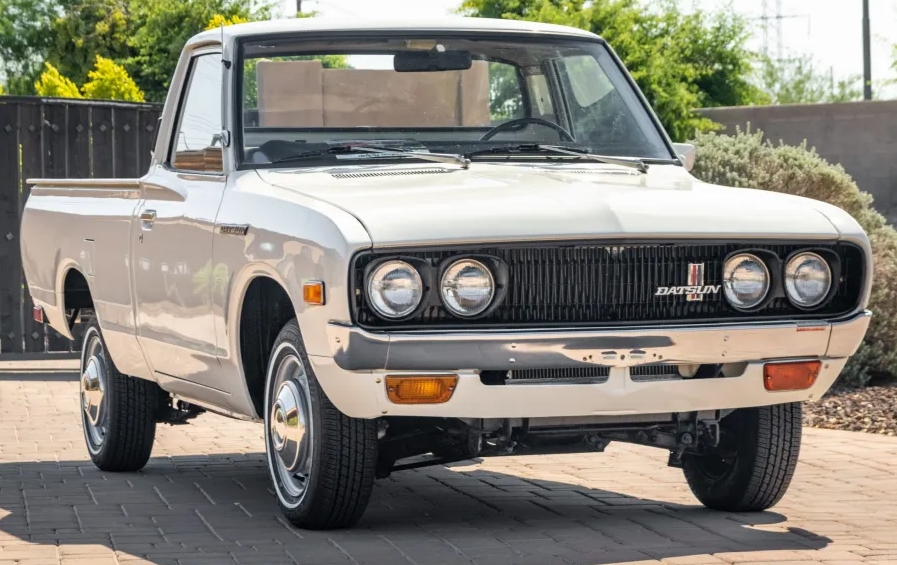
The exterior styling marked a distinct break from the utilitarian flat-fenders of the 1960s. The 620 featured a rounded, aerodynamic nose with integrated headlights and a distinct “Datsun 620” badge spanning the grille. The bed was longer than its predecessor, stretching to 78.7 inches, and featured a lower load floor height for easier cargo access. The cab was also wider, offering more shoulder room.
Trim Levels (1972–1973): Early 620s were offered in two primary configurations, identified largely by their badging rather than extensive cosmetic packages:
- Standard: The base model, featuring vinyl bench seating, painted steel wheels with hubcaps, and minimal chrome trim.
- Deluxe (LS): Added bucket seats (a rarity in trucks), a tachometer, woodgrain dash accents, additional chrome bumpers, and road wheels.
The Second Generation: 1974–1975
In late 1973, the automotive world was upended by the oil embargo. Suddenly, the fuel efficiency of the Datsun 620 became its greatest asset. For 1974, Datsun introduced a mid-cycle refresh that is often referred to as the “Second Generation” 620. While the chassis and engine remained largely unchanged, the aesthetics underwent a significant transformation.
The most noticeable change was the front end. The smooth, rounded grille of the early models was replaced by a flat face with a prominent chrome bumper and a new grille design featuring horizontal slats. This design was dictated by new US bumper impact regulations, requiring heavy, energy-absorbing bumpers that protruded further from the body.
Inside, the interior received a major upgrade. The dashboard was redesigned to house a new radio location and improved ventilation controls. The build quality, already a strong suit of Japanese manufacturing, was refined further with better-fitting panels and more durable upholstery materials.
Trim Levels (1974–1975):
- Base: Remained the work-spec model.
- Deluxe (LS): Continued as the top-tier trim, now featuring standard radial tires and upgraded exterior trim.
- The “S” Package: Toward the end of this period, Datsun introduced the “S” model designation. While not a distinct trim level in terms of luxury, the “S” denoted the updated Z20 engine compliance with stricter emissions standards.
It is worth noting that during this time, Datsun also produced the Datsun 610 in some markets (Australia and South Africa), which was a sedan version sharing the Z20 engine. However, in North America, the 620 truck remained the primary focus.
.
THIS might be a great place to get your new car from!
Or for those who are into the “car flipping” business, here’s an excellent resource for you!

.
The 1976 Model Year: The First Major Overhaul
1976 was a pivotal year for the 620. While the exterior dimensions remained compact, the truck received a facelift that modernized its silhouette. The front end was reshaped again, featuring a new grille with a “waterfall” design and flush-mounted headlights. The rear tailgate was redesigned with a “Datsun 620” stamped script, replacing the earlier bolt-on badges.
Mechanically, 1976 saw the introduction of the Z20-S engine. While retaining the 1.98L displacement, the engine was fitted with EGR (Exhaust Gas Recirculation) and thermal reactors to meet 1976 Federal emissions standards. Horsepower dropped slightly to 89 hp due to these emissions adjustments, but torque remained strong.
Trim Levels (1976):
- Standard: The bare-bones option for fleet buyers.
- Deluxe (LS): The premium option, now featuring upgraded carpeting, a dome light, and a cigarette lighter.
- Custom: A very rare trim that occasionally appeared in dealer inventories, essentially a Deluxe model with custom stripes and aluminum wheels.
1977–1979: The Long Bed and the Final Evolution
The final years of the 620 (1977–1979) represented the peak of the model’s development. Consumer demand for versatility grew, and Datsun responded.
The Long Bed (620L): For 1977, Datsun introduced the 620 Long Bed. This was a game-changer. While most compact trucks (like the Toyota Stout or Chevy LUV) were restricted to short beds, the 620L offered an 87.2-inch bed (the “L” designation specifically referred to this wheelbase extension). This was achieved by extending the frame behind the cab, allowing the truck to haul standard 4×8 plywood sheets flat on the bed floor—a feat previously reserved for full-sized trucks.
Engine Evolution (1978–1979): In 1978, the Z20 engine was further modified to comply with the US “Light Duty” emissions standards.
- Z20-L: Low-emission version (standard on most trucks).
- Z20-E: A version equipped with an EGR cooler and more sophisticated catalytic converters for California-spec models.
By 1979, the 620 was aging. While reliable, it lacked the amenities of newer competitors. However, it remained a bestseller due to its price point and durability.
1979 Trim Levels:
- Base: Vinyl seats, manual steering, manual brakes, steel wheels.
- Deluxe (LS): Power steering (optional), tachometer, woodgrain dash, cloth/vinyl seats, chrome bumpers, and a sliding rear window.
- Long Bed (L): Available in Base or Deluxe configurations, identified by the “L” suffix on the VIN.
- King Cab (Datsun 621): Technically a different model number (621), the King Cab (introduced in mid-1979) offered a small storage compartment behind the seats. While the 620 designation technically ended in 1979, the 621 King Cab was the direct successor and shared the same chassis.
Technical Specifications and Capability
Throughout its run, the Datsun 620 was defined by its mechanical simplicity:
- Transmission: 4-speed manual floor shift (standard). A 5-speed manual (overdrive) was available on Deluxe models starting in 1976. A 3-speed automatic was a rare option, usually reserved for the 621 King Cab.
- Drivetrain: Rear-wheel drive with a solid rear axle.
- Suspension: Independent double wishbone with coil springs at the front; leaf springs at the rear.
- Brakes: Drum brakes were standard on all four wheels until 1977, when front disc brakes became standard on the Deluxe trim to improve stopping power as safety regulations tightened.
- Payload: Rated for approximately 1,400 to 1,650 lbs depending on the year and bed length.
Legacy and Impact
The Datsun 620 is not merely a vintage truck; it is a historical pivot point. Before the 620, the “small truck” market in America was negligible. The 620 demonstrated that a vehicle didn’t need a V8 engine or a 100-inch wheelbase to be a capable hauler.
Its success forced the Big Three (GM, Ford, Chrysler) to take notice, eventually leading to the development of the Chevy S-10, Ford Ranger, and Dodge Dakota. The 620 also cemented the reputation of the Z-series engine, which would later be bored out to create the legendary Z24 engine used in the Hardbody trucks of the 1980s and 1990s.
In export markets like Australia and South Africa, the 620 (and its derivatives) became known as the “Carry-All” or “Stallion.” In these regions, it competed directly with the Holden Ute and Ford Falcon Ute, earning a reputation for being unbreakable.
Future Outlook
Today, the Datsun 620 has transitioned from a working tool to a cherished classic. Because these trucks were used hard and subjected to rust, surviving examples are becoming increasingly rare.
Current Market Trends:
- Survivors: Original, unmodified “survivor” trucks with patina and original paint are commanding high prices at auction.
- Restomods: There is a growing trend of restomodding 620s, often involving engine swaps (LS V8s or SR20DET turbos) and suspension upgrades, turning them into modern hot rods.
- Cultural Resurgence: With the rise of the “mini-truck” culture and the popularity of overlanding, the Datsun 620 is seeing a renaissance. Enthusiasts are retrofitting them with modern suspension, diesel engines, and expedition campers.
As the “JDM” (Japanese Domestic Market) scene continues to mature, vehicles that were once considered disposable—like the Datsun 620—are now being recognized for their build quality and historical significance. While you won’t see them on showroom floors, the Datsun 620 remains a vital, living piece of automotive history, still carrying loads and turning heads nearly 50 years after the last unit rolled off the line.