The Unlikely Giant: History of the Austin Mini
On August 26, 1959, the British Motor Corporation (BMC) unveiled a vehicle that would defy the automotive logic of the era. In a time when bigger was considered better, the Austin Mini was a radical statement of minimalism. Conceived not out of a desire for style, but out of necessity during the Suez Crisis fuel embargo, the Mini was designed to be small, economical, and surprisingly spacious. What began as a utilitarian solution to a fuel shortage evolved into a cultural icon, a motorsport legend, and one of the most significant automobiles of the 20th century.
The Genesis: Crisis and Innovation (1959–1960)
The story of the Mini begins with Leonard Lord, the managing director of BMC, who was determined to produce a small, fuel-efficient car to counter the German bubble cars that were gaining popularity in Britain. He tasked his brilliant designer, Alec Issigonis, with creating a prototype. Issigonis’s mandate was simple: fit a four-cylinder engine into a car that was no more than 10 feet (3 meters) long and 4 feet (1.2 meters) wide.
Issigonis achieved this through a revolutionary transverse engine layout, placing the engine sideways to maximize interior space. He also utilized 10-inch wheels with the tires mounted on the outside of the wheel wells to further increase cabin width. The suspension, featuring rubber cones rather than traditional springs, was another space-saving innovation.
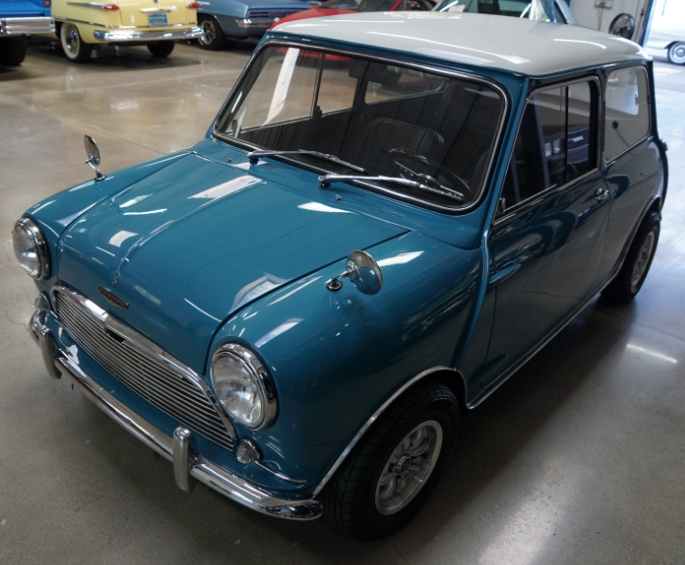
The Launch Models (1959–1960) When the car launched, it was sold under two names: the Austin Seven and the Morris Mini-Minor. This badge-engineering strategy was common at the time. The Austin Seven (often referred to simply as the “Seven”) featured a distinctive oval grille, while the Morris Mini-Minor had a flatter, more angular grille.
- Body Styles: Two-door sedan (saloon) and a commercial van variant.
- Trim Levels: Initially, trim was minimal. The early cars had sliding plastic side windows (later replaced by winding windows) and basic vinyl interiors. The dashboard was a simple metal panel, famously lacking a fuel gauge (drivers had to use a dipstick).
The Cooper and the Rise of the S (1961–1964)
The Mini’s fate changed forever in 1961 when racing legend John Cooper, a friend of Issigonis, saw the potential for a high-performance version. Cooper convinced BMC to let him tune the engine, increasing the power from 34 bhp to 55 bhp. The Mini Cooper was born.
Key Models (1961–1964):
- Austin Seven/Morris Mini-Minor: The standard models remained the entry-level options.
- Mini Cooper (998cc): Launched in 1961, this featured a tuned engine, disc brakes (a rarity at the time), and a sportier interior.
- Mini Cooper S (1071cc): Introduced in 1963, the “S” was a homologation special for racing. It featured a larger 1071cc engine, a twin-tank setup, and a close-ratio gearbox.
The 1964 Model Year Update: In late 1964, a significant update was introduced: the Mini Mk II. While visually similar, the Mk II featured a redesigned grille, external door hinges (replacing the earlier “suicide” doors), and a revised rear window. The interior received a new dashboard with a center speedometer (a hallmark of the Mini for decades).
The 850, 1000, and the 1275GT (1964–1969)
Following the success of the Cooper, BMC expanded the engine range to cater to different markets and budgets. The standard 848cc engine remained the base, but larger engines were introduced for export markets and performance enthusiasts.
Key Models (1964–1969):
- Mini 850 (848cc): The standard workhorse.
- Mini 1000 (998cc): Introduced around 1967, this engine became the new standard for higher-spec models, offering better reliability and performance than the earlier 998cc Cooper engine.
- Mini Cooper S (1275cc): In 1967, the Cooper S was updated with a 1275cc engine. This became the ultimate racing Mini, dominating the Monte Carlo Rally.
- Mini 1275GT (1275cc): Launched in late 1967 as a replacement for the Cooper (which was discontinued due to tax laws). The 1275GT was a “poor man’s Cooper,” featuring the larger engine but with a lower state of tune and a cheaper price tag. It was visually distinct with its blacked-out grille and specific trim.
The Mk III and the Wider Body (1969–1974)
In 1969, the Mini Mk III was introduced. The most significant change was the introduction of fixed windows (replacing the sliding windows) and the addition of external door handles with locks. However, the most notable structural change occurred in 1970 for the export markets (particularly the US and Switzerland): the Widebody.
Key Models (1969–1974):
- Mini 850, 1000, and 1275GT: These continued largely unchanged mechanically but received interior updates, including improved seats and the addition of a tachometer on sportier models.
- Mini Clubman (1969): A new front-end design was introduced for the Clubman, featuring a rectangular grille and a longer nose to accommodate a larger battery and improved crash protection. The Clubman was marketed as a slightly more upmarket family car.
- Mini 1275GT: Continued as the performance flagship until 1980.
- The Widebody (1970): To meet stricter crash regulations in the US, the Mini’s wheel arches were flared, and the track was widened. While the US market eventually rejected the Mini (emissions regulations killed it there in 1975), the wider body became standard for all Minis in later years, giving the car its iconic stance.
The Riley and Wolseley Era (1961–1969)
While the Austin and Morris badges were the most common, BMC also utilized the Mini platform for their premium brands, Riley and Wolseley, to compete with the small luxury cars of the time.
- Riley Elf (1961–1969): Based on the Mini Seven, the Elf featured a distinct “waterfall” grille, larger rear windows, and a longer boot (trunk) to house the spare wheel. It had a more luxurious interior with wood veneer dashboards.
- Wolseley Hornet (1961–1969): Similar to the Riley Elf but with a different grille design and slightly different trim. Both the Elf and Hornet were powered by the 848cc and later 998cc engines.
The 1974 “Rough Rider” and the Leyland Years
By the mid-1970s, the Mini was aging, but BMC (now part of British Leyland) kept it alive with special editions. In 1974, the Mini “Rough Rider” was introduced. This was a utility-oriented van/saloon featuring ruggedized suspension, vinyl seats, and a basic specification intended for commercial use.
The Austin/Morris Split: Throughout the 1970s, the distinction between Austin and Morris models blurred. In 1974, the “Austin” and “Morris” badges were standardized. The Mini 1000 became the primary model, featuring the 998cc engine. The “Mini” name began to stand alone, shedding the Austin or Morris prefix in many markets by the late 70s.
The MK IV and V: The Hydrastic Era (1976–1984)
In 1976, the Mini Mk IV was released. The most significant change was the introduction of plastic wheel arches (to cover rust issues) and a redesigned interior with a plastic dashboard. The rear subframe was also modified.
Key Models (1976–1984):
- Mini 1000: The mainstay of the range.
- Mini 1275GT: Continued until 1980, when it was discontinued due to the increasing cost of production.
- Mini “City” (1978): A special edition released to celebrate the Mini’s 20th anniversary. It featured a 998cc engine and unique “City” branding.
- Mini “Mayfair” (1980): A luxury trim level introduced to replace the 1275GT. It featured velour seats, a vinyl roof, and a more upscale finish.
In 1980, the Mini Mk V was introduced. This was largely an update to the Mk IV, featuring better rust protection (galvanized body panels) and a revised rear light cluster. The “Hydrastic” suspension (a self-levelling rear suspension system) was introduced on some models to improve ride quality.
.

.
The Italian Job and Cultural Icon (1960s–1980s)
It is impossible to discuss the evolution of the Mini without mentioning its cultural impact. In 1969, the film The Italian Job featured a trio of red, white, and blue Minis escaping through Turin’s sewers. This cemented the Mini’s status as a symbol of British cool and agility.
Throughout the 1980s, the Mini remained a fashion statement. It was no longer just a car; it was a lifestyle. The Mini “Sprite” (1981) and Mini “Mayfair” (1982) catered to this, offering stripes, decals, and sporty interiors.
The Final Years: Rover Group (1984–2000)
By the mid-1980s, the basic design was over 25 years old. However, the car was so profitable that British Leyland (later Rover Group) kept it in production with minimal changes.
The Mk VI, VII, and VIII (1984–2000):
- Mk VI (1984): A minor facelift with plastic bumpers replacing chrome ones.
- Mk VII (1990): The engine was finally updated to fuel injection (SPI), meeting new emissions standards. The 1275cc engine was reintroduced for the Mini “S” (1990–1996), a modern homage to the Cooper S.
- Mk VIII (1996): The final update featured a revised interior, airbags, and a catalytic converter.
The 40th Anniversary (1999): To celebrate 40 years, a limited run of 1,500 Mini 40th Anniversary models was produced. These featured a unique blue and white color scheme and were the last of the classic Minis to roll off the production line.
Production End: Classic Mini production finally ceased on October 4, 2000, at the Longbridge plant in Birmingham. The last car was a red Mini Cooper, number 5,387,946.
Technical Evolution Summary
Throughout its 41-year production run, the Mini underwent several mechanical changes:
- Engines:
- 848cc (1959–1967)
- 998cc (1967–2000)
- 1098cc (1967–1970, primarily for export)
- 1275cc (1967–2000)
- Transmissions:
- 4-speed manual (standard until 1996).
- 4-speed automatic (Hydramatic, then 3-speed automatic).
- 5-speed manual (introduced in the 1990s on the Cooper S).
- Suspension:
- Rubber cones (early years).
- Hydrastic (1980s).
- Coil springs (later years).
Future Outlook and Legacy
The Austin Mini (and its successors) left an indelible mark on automotive history. It proved that small cars could be fun, safe, and practical. Its front-wheel-drive layout became the standard for economy cars worldwide.
In 2001, BMW (who had acquired the Rover Group) launched the “New Mini,” a retro-styled tribute to the original. While the New Mini is significantly larger and more complex, it carries the spirit of the original.
Today, the classic Austin Mini is a highly sought-after collector’s item. From the rare 1959 Austin Seven to the 1990s Cooper S, these cars are celebrated at shows worldwide. They remain a testament to Alec Issigonis’s genius: a car that was smaller on the outside than it was on the inside.
The Austin Mini was more than a car; it was a revolution on four wheels. It democratized motoring, dominated rally stages, and became a canvas for personal expression. Its evolution from a bare-bones economy car to a global icon is a story of resilience and brilliant engineering. As we look back on its 41-year history, the Mini stands as a giant in the automotive world, proving that size truly does not matter.