The Unsung Hero: A Comprehensive Guide to the Toyota Sienta
In the vast and varied landscape of the automotive world, dominated by sleek sedans and rugged SUVs, there exists a category of vehicle that champions practicality above all else. These are the unsung heroes of daily life, designed not for the racetrack or the rugged trail, but for the complex ballet of school runs, grocery hauls, and family road trips. Among these champions of utility, the Toyota Sienta stands out as a masterclass in compact, clever design. A small MPV (Multi-Purpose Vehicle) with a giant heart, the Sienta has carved out a fiercely loyal following, primarily in Japan and Southeast Asia, by offering maximum space and versatility within a minimal footprint. This is the story of a vehicle that proves good things truly do come in small packages.
A Brief History: The Need for a Compact Colossus
The genesis of the Sienta can be traced back to the early 2000s. In dense, urban environments like those found across Japan, vehicle ownership comes with a unique set of challenges: narrow streets, tight parking spaces, and high taxes based on vehicle size and engine displacement. Traditional minivans, while practical, were often too large and cumbersome for this landscape. Toyota identified a clear market gap for a vehicle that could offer the three-row seating and sliding-door convenience of a minivan, but with the compact dimensions and fuel efficiency of a subcompact car.
The name “Sienta” itself is a portmanteau, creatively blending the Spanish word “siete” (seven) and the English word “entertain.” This fusion perfectly encapsulated the vehicle’s core mission: to comfortably entertain up to seven passengers in a fun, practical, and compact package. Built on a modified version of the successful Toyota Vitz/Yaris platform, the Sienta was engineered from the ground up to be the ultimate urban family hauler.
The Playful Pioneer: First Generation (XP80; 2003-2015)
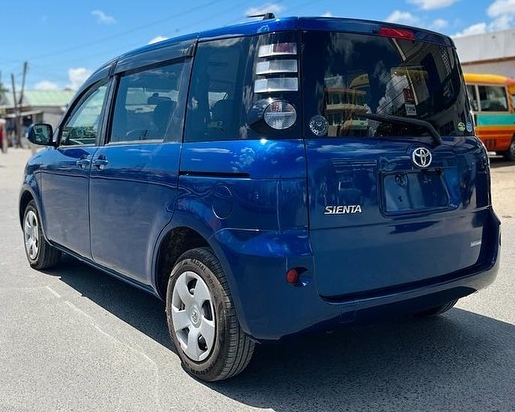
The first-generation Toyota Sienta debuted in September 2003, and its design was immediately distinctive. With its tall-boy profile, large bubble-like headlamps, and friendly, rounded aesthetic, it looked approachable and non-intimidating. It was a vehicle designed to be a useful tool, free from aggressive styling pretensions.
Key Features and Design:
- Platform: Based on the NBC (New Basic Car) platform shared with the Vitz, the Sienta offered a surprisingly nimble and easy-to-drive experience.
- Packaging: Its crowning achievement was its interior packaging. Despite being just 4,100 mm (161.4 inches) long, it featured three rows of seats. The third row could cleverly be folded and tumbled under the second-row seats, creating a flat and cavernous luggage area—a feature that was revolutionary for its class. The power sliding door (typically on the passenger side) was a godsend for families with small children or for parking in tight spots.
- Powertrain: The XP80 Sienta was powered by a single, reliable engine option: the 1.5-liter 1NZ-FE VVT-i four-cylinder petrol engine, producing around 110 horsepower. This was paired exclusively with a Super CVT-i (Continuously Variable Transmission) that optimized fuel efficiency for city driving. It was available in both front-wheel-drive (FWD) and a viscous-coupling all-wheel-drive (AWD) configuration.
Models and Trim Levels: The trim structure for the first generation was straightforward, primarily revolving around two main grades:
- X: The base model, offering the core Sienta experience with essential features like air conditioning, power steering, and the versatile seating arrangement. The power sliding door was often an optional extra.
- G: The higher-spec model, which added creature comforts such as a standard power sliding door, automatic climate control, better upholstery, and more interior trim options.
In 2006, the Sienta received a mid-cycle facelift with revised front and rear bumpers and new color options. More significantly, this refresh introduced a new, sportier trim level:
- Sienta DICE: Aimed at a younger demographic, the DICE featured a more aggressive, angular front bumper and grille, smoked headlamps and taillights, and unique interior trim. It retained the same practical interior but wrapped it in a visually distinct package.
The first-generation Sienta enjoyed a remarkably long production run of nearly 12 years, a testament to its fundamentally sound design and enduring popularity.
.
NO MORE dead batteries with this:

.
The Trekking Shoe Revolution: Second Generation (XP170; 2015-2022)
After over a decade, Toyota completely reimagined the Sienta for its second generation, launched in July 2015. Chief Engineer Hiroshi Kayukawa famously stated that the design inspiration came from the functionality and style of a trekking shoe. The result was one of the most polarizing and instantly recognizable vehicle designs of the decade.
Key Features and Design:
- Exterior: The XP170 Sienta was a radical departure from its predecessor. It featured bold, sweeping lines that ran from the headlights down to the lower grille and from the windows to the rear wheels, often highlighted by a contrasting black or colored plastic trim. These “tear streaks” or “garnish” elements were highly divisive but ensured the Sienta stood out in any parking lot. The overall shape was lower and more dynamic.
- Interior: The cabin was equally revolutionary. A flowing, multi-layered dashboard incorporated a high-mounted digital instrument cluster. The use of vibrant orange accent stitching and trim on certain models gave it a youthful, energetic feel. The interior space was further improved with a lower, flatter floor and “stadium-style” seating that gave rear passengers a better view forward.
- Powertrain: This generation marked the introduction of a highly efficient hybrid option.
- Petrol: A new 1.5-liter 2NR-FKE engine with VVT-iE offered improved thermal efficiency and fuel economy.
- Hybrid: The star of the show was the Toyota Hybrid System II, pairing a 1.5-liter 1NZ-FXE Atkinson cycle engine with an electric motor. This system, shared with the Aqua/Prius C, delivered class-leading fuel economy, often exceeding 27 km/L (63 MPG) on the Japanese JC08 cycle.
Models and Trim Levels: The trim lineup was expanded to cater to a wider range of buyers:
- X: The entry-level model, now better equipped than its predecessor and available in both petrol and hybrid versions.
- G: The mid-range, volume-selling trim, adding Toyota Safety Sense C (a suite of active safety features), dual power sliding doors, and smarter interior materials.
- G Cuero: Introduced later, this became the top-tier luxury trim, featuring synthetic leather upholstery and additional premium touches.
- Funbase: Responding to customer demand for more luggage space, Toyota introduced a two-row, five-seater version called the Sienta Funbase in 2018. This model boasted a massive, flat, and versatile cargo area, making it ideal for outdoor enthusiasts or small business owners.
- Welcab: Toyota also offered a comprehensive range of “Welcab” models, factory-modified for users with disabilities, including versions with wheelchair ramps or rotating lift-up seats.
The second-generation Sienta was an enormous commercial success, frequently topping the sales charts in Japan and becoming a fixture on the roads of Hong Kong, Singapore, and Indonesia.
Maturity and Modernity: Third Generation (XP210; 2022-Present)
Launched in August 2022, the third-generation Sienta represents a shift towards refinement and modern user-friendliness. While retaining the core DNA of its predecessors, it tones down the quirky styling in favor of a softer, more universally appealing aesthetic.
Key Features and Design:
- Platform: The latest Sienta is built on the advanced TNGA-B (Toyota New Global Architecture) platform, the same one that underpins the modern Yaris and Yaris Cross. This brings significant improvements in structural rigidity, ride comfort, handling dynamics, and crash safety.
- Exterior: The “trekking shoe” concept has been evolved into what Toyota calls a “Shikakumaru” (square and circle) design language. The sharp angles are gone, replaced by rounded corners and softer lines. Large, protective side mouldings add a touch of ruggedness and practicality, defending against door dings. The beltline is lower and the windows are larger, dramatically improving visibility for all passengers.
- Interior: The cabin is designed for ultimate ease of use. It features a modern layout with a large central touchscreen, digital instrument cluster options, and clever storage solutions like front-seat smartphone pockets and cupholders. The use of pleasant-to-the-touch fabric on the dashboard and door panels creates a warm, lounge-like atmosphere. The interior height has been increased, making it even easier to move around inside.
- Powertrain: The powertrains are the latest from Toyota’s “Dynamic Force” engine family.
- Petrol: A 1.5-liter M15A-FKS three-cylinder engine paired with a Direct Shift-CVT provides responsive and efficient performance.
- Hybrid: The new-generation 1.5-liter M15A-FXE hybrid system is more powerful and significantly more efficient than the outgoing model, achieving world-class fuel economy. It is also available with Toyota’s E-Four system, which adds a small electric motor to the rear axle for on-demand all-wheel drive.
Models and Trim Levels: Toyota simplified the trim structure to make the buying process easier:
- X: The well-equipped base model, available in 5- and 7-seater configurations. It comes standard with the latest Toyota Safety Sense package.
- G: The mid-grade trim, adding features like dual power sliding doors with kick sensors, upgraded interior materials, and more USB ports.
- Z: The top-tier luxury grade, featuring premium fabric upholstery, a larger infotainment screen, adaptive high-beam headlights, and exclusive bi-tone color options.
Future Outlook and Global Relevance
The Toyota Sienta’s success lies in its unwavering focus on its target audience: urban families who need maximum utility without the bulk. Its primary competitor has always been the Honda Freed, and the two vehicles continue to battle for the top spot in the compact MPV segment.
While the Sienta remains a product primarily for Asia, its design philosophy is more relevant than ever. As cities become more crowded and environmental concerns grow, the demand for smaller, more efficient, and space-maximized vehicles will only increase. The Sienta’s evolution, particularly with its latest hybrid technology and TNGA platform, positions it perfectly for this future.
Looking ahead, the logical next step for the Sienta nameplate would be further electrification. While a full battery-electric (BEV) version may still be some years away, the TNGA-B platform is compatible with such technology. A plug-in hybrid (PHEV) variant could be an intermediate step, offering extended electric-only range for city commuting.
In conclusion, the Toyota Sienta is far more than just a small van. It is a triumph of packaging, a case study in understanding customer needs, and a vehicle that has evolved from a playful pioneer into a sophisticated and modern family companion. For millions of families, it is the perfect, indispensable tool for navigating the complexities of modern life—an unsung hero that quietly and reliably gets the job done, one sliding door at a time.