The Unsung Workhorse: A Comprehensive History of the Daihatsu Rugger (FourTrak/Rocky)
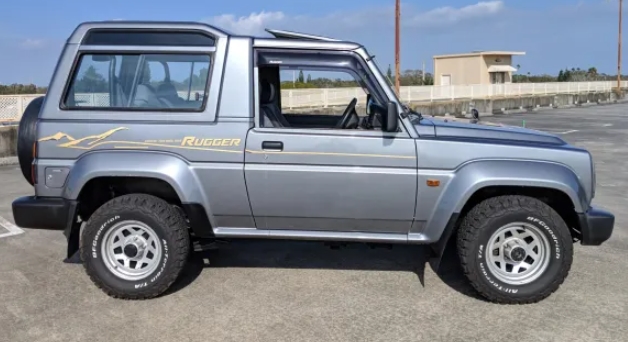
The landscape of 4×4 vehicles in the 1980s and 1990s was dominated by behemoths like the Toyota Land Cruiser and the Nissan Patrol, but a niche existed for something smaller, lighter, and uncompromisingly tough. Into this space roared the Daihatsu Rugger. Known globally by a confusing array of names—including the Daihatsu FourTrak in Europe and the Daihatsu Rocky in North America and Australia—the Rugger lineage, born from the utilitarian Taft, carved out a formidable reputation for reliability, mechanical simplicity, and incredible off-road capability.
While never achieving the sheer sales volume of its larger rivals, the Rugger (and its variants) became the go-to utility vehicle for farmers, expedition drivers, and military forces worldwide. This article provides a comprehensive, factual history of the Rugger, detailing its specifications, production years, and the complex array of models and trim levels offered during its two-decade run.
Brief History: From Taft to Rugger
Daihatsu, specializing in small cars and utility vehicles, had established its 4×4 pedigree long before the Rugger’s introduction. The true genesis of this lineage lies with the Daihatsu Taft (F10 Series), introduced in 1974. The name “Taft” was an acronym for “Tough and Almighty Four-wheel Touring.”
The Taft was a classic, bare-bones utility vehicle directly targeting the Suzuki Jimny and Jeep CJ series. It featured a short wheelbase, leaf spring suspension, and a sturdy ladder frame. The Taft proved Daihatsu’s ability to build a durable 4WD platform, laying the foundation for the more robust and refined Rugger that followed a decade later. Production of the original Taft mostly ceased by 1984, paving the way for the Rugger generation.
.
NO MORE dead batteries with this:

.
Generation One: The Original Rugger (F70/F80 Series)
The first-generation Rugger was introduced in 1984, developed as a significantly more powerful and slightly more comfort-focused successor to the Taft. This generation established the core identity of the vehicle: a compact, durable 4WD designed for hard use.
Production Years and Nomenclature
- Production Run: 1984 – 1993
- Japan: Daihatsu Rugger
- UK/Europe: Daihatsu FourTrak
- North America/Australia: Daihatsu Rocky
Chassis and Body Styles
The F70/F80 series offered a wide range of body styles to meet global market demands, often categorized by their chassis code suffixes:
| Chassis Code | Body Style | Description and Use |
|---|---|---|
| F70 / F75 | Short Wheelbase (SWB) | Two-door, often with a soft top or removable hardtop. Focused on agility and extreme off-roading. |
| F80 / F85 | Long Wheelbase (LWB) | Four-door wagon or traditional commercial van, offering greater passenger and cargo capacity. |
| F77R / F87R | Resignated Models | Often used for specific van or commercial use variations in the European market. |
Engines Offered (F70/F80 Series)
The Rugger was renowned for its reliance on simple, reliable engines, particularly its diesel lineup.
| Engine Code | Type | Displacement | Fuel | Output (Approx.) | Key Markets |
|---|---|---|---|---|---|
| DG | I4 SOHC | 2.0L | Gasoline | 64 kW (86 hp) | Japan, Limited Export |
| 3Y / 4Y | I4 OHV (Toyota derived) | 2.0L / 2.2L | Gasoline | 70–75 kW | Export (Rocky/FourTrak) |
| DL50 | I4 SOHC | 2.7L | Diesel (Naturally Aspirated) | 55 kW (74 hp) | Global Utility |
| DL52T | I4 SOHC | 2.7L | Turbo Diesel | 67 kW (90 hp) | Global (Performance Option) |
Trim Levels (First Generation)
Trim levels varied significantly depending on the market and the intended application (Passenger vehicle vs. Commercial vehicle).
Japanese Domestic Market (Rugger)
The JDM trims often focused on higher specification and comfort for the passenger models:
- Rugger DX: The base utility model, often with minimal amenities, steel wheels, and vinyl interiors. Primarily used for commercial or fleet purposes.
- Rugger SX: Mid-range trim, offering features like power steering (optional), tachometer, and improved cloth seating.
- Rugger SG: The top-tier passenger model, especially prominent on the LWB (F80) wagons. Featured alloy wheels, factory air conditioning, and often the standard turbo diesel engine.
- Rugger Commercial: Stripped-down van versions (often F87) designed to meet classification rules in Europe for tax purposes, featuring blanked-out rear windows and minimal seating.
European/North American Market (FourTrak/Rocky)
In export markets, trims were often dictated by body style:
- Rocky SE: Base model SWB (North America).
- FourTrak Fieldman: Base model LWB or SWB, denoting a heavy-duty, utilitarian vehicle.
- FourTrak DL/TDL: Mid-range models, often featuring the naturally aspirated (DL) or turbo diesel (TDL) engine, and more comfortable interiors.
- FourTrak Estate/Wagon: The full LWB four-door passenger version, typically offering the highest level of comfort, heating, and integrated audio systems.
Generation Two: Refinement and Modernization (F70/F90 Series)
By the early 1990s, the market demanded greater refinement, safety features, and compliance with stricter emissions standards. Daihatsu responded with the second generation of the Rugger, retaining the robust chassis while significantly updating the body, interior, and engine lineup.
Production Years and Nomenclature
- Production Run: 1993 – 2002 (Production continued in some markets, notably Indonesia, until 2007)
- Japan: Daihatsu Rugger
- UK/Europe: Daihatsu FourTrak
- Indonesia/Australia: Daihatsu Taruna/Rocky (Note: The F90 lineage overlapped with the smaller, more lifestyle-focused F300 series, globally known as the Feroza/Sportrak/Rocky, but the core Rugger chassis remained distinct and heavier duty).
Chassis and Body Styles
The F90 chassis retained the heavy-duty ladder frame and solid axles (though suspension geometry was refined) but featured a smoother, more aerodynamic exterior design. The LWB wagon became significantly more popular in passenger markets.
| Chassis Code | Body Style | Notes on Evolution |
|---|---|---|
| F90 | Short Wheelbase (SWB) | Maintained the two-door format; emphasized sporty styling and agility. |
| F95 | Long Wheelbase (LWB) | The primary four-door passenger wagon; offered more luxurious interior options. |
Engines Offered (F70/F90 Series)
The second generation introduced the critically acclaimed HD series gasoline engines and upgraded the diesel offerings with intercooling for better performance and efficiency.
| Engine Code | Type | Displacement | Fuel | Output (Approx.) | Key Features |
|---|---|---|---|---|---|
| HD-E | I4 SOHC | 1.6L | Gasoline (EFI) | 77 kW (103 hp) | Smooth, modern, used mainly in SWB models. |
| HD-EFI | I4 SOHC | 2.0L | Gasoline (EFI) | 88 kW (118 hp) | Used in LWB models; greater low-end torque. |
| DL-T | I4 SOHC | 2.8L | Turbo Diesel | 67 kW (90 hp) | Updated version of the original 2.7L diesel. |
| DL-TCI | I4 SOHC | 2.8L | Intercooled Turbo Diesel | 75 kW (101 hp) | Peak diesel performance; highly sought after for reliability. |
Trim Levels (Second Generation)
The F90 series saw greater differentiation between utility and passenger models, especially in Japan and Europe.
Japanese Domestic Market (Rugger)
- Rugger SX: The entry-level model, often equipped with the 2.8L diesel. Focused on utility and durability.
- Rugger ZR: Mid-range comfort package, featuring improved sound insulation, electric windows, and better cloth upholstery.
- Rugger ZRX / ZXR: Top-spec model, featuring the 2.0L gasoline engine, automatic transmission option, multi-media system (for the time), and luxury appointments like chrome trim and two-tone paint.
- Rugger “Fieldman” Special Edition: A rugged edition often fitted with heavy-duty accessories like winches, spotlights, and reinforced bumpers (Japanese and European markets).
European Market (FourTrak)
In Europe, the name “FourTrak” defined the platform, with trims highlighting utility and luxury:
- FourTrak Commercial: Base van model (tax-exempt in many areas), prioritizing cargo space and the robust DL-T diesel.
- FourTrak E Series (Economy): Base passenger specification, usually SWB, with vinyl or simple cloth interior, aimed at the budget utility market.
- FourTrak TDX / TDXi: Mid-to-high specification, denoting the Turbo Diesel (TDX) or Intercooled Turbo Diesel Injection (TDXi). Often included power steering, central locking, and available air conditioning.
- FourTrak Grand Estate: The top-of-the-line LWB model, offering the most comfortable ride, full carpets, and options like heated seats and anti-lock brakes (ABS)—a rare feature on early 90s utility 4x4s.
Engineering and Drivetrain
The Rugger’s success stemmed not from high-tech complexity but from its straightforward, heavy-duty mechanicals.
The Chassis and Suspension
Both generations utilized a traditional body-on-frame construction with an immensely strong ladder chassis.
- Axles: The Rugger series featured solid front and rear axles, a design choice favored for its durability and articulation in extreme off-road conditions, contrasting with the Independent Front Suspension (IFS) adopted by many competitors in the 1990s.
- Suspension:
- Gen 1 (F70/F80): Utilized robust, reliable leaf spring suspension on all four corners. This provided high load capacity and excellent durability but contributed to a rougher ride.
- Gen 2 (F90): Retained the solid axles but transitioned to coil springs at the rear and, critically, torsion bar independent front suspension (IFS) and trailing links at the front on most passenger models. This was a crucial modification designed to improve on-road handling and passenger comfort, though the IFS reduced the articulation slightly compared to the leaf-sprung Gen 1.
The 4WD System
The Rugger employed a classic, part-time four-wheel-drive system:
- High Range (2H): Rear-wheel drive for pavement driving.
- High Range (4H): Four-wheel drive (for loose surfaces).
- Low Range (4L): Gearing reduction for steep climbs, heavy pulling, or extreme off-roading.
Most models featured manual locking hubs on the front axle, necessary to engage 4WD. Later F90 models offered automatic free-wheeling hubs as standard on higher trims.
The Diesel Advantage
The 2.8L DL-TCI engine is arguably the heart of the Rugger’s legend. This intercooled, indirect-injection four-cylinder diesel was noted for its low-rev torque delivery and ability to run reliably on varying fuel qualities globally. Its mechanical injection pump meant high resistance to complex electronics failures, making it a favorite for remote area travel.
The FourTrak vs. The Feroza/Sportrak Confusion
It is crucial to distinguish the Rugger (F70/F90, the heavy-duty model) from the Daihatsu Feroza (or Sportrak in the UK, Rocky in Oceania/Japan, F300 series chassis).
The Feroza (produced 1989–1998) was built on a different, smaller, and vastly lighter platform. It featured a focus on gasoline engines (1.6L HD series) and full independent suspension, aiming at the burgeoning ‘SUV’ or lifestyle market. The Rugger/FourTrak remained the dedicated, heavy-duty utility vehicle throughout its lifespan.
Legacy and Future Outlook
The Daihatsu Rugger officially concluded production in most major markets by 2002 (with some specialized, low-volume production lasting slightly longer in Asia). Daihatsu subsequently shifted its focus entirely toward compact city cars, minivans, and lightweight SUVs, driven by its closer integration into the Toyota Group.
Current Collector Status
Today, the Rugger (or FourTrak/Rocky) enjoys a robust and growing following among enthusiasts. Its appeal lies in three key areas:
- Durability: The simple mechanics and rugged chassis mean that even high-mileage examples are relatively easy to maintain and repair.
- Value Proposition: As the prices for period rivals like the Toyota Land Cruiser 70-series and Mercedes G-Wagen have skyrocketed, the Rugger offers comparable off-road capability for a fraction of the cost, making it a “smart” classic 4×4.
- Overlanding Potential: The LWB models, particularly those with the 2.8L intercooled diesel engine, are highly prized by the overlanding community for their reliability and ease of modification.
Future Outlook for the Nameplate
While the Daihatsu brand no longer sells new vehicles in many Western markets (exiting Europe in 2013), the Rugger nameplate occasionally surfaces in concept discussions. However, given modern safety and emissions mandates, any true revival would likely require a complete chassis redesign, probably based on a shared Toyota platform.
The primary “future” of the Rugger is its legacy: continuing its life as a dependable second-hand workhorse for the remainder of its mechanical lifespan, cementing its status as one of the toughest, most understated Japanese 4x4s of its era. The Daihatsu Rugger was not a luxury vehicle; it was a tool, and a tool built exceptionally well to last.