The Vector M12: America’s Forgotten Supercar Experiment
In the 1990s, the supercar world was dominated by European names like Ferrari, Lamborghini, and McLaren. America’s contribution to the ultra-exotic segment was minimal, but one company — Vector Aeromotive Corporation — sought to change that. The Vector M12, produced from 1995 to 1999, was the result of an ambitious and controversial chapter in American automotive history. Intended as a follow-up to the wild, wedge-shaped Vector W8, the M12 had the styling and performance aspirations of a true exotic, but its development story and reception were far more turbulent.
This article will explore the M12’s origins, specifications, variants, production run, and eventual fate, along with a look at its legacy and the possibility (or improbability) of a revival.
The Origins of Vector Aeromotive
Vector Aeromotive was founded in the late 1970s by automotive designer and engineer Gerald Wiegert. Wiegert’s vision was to create an American supercar capable of competing with the best from Italy and Germany. The first production model, the Vector W8, arrived in the early 1990s, powered by a twin-turbocharged V8 producing over 600 horsepower. The W8 was extreme, rare, and expensive, with only 17 examples built, but it gained attention for its futuristic styling and impressive performance claims.
However, financial instability plagued Vector from the beginning. By the mid-1990s, a takeover by Indonesian company Megatech — which also owned Lamborghini at the time — resulted in Wiegert being forced out of his own company. This change in management directly influenced the creation of the M12.
.

.
Development of the Vector M12
The M12 was conceived under Megatech’s leadership as a more production-ready, commercially viable exotic than the W8. Rather than develop an entirely new powertrain from scratch, the company decided to base the M12 on components from Lamborghini’s then-current model, the Diablo. This decision was both practical and controversial: the M12 would use a Lamborghini-sourced V12 engine and parts of the Diablo’s chassis architecture, but wrapped in a unique Vector-designed body.
This approach was intended to solve two problems:
- Reliability and emissions compliance – The Diablo’s engine was already certified for road use in the U.S.
- Development costs – Using an existing powertrain would reduce expenses compared to developing a proprietary engine.
The result was a car that looked distinctly “Vector” on the outside but was mechanically tied to an Italian supercar.
Design and Styling
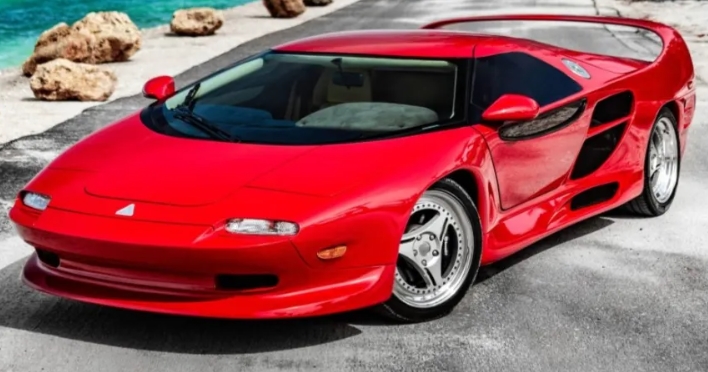
The Vector M12’s styling was dramatic, with sharp creases, a low wedge profile, and prominent air intakes. While it retained some visual DNA from the earlier W8, it was smoother and more organic in shape, aligning more closely with mid-1990s supercar design trends. The body panels were made primarily from fiberglass and composite materials, mounted over a tubular steel spaceframe.
The cabin was more conventional than the W8’s fighter jet–inspired interior, but it still featured a driver-focused layout, leather upholstery, and high-end trim. The M12’s interior was criticized by some for lacking the uniqueness and high-quality finish expected in its price range, especially compared to European rivals.
Specifications
The heart of the Vector M12 was a 5.7-liter Lamborghini V12 engine, naturally aspirated, producing around 492 horsepower and 425 lb-ft of torque. This engine was mated to a five-speed manual transmission driving the rear wheels. Performance figures were competitive for the era:
- 0–60 mph: Approximately 4.8 seconds
- Top speed: Around 189 mph (304 km/h)
- Curb weight: Roughly 3,600 lbs (1,633 kg)
While these numbers were impressive, they fell short of some of the M12’s contemporaries, such as the Ferrari F50 or McLaren F1, which were lighter and quicker.
Models and Trim Levels
The Vector M12 was offered in a few notable variants during its short life:
1. Vector M12 (Base Model) – 1995–1999
This was the standard production version, equipped with the Lamborghini V12 and a five-speed manual gearbox. Available in a variety of exterior colors, it featured Vector’s distinct wedge styling and a relatively high level of standard equipment.
2. Vector SRV8 – Prototype / One-off
Although not technically a trim of the M12, the SRV8 was a related model developed after the M12 in the late 1990s. It replaced the Lamborghini V12 with an American V8 engine and served as a testbed for future Vector designs. Only a single prototype was built, and it never entered mass production.
3. Vector M12 Racing Version (Prototype)
A racing variant of the M12 was built to compete in professional motorsport, specifically in the IMSA GT Championship. This car featured modifications for track use, including a stripped interior, racing suspension, and aerodynamic changes. However, it suffered mechanical issues in competition and did not achieve notable success.
Production Numbers
The Vector M12 was hand-built in extremely small numbers at the company’s facility in Green Cove Springs, Florida. Production was slow and plagued by quality control issues and financial instability. In total, only 14 Vector M12s were produced between 1995 and 1999, including prototypes. This extreme rarity has made the M12 an unusual and obscure collectible in the modern supercar market.
Market Reception
The M12 faced mixed to negative reviews from automotive journalists. On paper, it was an exotic with a prestigious engine, striking looks, and American pedigree. In practice, it was criticized for:
- Handling – Reviewers found the M12 heavy and less agile than competitors.
- Build quality – Fit and finish issues were common.
- Price – At around $189,000 in the mid-1990s, it was priced against better-known and more refined supercars.
- Identity crisis – Some felt that using a Lamborghini engine undermined Vector’s claim of being a uniquely American supercar manufacturer.
Despite this, the M12 did attract a small but passionate group of buyers who appreciated its rarity and distinctive styling.
Motorsport Efforts
The M12’s brief foray into racing came in 1998, when Vector entered a modified version into the IMSA GT Championship. The effort was short-lived: the car failed to finish its debut race at Sebring due to mechanical failure, and the project was quickly abandoned. This lack of motorsport success further hampered the M12’s credibility in the supercar world.
Demise of the M12 and Vector
By 1999, Vector Aeromotive was in financial ruin. Poor sales, high production costs, and the failure to establish the M12 as a credible alternative to European rivals led to the end of production. Megatech sold its interest in Vector, and Gerald Wiegert briefly regained control of the brand, but by then the company was effectively dormant.
Legacy and Collectibility
Today, the Vector M12 is remembered as a curious footnote in supercar history — a bold but flawed attempt to blend American branding with Italian engineering. Its extreme rarity, combined with its unusual backstory, has made it a collector’s item for enthusiasts of obscure exotic cars. Auction appearances are rare, but when an M12 does surface, it often sells for significantly more than its original MSRP, reflecting its scarcity rather than its performance credentials.
Future Outlook
The likelihood of a true Vector revival is slim. Gerald Wiegert, the brand’s founder and most vocal champion, passed away in 2021. Without his leadership and given the current dominance of established supercar brands, a return of Vector as a viable manufacturer seems unlikely. However, the renewed interest in 1990s and early-2000s supercars has sparked curiosity about the M12 among younger enthusiasts and collectors.
Electric hypercars and hybrid performance vehicles now define the cutting edge of the exotic market, meaning that any hypothetical Vector revival would need to embrace new technology while honoring the brand’s original ethos of American performance innovation. Still, given the M12’s troubled history, its story is more likely to remain a fascinating piece of automotive trivia rather than the foundation for a new model.
Conclusion
The Vector M12 was an ambitious but ultimately ill-fated supercar. Produced from 1995 to 1999 in just 14 units, it represented a major shift for Vector Aeromotive under foreign ownership, swapping the radical, homegrown engineering of the W8 for Italian mechanicals in an attempt to reach the market more quickly.
While it failed to achieve commercial or motorsport success, the M12 stands as a rare artifact of an era when the idea of an American-built exotic was still novel. For collectors, it offers a blend of rarity, dramatic styling, and a fascinating backstory — a reminder that in the supercar world, the line between bold innovation and overreach can be razor thin.
Key Facts Recap:
- Manufacturer: Vector Aeromotive Corporation
- Years Produced: 1995–1999
- Total Production: 14 units (including prototypes)
- Engine: 5.7L Lamborghini V12, ~492 hp
- Transmission: 5-speed manual
- Top Speed: ~189 mph
- Variants: Standard M12, M12 Racing Prototype, related SRV8 prototype
- Legacy: Rare, controversial, and collectible in niche circles