The Versatile Workhorse Legacy: History of The International Paystar
In the world of heavy-duty trucks, certain names evoke a sense of ruggedness and unwavering capability. For decades, the International Paystar has been one such name. A direct successor to the legendary “Loadstar,” the Paystar was not just a single truck but a versatile platform that became a fixture in construction, logging, utility, and municipal fleets across North America. Its evolution reflects the changing demands of the trucking industry, from the chrome-nosed classics of the mid-60s to the aerodynamic workhorses of the 21st century. This is the story of the International Paystar, a true icon of hard work.
The Genesis: The Loadstar Foundation (1962-1969)
To understand the Paystar, one must first look at its predecessor, the International Loadstar. Introduced in 1962, the Loadstar was a revolutionary truck for International Harvester. It featured the “Cargostar” style cab, a cab-over-engine (COE) design with a low cab floor and a distinctive, prominent grille. This design offered superior visibility and a more aerodynamic profile than the long-nosed conventional trucks of the era. The Loadstar quickly established itself as a tough and versatile platform, available in a wide range of configurations. It was the Loadstar that set the stage for what would become the Paystar line.
First Generation: The Birth of a Powerhouse (1970-1977)
In 1970, International Harvester decided to elevate the Loadstar’s capabilities. They introduced the “Paystar” name as a new top-of-the-line, severe-service trim level. These early Paystars were still fundamentally Loadstars, identifiable by their square, flat-fronted cab design, but they were equipped with more robust components.
- Model Designation: The Paystar designation was typically applied to the 1600, 1700, 1800, and 1900 series Loadstar models.
- Key Features: The Paystar trim was an appearance and capability package. It included a prominent chrome “Paystar” script on the grille, chrome bumpers, and interior upgrades. Crucially, it signified the availability of higher-GVWR (Gross Vehicle Weight Rating) chassis, heavy-duty axles, and more powerful engine options.
- Engines: Power came from a range of International engines, including the venerable DV-550 (a 264 cubic inch V8), the IDI-345 (a 345 cubic inch V8), and the powerful and popular DT-466 inline-six diesel.
- Models and Trim Levels:
- Paystar 1600/1700: Lighter-duty models often used as tow trucks, delivery trucks, or in light municipal service.
- Paystar 1800/1900: The heavyweights of the first generation. These were true vocational trucks, configured as dump trucks, cement mixers, and haulers. The 1900 series was often available in an 8×4 axle configuration for extreme loads.
The first-generation Paystar was a tough, no-nonsense truck, defined by its squared-off cab, chrome detailing, and mechanical simplicity. It was a favorite among owner-operators in construction and agriculture who needed a dependable, customizable machine.
.
THIS might be a great place to get your new car from!
Or for those who are into the “car flipping” business, here’s an excellent resource for you!

.
Second Generation: The Aerodynamic Transformation (1978-1988)
In 1978, International Harvester gave its cab-over line a major update. The old, squared-off “Cargostar” cab was replaced with a new, more aerodynamic cab design featuring curved glass and a sloped front. This new cab was the basis for the Paystar models of this era.
- Models and Designation: The Paystar name continued to be applied to the high-capacity versions of the new cab-over line. The series were renumbered to 1550, 1650, 1750, 1850, and 1950.
- Key Features: The most obvious change was the new cab. It was more comfortable and modern. The Paystar models still received the heavy-duty “Paystar” grille treatment, often featuring a large International “I” emblem, and robust chrome bumpers.
- Trim Levels:
- S: The standard trim for the 1550-1950 series.
- Paystar: The premium vocational trim, signifying heavier components and the distinct grille.
- Engine and Drivetrain: The DT-466 remained the go-to diesel engine, but more powerful options were available. The legendary DTI-530 (a 530 cubic inch V8 diesel) and the massive DTI-930 (930 cubic inch V8) could be specified for the most demanding applications. These trucks were often paired with 5, 6, or 10-speed transmissions and heavy-duty Rockwell axles.
This generation of Paystar was defined by its distinctive “bunk” or “double bunk” configuration, where the engine was located under the cab, creating a raised seating position. This design was popular in vocational applications where drivers made frequent stops and needed a place to rest without leaving the cab area. These Paystars were the kings of the construction site, easily recognizable by their aerodynamic cab and powerful stance.
Third Generation: The 9000i Paystar (1989-1999)
By the late 1980s, International launched a completely new family of heavy-duty trucks: the 9000i series. This included the iconic 9370 conventional, but the cab-over models were also redesigned, and the top-tier vocational model was renamed the 9000i Paystar. This generation represented a significant leap in driver comfort and engineering.
- Models and Trim Levels:
- 9000i S: The standard cab-over model.
- 9000i Paystar: The flagship severe-service model. It featured a unique front end with a more complex, angular grille and a distinct “Paystar” badge.
- 9200i Paystar: This model designation was used for a unique version of the Paystar that utilized the cab from the 9200 conventional truck, but on a COE chassis. This “hybrid” design offered the serviceability of a COE with the familiarity and comfort of a conventional cab.
- Key Innovations: The 9000i Paystar introduced the “Cab-Forward” design, where the cab was positioned ahead of the front axle for better weight distribution and turning radius. This generation also offered a “4-Port” day cab or a “Sleeper” cab option. The sleeper was particularly popular with logging and long-haul vocational drivers.
- Engines: The DT-466 was still the workhorse, but the powerful T444E V8 turbodiesel (a 7.3L PowerStroke derivative) was available in lighter-duty configurations. The DT-530 and DT-930 remained available for top-spec models.
- Technology: This era saw the introduction of more advanced electronics for engine management and diagnostics, a move away from the purely mechanical trucks of the past.
The 9000i Paystar was a highly successful truck, known for its rugged frame, powerful engine options, and improved driver environment. It was a common sight in heavy construction, oil fields, and municipal fleet service.
Fourth Generation: The CF Series and the Paystar 5900i (2000-2009)
In 2000, International launched the all-new CF series of cab-over trucks (CF meaning “Cab-Forward”). This was a completely new platform from the ground up, and the top-tier vocational model was christened the Paystar 5900i. This truck was a modern beast, designed to compete in a market dominated by Freightliner, Kenworth, and Peterbilt vocational trucks.
- Models and Trim Levels:
- CF-500 / CF-600: These were the standard models.
- Paystar 5900i: The pinnacle of the CF line. It was offered in two primary configurations: a Day Cab and a Sleeper Cab.
- Key Features: The Paystar 5900i was easily identified by its large, aerodynamic front fascia, which was smoother than previous generations. It was offered in both 6×4 and 8×4 axle configurations. The interior was a major step forward, offering a much more ergonomic and comfortable environment with improved visibility.
- Engines: The primary engine during this era was the International DT466 (later renamed the MaxxForce DT). In 2007, International introduced the MaxxForce 10 (a 10.3L engine) as an option for applications needing more torque than the DT466 but not as much as the larger DT9. The MaxxForce 13 (12.4L) was also introduced later in the production run.
- The 2007 Emissions Challenge: The 2007 model year brought about significant emissions regulations. International’s solution, which used an Exhaust Gas Recirculation (EGR) system without a Diesel Particulate Filter (DPF) initially, proved problematic, leading to reliability issues and a damaged reputation for this specific line of engines. This period was a challenging one for the Paystar 5900i.
Despite the engine issues of the late 2000s, the Paystar 5900i was a modern, capable truck that served well in numerous demanding roles.
Fifth Generation: The Paystar 5900 S (2010-Present)
International Harvester was long gone, having been bought by Navistar in 1986. By 2010, Navistar was struggling and looking to revitalize its product line. The result was a facelift and rebranding of the Paystar, which was introduced in late 2010 as the Paystar 5900 S.
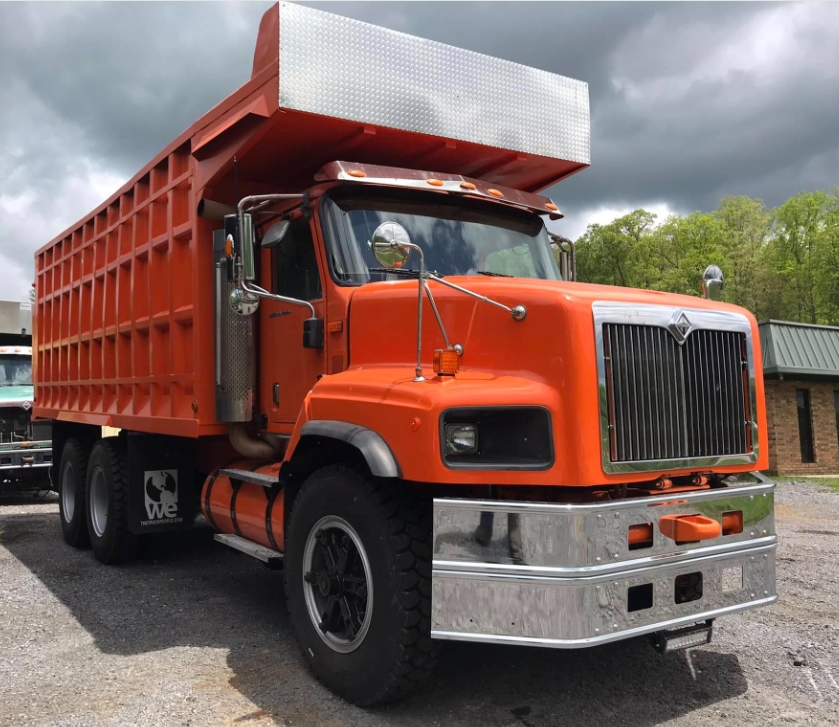
- Key Features: The “S” stood for “Sleeper,” although a day cab was also available. This generation featured a completely redesigned front clip with a much more aggressive and aerodynamic look, including a large, integrated bumper. The cab and interior remained largely the same as the 5900i, but with updated materials and technology.
- Engine Controversy: This is the most critical part of the 5900 S’s history. During this time, Navistar controversially continued to rely on its EGR-only system for emissions control, avoiding the use of a DPF that competitors were using. This led to severe engine reliability problems, high warranty costs, and ultimately, Navistar’s decision in 2013 to abandon its in-house engine program and begin sourcing engines from Cummins.
- The Cummins Era (2013-Present): From 2013 onward, the Paystar 5900 S became available with the Cummins ISX15 engine. This move restored confidence in the brand. The Paystar now had a proven, reliable powerplant, making it a highly competitive vocational truck once again. Today, the Paystar 5900 S (or simply “International Paystar”) is offered with a choice of Cummins diesel or natural gas engines, paired with Allison transmissions, serving in the same heavy-duty roles it always has: dump, refuse, concrete, logging, and utility.
The Paystar’s Enduring Place in Trucking History
The Paystar’s legacy is not one of a single, static design, but of constant adaptation. It evolved from the straightforward Loadstar-based truck of the 1960s, through the aerodynamic transformations of the 70s and 80s, to the high-tech platforms of today. It was International’s answer to every heavy job, a reliable partner for businesses that depended on their trucks to make a living.
While the name “Paystar” has been used to signify premium capability across five distinct generations of truck design, its core identity has remained the same: a versatile, powerful, and dependable vocational truck.
Future Outlook
Today, the Paystar is a product of Navistar International Corporation, now a part of the Traton Group alongside Scania, MAN, and Volkswagen Caminhões e Ônibus. The future of the Paystar will likely mirror the trends of the broader heavy-duty truck industry. We can expect to see:
- Electrification: As vocational routes are often shorter and return to a central depot, they are ideal candidates for electrification. An all-electric Paystar, potentially sharing technology with the International eMV Series, is a logical and likely future development.
- Advanced Driver-Assistance Systems (ADAS): Features like automated emergency braking, lane departure warnings, and blind-spot monitoring will become standard, enhancing safety on chaotic construction sites and city streets.
- Connectivity: Telematics and data analytics will allow fleet managers to optimize routes, monitor vehicle health, and improve fuel efficiency in real-time.
From its humble beginnings as a trim package on a Loadstar to its current status as a modern, technologically advanced vocational truck, the Paystar has proven its staying power. It is a testament to International’s commitment to building trucks that work as hard as the people who drive them. The Paystar isn’t just a truck; it’s a legacy of strength and versatility, built to conquer the toughest jobs on the road.