TVR 280i & 350i: The Evolution of TVR’s Wedge‑Era Sports Cars
The TVR 280i and TVR 350i represent two cornerstone models in the British sports car maker TVR’s unique Wedge era — a period spanning the 1980s into the early 1990s defined by sharply styled, lightweight, driver‑focused sports cars. Based on the ground‑breaking Tasmin, these two models marked TVR’s transition from modestly powered imported engines toward serious performance machines. This article explores the evolution of the 280i and 350i, their technical details, variations offered during their production runs, historical significance, and their legacy in the modern automotive world.
Origins of the Wedge‑Shaped TVRs
To understand the 280i and 350i, one must first look at the TVR Tasmin — a project launched in 1980 that introduced a wedge‑shaped design penned by Oliver Winterbottom, giving TVR a modern look in an era when rounded shapes were falling out of fashion. The Tasmin laid the foundation for the wedge family that TVR would refine through the decade.
The wedge design was not just aesthetic — it symbolized a shift in TVR’s approach: blending aerodynamic efficiency with a lightweight chassis and mechanical simplicity. Built on a tubular steel frame with fiberglass body panels, this architecture was carried forward into both the 280i and 350i models that followed.
.

.
TVR 280i (1984–1988): The V6 Sports Car
The TVR 280i was introduced in 1984 as a renamed iteration of the earlier Tasmin 280i (which started life in the Tasmin line from around 1980). The 280i served as the entry‑level model of the wedge family but still offered robust performance and classic TVR character.
Engine and Performance
- Engine: 2.8‑liter Ford Cologne V6
- Output: Around 160 hp (typical for early 280i), giving spirited performance in a light car.
- Transmission: 5‑speed manual driving the rear wheels.
- 0‑60 mph: Around 8 seconds (approximate).
- Top Speed: ~130 mph (209 km/h).
The 280i was noted for its engaging driving experience and relatively quick responses thanks to its lightweight construction. While not a blisteringly fast car by supercar standards, it provided a compelling blend of performance and character for enthusiastic drivers.
Body Styles and Variants
The 280i was offered in several body variants during its production:
- 2‑seat Fixed Head Coupé (FHC) — classic coupe form.
- Convertible / Drop‑head Coupé (DHC) — offering open‑top motoring.
- (Early days) Some Tasmin/280i models also featured a 2+2 coupé layout before the name change.
Converted and export versions had minor differences; for instance, some units sold in the United States included smog control equipment, which slightly reduced power.
Production and Market Position
TVR produced an estimated approximately 980 units of the 280i between 1984 and 1988 — including both coupes and convertibles — making it a comparatively rare car today.
In the UK market the 280i initially served as the accessible wedge‑era sports car. However, its appeal in Britain waned compared to the more powerful Rover‑V8‑powered models, leading to the discontinuation of the right‑hand‑drive versions by 1986, although export production continued for some markets until 1988.
TVR 350i (1983–1990): The V8 Performance Step‑Up
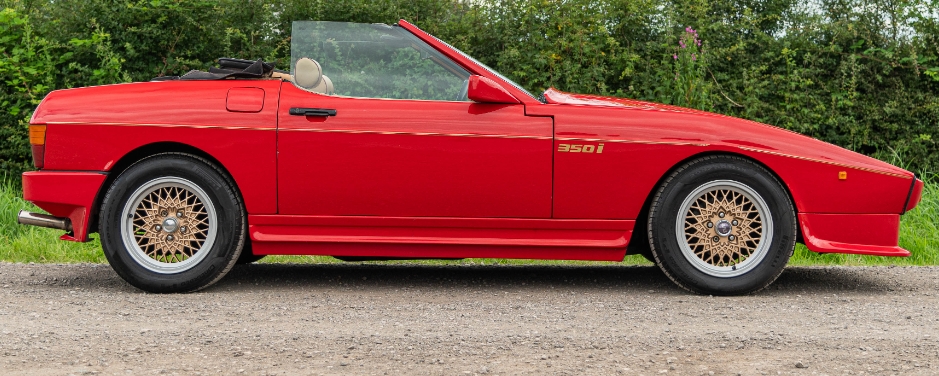
The TVR 350i arrived in 1983 as a more performance‑oriented model, positioned above the 280i in TVR’s wedge hierarchy. Essentially a Tasmin wedge with a Rover V8, it transformed the wedge from an engaging sportscar into a genuine performance contender.
Engine and Performance
- Engine: 3.5‑liter Rover V8 (Buick‑derived).
- Power: Around 190 hp (197 hp depending on measurement).
- Transmission: 5‑speed manual, rear‑wheel drive.
- Performance: 0‑60 mph in roughly 6.5–6.6 seconds, top speed circa 135‑136 mph (218‑219 km/h).
This swap gave the 350i markedly better acceleration and performance than its V6 sibling, while still preserving the lightweight wedge ethos that TVR championed.
Body Styles and Variants
The 350i continued the wedge lineage with similar body formats:
- Convertible / Drop‑head Coupé — the most common 350i configuration.
- Fixed Head Coupé — rare; some sources note just six examples made.
TVR also experimented with supercharged versions (SX variants) through independent tuners, though these were not mass factory models.
Special Editions and 350SE
In 1990, as the wedge series was winding down, TVR introduced a 350SE — a limited special edition with enhanced performance tweaks and suspension upgrades, often denoted by numbered plaques. These were produced in very small numbers (around 25 units) and are especially collectible.
Broader Wedge Context
While the 280i and 350i formed the backbone of the wedge family, they existed alongside a range of higher‑performance variants developed in collaboration with engineers and tuners. These included cars like the 390SE, 400SE, and the hardcore Big Bad Wedges (e.g., 420SEAC), which pushed Rover V8 displacement to much larger capacities.
The wedge series overall lasted from 1980 until 1991, when it was replaced by the more rounded and modern‑styled TVR Griffith and TVR Chimaera. Production of all wedge‑shaped TVRs exceeded 2600 units across all variants — with the 280i and 350i being the most numerous.
Driving Experience and Engineering Traits
Both the 280i and 350i epitomized TVR’s core engineering philosophy: light weight, rear‑wheel drive, and minimal electronic intervention. The manually geared steering, firm suspension, and responsive throttle made these cars true purist machines of their time.
The fiberglass bodywork kept weight low, enhancing performance and cornering agility. Interior fittings were typically simple, with a blend of leather trim, wood veneer, and exposed switchgear — reflecting TVR’s focus on performance over luxury.
Market and Cultural Impact
In the 1980s, the 280i and 350i helped reposition TVR as a bona‑fide player in the niche sports car segment, challenging contemporary competitors from Europe. The wedge design was sharp and distinctive, standing out against curvier rivals from Lotus, Porsche, and rival roadsters of the era.
In markets like the U.S., the 280i (with its V6 engine) was more common early on due to emissions and certification hurdles that affected the V8 350i’s entry. This gave the 280i a unique place in the brand’s export history.
The 350i, with its V8 heart, became a quintessential classic British sportscar — loud, raw, and direct — and now commands substantial enthusiast interest. The rare fixed‑head coupés and 350SE specials are particularly prized by collectors.
Future Outlook and Legacy
TVR’s historical models have seen a resurgence in collector interest as enthusiasts seek analog driving experiences in an era dominated by electronics and hybrid powertrains. The 280i and 350i — as entry points into the wedge world — remain popular at historic motorsport events, classic car rallies, and club meets. Their relative rarity compared to mass‑market cars adds to their collectible appeal.
Although TVR itself was later revived with new models like the modern Griffith and future plans for electric‑assisted sports cars, the legacy of the wedge era — and specifically the 280i and 350i — remains foundational in the company’s storied heritage.
Conclusion
The TVR 280i and 350i mark an important chapter in British sports car history. Born from the ambitious wedge design experiment of the 1980s, they bridged TVR’s early slow‑burner origins with more potent V8‑powered performance. With roughly a thousand or more examples built across both models, they combine rarity with raw driving engagement — qualities that endear them to enthusiasts even decades after production ended. Their place within the broader wedge family further underscores a unique era in performance car design, one remembered for its passion, simplicity, and distinctive wedge silhouette.