Willys Utility Wagon: The Evolution of America’s First Mass-Market SUV
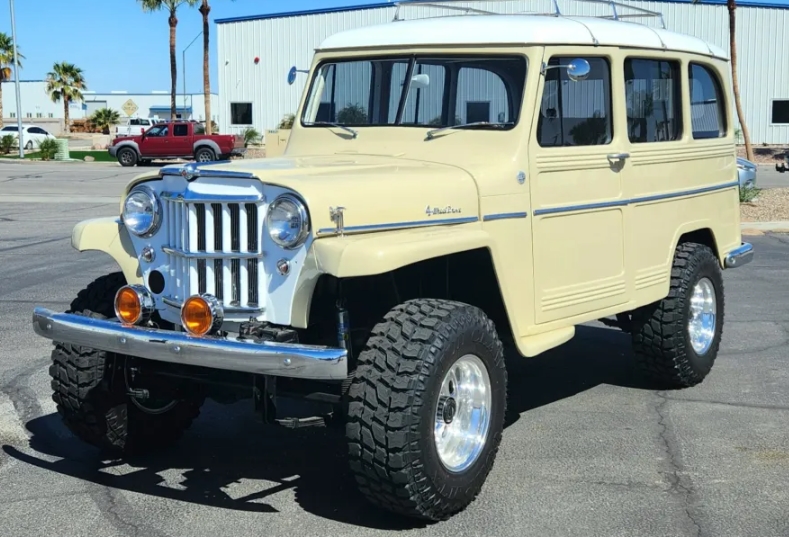
The Willys Utility Wagon — most commonly known as the Willys Jeep Station Wagon or simply Willys Wagon — holds a distinguished place in automotive history as one of the earliest all-steel station wagons produced for the mass market and a direct ancestor of the modern sport utility vehicle (SUV). Built on rugged Jeep chassis and sharing much of its mechanical DNA with wartime and post-war Jeep trucks and CJs, the Utility Wagon blended passenger comfort with real off-road capability. Its evolution from 1946 through 1965 in the U.S. (with continued international production afterward) reflects changing consumer expectations, technological progress, and Willys’ role in defining a new automotive segment.
Origins: Post-War Innovation (1946–1948)
After World War II, Willys-Overland Motors turned its attention from military production to civilian vehicles, leveraging its expertise with the Jeep platform. Among the first fruits of this effort was the Willys Jeep Wagon, introduced in 1946. Designed by industrial designer Brooks Stevens, it was one of the first all-steel station wagons aimed at everyday drivers, departing from the traditional wood-bodied “woodies” of the time and offering easier maintenance, improved durability, and more safety in a family-friendly package.
Technically, the early wagon shared its 104-inch wheelbase with Jeep trucks of the era, and early models used the L-134 “Go-Devil” four-cylinder engine — the same powerplant found in civilian Jeep CJs — offering modest but reliable performance suited to a variety of tasks.
Initially, the wagon was offered only with rear-wheel drive, and Willys marketed it simply as a station wagon — a vehicle capable of carrying people and cargo in ways that few others on the market could match.
Introducing Four-Wheel Drive: The Utility Wagon (1949–1954)
The Utility Wagon’s most significant milestone came in 1949, when Willys introduced four-wheel drive (4WD) versions of the Jeep Wagon lineup. While the two-wheel-drive variant continued to be called the “Station Wagon,” the 4WD model was distinguished as the Utility Wagon — a designation that emphasized its capability on unpaved roads, farms, and work sites as well as in suburban driveways.
This 4WD Utility Wagon is often cited by automotive historians as one of the earliest production vehicles to combine all-steel body construction with genuine four-wheel drive for passenger-car use, laying conceptual groundwork for later SUVs.
Mechanically, the early Utility Wagons retained Jeep-derived ruggedness: solid front axles, leaf springs, and a transfer case suitable for tackling rough terrain. The body remained utilitarian but practical, with a fold-down tailgate and configurable seating capable of transporting people and cargo.
.

.
Mid-Century Refinements and Variants (1950–1955)
As the 1950s began, Willys continued refining the Wagon line. In 1950, the model designation systems evolved, with updated grilles and body styling echoing other Willys/Jeep vehicles. That year also brought new engine choices: in addition to the continuing four-cylinder, six-cylinder engines such as the L-161 “Lightning” and later the F-134 “Hurricane” were offered.
Various body variants appeared alongside the core Utility Wagon, including:
- Panel Delivery: A variant with enclosed rear sides and double rear doors, designed for commercial use.
- Sedan Delivery: Similar to the Panel Delivery, with emphasis on cargo hauling rather than passenger seating.
By 1954, the six-cylinder lineup had grown, with the 6-226 “Super Hurricane” flathead engine delivering more robust power — important as wagons were used for heavier tasks and family trips alike.
1955 Rebranding and “Utility Wagon” Era (1955–1960)
By 1955, with changes in Willys’ corporate structure and an increasing focus on industrial vehicles, the station wagon was officially rebranded across the board as the Utility Wagon — the name reflecting its broader purpose and capability.
Several refinements and trim options appeared during this period:
Maverick Special (1958–1960)
In an attempt to boost appeal and modernize the line, Willys offered the Maverick Special — a two-wheel drive Utility Wagon with a more stylish, somewhat upscale trim package tied in with the popular TV show Maverick. It featured unique two-tone paint schemes, upgraded interiors, and optional accessories aimed at attracting everyday buyers who wanted more than a simple work wagon.
Despite its tie-in with popular culture, the Maverick Special was discontinued around 1960 when Willys’ sponsorship of the show ended, but it remains a noteworthy early attempt to differentiate Utility Wagon trim levels.
Final Years in the U.S. and Succession (1960–1965)
In the early 1960s, the Utility Wagon lineup continued to evolve modestly with mechanical improvements and occasional styling updates (such as one-piece windshields and updated grille treatments). The 6-230 “Tornado” overhead-cam six-cylinder engine was introduced around 1962, offering smoother performance and better highway manners compared with older flathead engines.
Despite these updates, by the mid-1960s the Utility Wagon looked increasingly dated compared to newer full-size SUVs and station wagons. With shifting consumer preferences and the launch of the more modern Jeep Wagoneer (SJ) — which offered greater comfort, automatic transmissions, and a more refined unibody-like experience — Willys and its successor Kaiser-Jeep Corporation phased out the Utility Wagon line in 1965 in the United States.
International Production and Legacy (1965–1977)
Though U.S. production ended in 1965, the Utility Wagon continued in international markets for several more years. In Argentina, production extended into the 1970s, while in Brazil the vehicle was not only built locally but eventually facelifted and renamed — for example as the Rural Willys. Brazilian production continued until around 1977, demonstrating the durability of the basic Utility Wagon design and its appeal in markets where rugged capability and simplicity were prized.
Technical and Design Characteristics
What set the Utility Wagon apart from many contemporaries were several defining features:
- All-steel body construction — ahead of the wood-panelled wagons common in the 1940s.
- Versatile seating and cargo space, including removable rear seats and a fold-down tailgate with cargo flexibility.
- Optional four-wheel drive — making it one of the earliest mass-market vehicles to pair SUV-like capability with a passenger-friendly body.
- A range of engines — from the early Go-Devil four to later six-cylinder units like the Super Hurricane and Tornado — allowing buyers to prioritize economy or power depending on needs.
Trim and Variant Overview
Unlike modern cars with clearly marketed trim levels, the Utility Wagon’s variations were often incremental or model-year specific. Key differentiations included:
Station Wagon (2WD):
- Rear-wheel drive family hauler with removable seats.
Utility Wagon (4WD):
- Four-wheel drive version introduced in 1949, the model that cemented its SUV legacy.
Panel/Sedan Delivery:
- Commercial variants without rear side windows, optimized for cargo and business use.
Maverick Special:
- 1958–1960 upscale two-wheel-drive trim with distinctive styling aids.
Engine variants were often identified by their displacement and code names (e.g., L-134, F-134 Hurricane, 6-226 Super Hurricane, 6-230 Tornado), and buyers had different power options over the years depending on availability and year.
Cultural Impact and Historical Significance
The Utility Wagon’s role in automotive history cannot be overstated. Produced in the U.S. from 1946 to 1965 (and beyond in South America), it introduced consumers to a vehicle that could do many tasks at once — carry the family, haul cargo, and traverse rugged terrain — long before the term “sport utility vehicle” entered popular language.
Auto historians and enthusiasts often credit the Utility Wagon as a spiritual predecessor of the modern SUV, predating notable successors like the Jeep Wagoneer, Ford Bronco, and International Scout. Its combination of passenger comfort and four-wheel-drive capability set a pattern that countless later models would follow.
Future Outlook and Collectibility
Today, original Willys Utility Wagons are highly prized by classic vehicle collectors and restorers. Their rugged simplicity, historical significance, and versatility make them sought-after examples of early SUV evolution. Restored examples — particularly four-wheel-drive Utility Wagons and rare trim packages like Maverick Specials — command respect at vintage auto shows and auctions.
In broader automotive culture, the Utility Wagon’s legacy lives on in Jeep’s modern SUV lineup and in the global shift toward vehicles that blend utility, comfort, and capability — traits first combined by Willys more than seven decades ago.
The Willys Utility Wagon stands as a milestone in automotive history: an early all-steel station wagon and one of the first vehicles to fuse passenger comfort with rugged capability. Produced from 1946 to 1965 in the U.S. and continued in other markets until the late 1970s, it laid the groundwork for the modern SUV segment. Through its evolution — from basic two-wheel-drive family wagon to capable four-wheel-drive Utility Wagon and commercial variants — Willys demonstrated the enduring appeal of versatile vehicles. Today, its influence remains visible in countless SUVs that millions drive worldwide, making the Utility Wagon a true pioneer in its class.