Z-car Evolution: History of the Nissan Z Nismo
Of all the legendary nameplates in the automotive world, few carry the same weight of history and enthusiast adoration as Nissan’s Z-car. For over five decades, it has represented the quintessential Japanese sports car: stylish, potent, and attainable. But for those who demand more, for whom the standard Z is merely a starting point, Nissan has an answer. It’s a five-letter acronym that signifies the absolute pinnacle of factory performance: NISMO.
The Nissan Z Nismo is not just a trim level; it is a philosophy. It represents a direct link between the company’s storied racing heritage and the cars available in the showroom. Born from the crucible of motorsport, NISMO (a portmanteau of NISsan MOtorsport International) transforms the already capable Z into a sharper, more focused, and uncompromising driving instrument. This is the story of that transformation, a lineage of track-honed machines built for the discerning driver.
The Genesis: What is NISMO?
Before delving into the cars themselves, it’s crucial to understand the badge they wear. Established in 1984, NISMO was created to consolidate Nissan’s formidable motorsport efforts under one banner. From dominating the punishing circuits of the Japanese Grand Touring Championship (JGTC) with the Skyline GT-R to conquering the grueling 24 Hours of Daytona, NISMO’s purpose has always been to win races.
This pursuit of victory yields invaluable data and engineering expertise. The Nismo road cars are the direct beneficiaries of this knowledge. They are not simply exercises in styling; every vent, wing, chassis brace, and suspension component is a piece of that racing DNA, meticulously tuned to enhance performance in a tangible way. The Nismo philosophy prioritizes holistic balance over raw, straight-line power. It’s about how the car feels in the corners, how it communicates with the driver, and how it inspires confidence at the limit.
.

.
The Trailblazer: The 350Z NISMO (2007-2008)
After years of offering Nismo parts through its aftermarket catalogue, Nissan finally gave North America its first fully integrated, factory-built Nismo Z model in 2007. Based on the Z33 generation 350Z, this car laid the foundational formula for all Nismo Zs to come.
Years Produced: 2007-2008
Model & Trim: The 350Z Nismo was offered as a singular, distinct model, positioned above the Grand Touring trim.
Interestingly, the Nismo treatment for the 350Z did not include a power increase. It was equipped with the same high-revving 3.5-liter VQ35HR V6 engine found in other 2007-2008 models, producing an identical 306 horsepower and 268 lb-ft of torque. Instead, Nismo’s engineers focused exclusively on the chassis and aerodynamics, proving their commitment to handling over horsepower.
The most striking feature was the aggressive body kit. Developed in a wind tunnel, it was far from cosmetic. A long, pronounced front bumper and a towering rear wing worked in concert to generate genuine downforce at speed, pressing the car into the tarmac for improved stability.
Beneath the skin, the transformation was even more profound. The standard chassis was significantly reinforced. Nismo engineers introduced additional body seam welds for greater structural rigidity. A truly unique feature was the inclusion of front and rear “body dampers.” These were essentially performance-tuned shock absorbers mounted transversely within the chassis itself, designed to quell vibration and flex, resulting in a more precise and communicative driving experience.
The suspension was completely overhauled with stiffer springs, performance-tuned Sachs dampers, and thicker anti-roll bars. This was paired with lightweight, forged RAYS Engineering alloy wheels (18-inch front, 19-inch rear) and a potent Brembo braking system with four-piston front calipers. The result was a car that was raw, direct, and unapologetically firm. It was a true track-day special, a scalpel in a world of blunt instruments, and it set the stage for what was to come.
The Evolution: The 370Z NISMO (2009-2020)
With the arrival of the shorter, lighter, and more powerful Z34 generation 370Z, Nismo had a superior canvas on which to work. The 370Z Nismo enjoyed a much longer production run and underwent a significant mid-cycle refresh, effectively creating two distinct versions.
Phase 1 (2009-2014): The Raw Performer
Building on the 350Z Nismo’s principles, the first-generation 370Z Nismo received the power bump its predecessor lacked. The 3.7-liter VQ37VHR V6 was tuned with a unique H-pipe exhaust system and revised engine mapping, pushing output to 350 horsepower and 276 lb-ft of torque—an increase of 18 hp and 6 lb-ft over the standard model.
The chassis and suspension were once again the primary focus. Stiffer spring rates (15% front, 10% rear) and dampers, along with larger anti-roll bars, made the car exceptionally flat through corners. The body dampers from the 350Z Nismo were carried over, further enhancing chassis feel. The aero package was even more dramatic, with a deep front chin spoiler, side sills, and a massive, integrated rear wing. Everything was functional, designed to manage airflow and increase downforce. This iteration was only available with a six-speed manual transmission featuring Nissan’s innovative SynchroRev Match technology.
Phase 2 (2015-2020): The Refined Weapon
For the 2015 model year, the 370Z Nismo received a comprehensive update that broadened its appeal without diluting its core purpose. The biggest change was aesthetic. The aggressive but somewhat “aftermarket” look of the previous model was replaced with a more integrated and mature design, heavily inspired by the flagship GT-R. The new body kit featured a sleeker front bumper with LED daytime running lights, redesigned side sills, and a smaller, yet still effective, rear spoiler.
The most significant upgrade, however, was inside the cabin. The standard seats were replaced with spectacular Nismo-branded Recaro sport seats, offering vastly superior support and comfort. This single change transformed the interior experience.
Recognizing a wider market, Nissan made two key additions. For the first time, a seven-speed automatic transmission with paddle shifters was offered as an option. Furthermore, a “Tech” trim level was introduced, which added a Bose audio system, a 7-inch touchscreen navigation system, and a rearview camera, making the Nismo a more viable daily driver. While some purists lamented the addition of an automatic, it demonstrated Nismo’s evolution towards creating a more complete and versatile performance car.
The Modern Era: The Nissan Z NISMO (2024-Present)
After a brief hiatus, the Nismo badge returned to the Z for the 2024 model year, applied to the new RZ34 generation. This latest incarnation represents the most powerful and technologically advanced Nismo Z ever created, embracing a new era of turbocharged performance.
Years Produced: 2024-Present
Model & Trim: Like its predecessors, the Z Nismo is a standalone model at the top of the Z hierarchy.
At its heart is a tuned version of the 3.0-liter twin-turbocharged VR30DDTT V6 engine. Nismo engineers improved cooling, revised the electronic wastegate control for increased turbocharger boost and turbine speed, and implemented ignition timing strategies borrowed from the GT-R Nismo. The result is a formidable 420 horsepower and 384 lb-ft of torque—a 20 hp and 34 lb-ft increase over the Z Performance model.
In a move that sparked debate among enthusiasts, the 2024 Z Nismo is available exclusively with a nine-speed automatic transmission. Nismo’s justification is pure performance; their engineers recalibrated the transmission for faster, more aggressive downshifts and integrated Nismo-specific clutch packs, enabling shift times to be cut by nearly half. On a racetrack, the automatic is undeniably faster and more consistent.
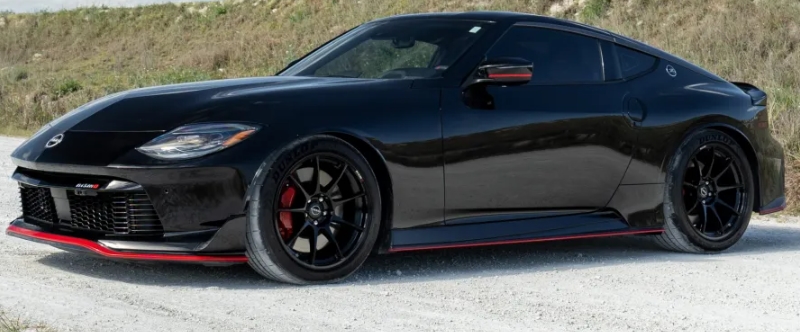
True to its heritage, the chassis received a complete overhaul. Additional bracing was added to the front, rear, and underbody, increasing torsional rigidity by 2.5%. The suspension features stiffer springs, larger and retuned dampers, and stiffer bushings. The brakes are larger, with 15-inch front rotors clamped by four-piston Akebono calipers. These are housed within new, gloss black RAYS wheels that are both wider and lighter than those on the Z Performance, wrapped in sticky Dunlop SP Sport MAXX GT600 tires.
The exterior features the “Grand-Nose” or “G-Nose,” a styling cue that harkens back to the classic Fairlady 240ZG. This longer front fascia, combined with canards, a taller three-piece rear spoiler, and reshaped side sills, works to create positive downforce and reduce drag.
Future Outlook and Legacy
The Nissan Z Nismo stands as a testament to the enduring appeal of a driver-focused sports car. Each generation has faithfully adhered to a core set of principles: functional aerodynamics, a fortified chassis, track-tuned suspension, and enhanced driver engagement. While the methods have evolved—from the naturally aspirated, seam-welded 350Z to the turbocharged, electronically sophisticated 2024 model—the purpose has remained unchanged.
As the automotive industry pivots towards electrification, the future of a gasoline-powered car like the Z Nismo is uncertain. It may very well represent the last of its kind—the ultimate internal combustion expression of Nissan’s Z-car legacy.
For now, however, it remains the sharpest tool in Nissan’s sports car shed. It is more than just the sum of its parts; it is the culmination of decades of racing experience, a bridge between the circuit and the street. For the driver who understands that true performance is measured not in straight lines but in apexes, the Nissan Z Nismo is, and always has been, the definitive choice.