Tata Safari: A Comprehensive History and Model Overview
The Tata Safari is one of India’s most iconic sport utility vehicles (SUVs), a nameplate that has been synonymous with rugged adventure, long-distance touring, and the aspiration of owning a full-size SUV since its launch in the late 1990s. Produced by Tata Motors, the Safari has undergone significant transformations over the years, moving from a ladder-frame, rear-wheel-drive off-roader to a modern monocoque, front-wheel-drive crossover SUV. This evolution reflects broader trends in the automotive industry, changing consumer demands, and Tata Motors’ own growth in design, engineering, and global ambitions.
1. Origins and Brief History
The Tata Safari was first introduced in 1998, making it one of the first SUVs developed, designed, and manufactured entirely in India. At launch, it was positioned as an affordable, comfortable, and capable family SUV—a segment that was largely untapped in India at the time. The vehicle was developed during a period when Tata Motors (then known as TELCO—Tata Engineering and Locomotive Company) was expanding beyond commercial vehicles into passenger cars.
The original Safari was built on a ladder-frame chassis derived from Tata’s light commercial vehicle platform, but it featured a more refined suspension setup for passenger comfort. This combination allowed the Safari to offer good off-road capability while being comfortable on highways—something that appealed to Indian consumers who wanted a vehicle that could handle varied terrains.
2. First Generation (1998–2019)
The first-generation Tata Safari had a production run of over two decades, undergoing multiple facelifts and mechanical upgrades.
Design and Engineering
At launch in 1998, the Safari featured a 2.0-litre turbocharged diesel engine producing around 90 horsepower, paired with a 5-speed manual gearbox. It offered a tall driving position, good ground clearance, and optional four-wheel drive, making it a true SUV by traditional standards.
Over the years, Tata introduced several updates:
- 2003: Introduction of the Safari EXi petrol variant with a 2.1-litre engine, catering to urban buyers.
- 2005: The iconic 3.0-litre Dicor diesel engine was introduced, offering improved performance and refinement.
- 2007: Launch of the 2.2-litre Dicor engine, developed with assistance from AVL of Austria, delivering better fuel efficiency and reliability.
- 2010: Facelift with minor cosmetic changes, improved interiors, and updated equipment.
Trim Levels and Variants (First Generation)
Over its long production life, the first-gen Safari was offered in a variety of trims, including:
- Base / LX – Entry-level models with basic interior features, manual air conditioning, and steel wheels.
- EX – Mid-level trim with additional comfort and convenience features.
- VX – Premium variant with alloy wheels, upgraded upholstery, and enhanced audio systems.
- GX – Positioned between EX and VX, offering a balance of equipment and value.
- VX 4×4 – Top-end trim with four-wheel drive, often equipped with a limited-slip differential.
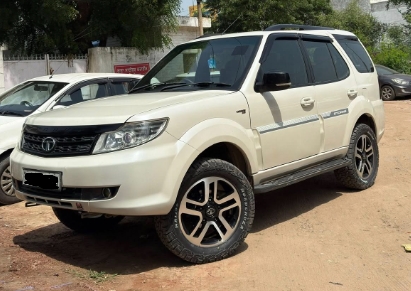
- Storme Variants (2012–2019) – The Safari Storme was a heavily updated version introduced in 2012. It featured refreshed styling, improved chassis dynamics, and better NVH (noise, vibration, and harshness) control.
- Storme LX
- Storme EX
- Storme VX
- Storme VX 4×4
The Safari Storme
The Storme represented a significant facelift rather than an all-new model. It adopted Tata’s hydroformed chassis for greater rigidity and safety, a new front fascia, revised interiors, and a more powerful version of the 2.2 Varicor diesel engine. The range-topping Varicor 400 engine (introduced in 2015) produced 156 PS and a hefty 400 Nm of torque, paired with a 6-speed manual gearbox.
The Safari Storme also served as the base vehicle for the Indian Army’s GS800 (General Service 800 kg payload) program, replacing the Maruti Gypsy for several military applications. This underlined its durability and off-road credibility.
.

.
3. Second Generation (2021–Present)
After the Safari Storme was discontinued in 2019 due to Bharat Stage VI (BS6) emission norms and declining demand for ladder-frame SUVs in urban markets, Tata Motors revived the Safari nameplate in 2021. The modern Safari is a completely different vehicle, based on Tata’s Optimal Modular Efficient Global Advanced Architecture (OMEGARC), itself derived from Jaguar Land Rover’s D8 platform used in the Land Rover Discovery Sport.
Design and Engineering
The 2021 Safari is essentially the three-row version of the Tata Harrier, featuring a monocoque chassis, front-wheel drive layout, and modern safety and comfort features. It retains a bold and upright stance, with design cues that pay homage to the original Safari, such as a stepped roofline and strong shoulder lines.
The new Safari is powered by a 2.0-litre Kryotec turbo-diesel engine (sourced from Fiat Chrysler Automobiles), producing 170 PS and 350 Nm of torque. Transmission options include:
- 6-speed manual gearbox
- 6-speed Hyundai-sourced torque converter automatic
Trim Levels and Variants (Second Generation)
The new Safari has been offered in numerous trims, often updated with special editions:
- XE – Base variant with essential features like dual airbags, all-4 disc brakes, and projector headlamps.
- XM / XM+ – Adds more comfort features, infotainment upgrades.
- XT / XT+ – Mid-level trims with larger touchscreen infotainment, connected car tech, and panoramic sunroof (XT+).
- XZ / XZ+ – Premium trims with leatherette upholstery, JBL sound system, terrain response modes.
- Adventure Persona Edition – Cosmetic enhancements with special color schemes and interior accents.
- Gold Edition – Luxury-oriented variant with unique gold accents, ventilated seats for front and second row.
- Dark Edition – Blacked-out exterior and interior elements for a sportier look.
- Kaziranga Edition – Inspired by India’s Kaziranga National Park, with grassland beige paint and thematic interior touches.
- Accomplished+ – Top-end variant in later updates, offering the most advanced driver aids and features.
4. Market Position and Competitors
When it was first launched, the Tata Safari competed with vehicles like the Mitsubishi Pajero, Mahindra Armada/Scorpio, and imported SUVs. In its modern form, the Safari competes with three-row SUVs such as the Mahindra XUV700, Hyundai Alcazar, and MG Hector Plus.
Historically, the Safari has always aimed to balance ruggedness with comfort. While the earlier ladder-frame Safari leaned more toward off-road adventuring, the new monocoque Safari is focused on urban families wanting space, premium features, and occasional touring capability.
5. Sales and Reception
The first-generation Safari enjoyed strong sales in the early 2000s but gradually lost market share to newer, more refined competitors. The Safari Storme rekindled some enthusiasm, especially among enthusiasts and fleet/military buyers, but could not fully reverse the trend.
The 2021 Safari launch marked a resurgence in interest. Tata Motors capitalized on nostalgia for the Safari name while offering a thoroughly modern SUV. Sales have been healthy, with waiting periods for certain variants, especially after the introduction of special editions.
6. Safety and Technology
The first-generation Safari offered basic safety features for its time, such as seatbelts for all passengers, optional ABS, and dual airbags in higher trims. However, its safety ratings were never formally tested by agencies like Global NCAP.
The second-generation Safari benefits from Tata’s increased focus on safety:
- All-disc brakes
- Electronic Stability Program (ESP) standard across all variants
- Hill Hold Control and Hill Descent Control
- Multiple airbags (up to 6 in top trims)
- ISOFIX child seat mounts
- Advanced connected-car features through Tata’s iRA platform
While the Harrier (its close sibling) has not yet undergone a Global NCAP test in its updated form, Tata’s recent models have generally scored well in safety tests.
7. Future Outlook
The Tata Safari nameplate appears poised for continued relevance in India’s SUV market.
Potential future developments include:
- Petrol Engine Option – Tata Motors has hinted at developing a 1.5-litre turbo-petrol engine that could be offered in the Safari to meet growing demand for petrol SUVs.
- Hybrid or Electric Versions – Given Tata’s aggressive push into EVs with models like the Nexon EV, a hybrid or electric Safari could emerge in the second half of the 2020s.
- All-Wheel Drive – Although the current Safari is front-wheel-drive only, Tata has suggested that the OMEGARC platform is AWD-capable. If demand for adventure SUVs grows, a future AWD Safari could be possible.
- Global Exports – The original Safari was exported to markets in Europe, Africa, and the Middle East. The new Safari could see expanded export potential, especially in right-hand-drive markets.
8. Legacy and Cultural Impact
The Tata Safari holds a special place in the hearts of many Indian automotive enthusiasts. In the late 1990s and early 2000s, it was a symbol of status and freedom, featuring in numerous advertisements that emphasized the romance of the open road. The tagline “Reclaim Your Life” became iconic, encapsulating the Safari’s positioning as a vehicle for those seeking escape from routine.
The Safari’s long service with the Indian Army further cemented its reputation for toughness. Even today, older Safaris are a common sight in rural and semi-urban areas, where their robust build and high ground clearance are valued.
Conclusion
From its 1998 debut as India’s first domestically developed SUV to its modern 2021 rebirth as a sophisticated three-row family SUV, the Tata Safari has undergone a remarkable transformation. Across its ladder-frame and monocoque generations, it has adapted to changing market conditions, consumer preferences, and regulatory requirements.
While the rugged, go-anywhere nature of the original Safari has given way to a more urban-friendly focus, the nameplate still carries the emotional weight of its heritage. With Tata Motors’ renewed focus on design, safety, and electrification, the Safari’s future looks promising—not just as a nod to the past, but as a relevant, competitive player in the evolving SUV segment.