The Celestial Body: The Evolution and Legacy of the Mazda Eunos Cosmo
In the pantheon of automotive history, some cars are celebrated for their speed, others for their handling, and a select few for their engineering audacity. The Mazda Eunos Cosmo belongs firmly in the last category. It was not merely a car; it was a rolling statement of intent, a technological flagship that served as both the pinnacle of the exclusive Eunos luxury division and a testbed for the rotary engine technology that would define Mazda for decades. Its story is one of ambition, innovation, and a name so grand it was borrowed from the cosmos itself.
The Genesis: A Legacy Reborn (1967-1972)
The Cosmo nameplate holds a sacred place in Mazda’s history. The original 1967 Mazda Cosmo (L10B) was the world’s first production car to be powered by a twin-rotor Wankel rotary engine. It was a limited-production, two-seat sports coupe that was both a technological marvel and a stunningly beautiful machine. It established Mazda’s commitment to the rotary when other manufacturers were skeptical. However, after the 1972 model year, the Cosmo name went into hibernation as Mazda navigated the tumultuous landscape of the 1970s, including the 1973 oil crisis which was particularly punishing for fuel-thirsty rotary engines.
.
THIS is GOOD stuff if your car is in need:

.
The First Generation (XC10): A Grand Tourer for a New Era (1981-1989)
By the early 1980s, Mazda was a maturing, ambitious company. It decided to launch a new premium sales channel, “Eunos,” to market more luxurious and technologically advanced vehicles. For this new channel, they needed a true flagship. The perfect candidate was to resurrect the prestigious Cosmo name, but this time, the vision was entirely different. This would not be a small sports car, but a large, opulent personal luxury coupe.
Debut and Design: The all-new Eunos Cosmo debuted in May 1981 as a 1982 model. Built on the FC-series Savanna (RX-7) platform, it was a long, sleek, and heavily pillared coupe with distinctive pop-up headlights. Its design was clean and sophisticated, prioritizing quiet, comfortable grand touring over the raw aggression of its sports car cousins. With a length of nearly 4.5 meters and a weight of over 1,400 kg, it was a substantial vehicle, designed to compete with cars like the Toyota Soarer, Nissan Skyline/Gloria coupe, and the Isuzu Piazza.
Powertrain and Models: The engine bay of the first-generation Cosmo was a showcase of Mazda’s engineering prowess.
- 12A Rotary (1981-1986): The base model was powered by a naturally aspirated 12A twin-rotor engine producing 135 horsepower. It was smooth and uniquely rotary, but lacked the punch for a car of its size.
- 13B-RESI Rotary (1983-1989): In 1983, Mazda introduced the game-changing EGI (Electronic Gasoline Injection) version of its 13B twin-rotor engine, branded with the “RESI” (Rotary Engine Super Injection) badge. This engine, borrowed from the Savanna RX-7, featured a twin-scroll intake system that dramatically improved torque and drivability, producing 135-160 hp depending on the trim.
- 20B-REW Rotary (1986-1989): The ultimate expression of the first-generation Cosmo was the “20B” model. This was not a 20B engine in the traditional sense; it was the legendary twin-turbocharged 13B-REW from the RX-7 Turbo II, detuned slightly for the Cosmo’s luxury application. This model, identifiable by its forged wheels and subtle spoiler, was the first production application of a twin-turbo rotary and produced a formidable 185 hp and 188 lb-ft of torque.
Trim Levels: The Cosmo was offered in several distinct trim levels, denoted by the popular JDM “package” system:
- L (Base): The entry-point, well-equipped with power windows, mirrors, and a premium stereo.
- X (Mid-range): Added features like cruise control, a more sophisticated climate control system, and higher-grade interior materials.
- S (Sports): Often paired with the 13B-RESI or 20B engine, this trim featured sportier suspension, limited-slip differential, and more aggressive styling cues.
- Limited: A special edition introduced late in the run, often with two-tone paint, unique wheels, and plush interiors, emphasizing its luxury aspirations.
The Second Generation (XC20): The Apex of Luxury and Technology (1990-1995)
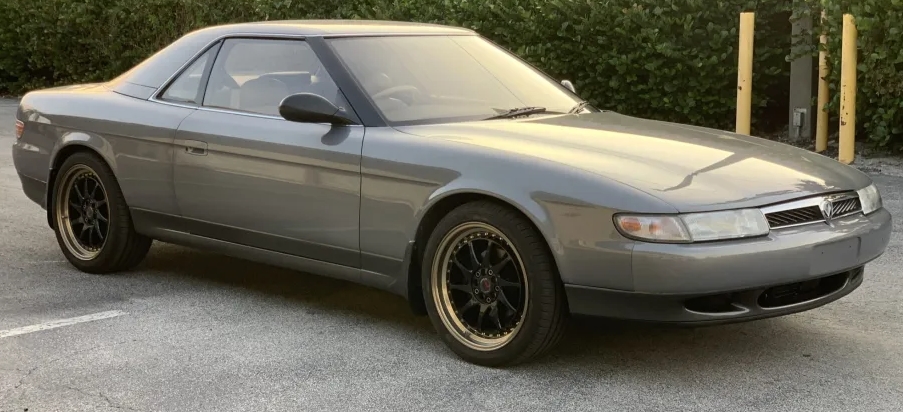
For the 1990 model year, Mazda unveiled the completely redesigned Eunos Cosmo. If the first generation was a statement, the second was the definitive speech. It was larger, more opulent, and crammed with technology that was years ahead of its competitors. It was designed to challenge the world’s best grand tourers, even aiming at the Mercedes-Benz SL of the era.
Design and Engineering: The XC20 Cosmo grew to nearly 4.7 meters in length and tipped the scales at over 1,600 kg. Its styling was a pure 1990s Japanese luxury grand tourer: a long hood, a sweeping cabin, and razor-sharp creases. It still used the FC RX-7 platform, but heavily modified with a longer wheelbase and wider track.
The Three-rotor Revolution: The headline act of the new Cosmo was its engine. For the first time, the world was introduced to a production three-rotor Wankel engine.
- 20B-REW: This was the star. The “20B” designation was correct this time—a 2.0-liter, three-rotor, twin-turbocharged engine. It produced 280 hp (the unofficial “gentlemen’s agreement” limit in Japan at the time) and a massive 295 lb-ft of torque. It was a masterpiece of engineering, delivering effortless, turbine-like power. The sequential twin-turbo system was designed to eliminate lag and provide a wide, flat torque curve.
- 13B-REW: The base engine was the same twin-turbo 13B from the RX-7, detuned to 220 hp for a smoother, more refined delivery suited to the Cosmo’s character.
The Interior as an Experience: The interior of the second-generation Cosmo is what truly cemented its legend. The dashboard was a symphony of digital displays.
- Full Digital Dash: A massive, full-width LCD screen displayed the speedometer, tachometer, and a host of other information. The tachometer even featured a unique “boost” bar that changed color as boost pressure increased.
- E-DCCAS: The Electronic Dual-Camera Controlled Active Suspension was a world-first. It used two front-facing cameras to scan the road surface ahead and proactively adjust the suspension damping for each wheel before hitting a bump.
- Other Tech: It featured a graphical navigation system (a rarity at the time), a premium Bose sound system, automatic climate control with rear passenger controls, and a keyless entry and start system.
Trim Levels: The trim structure for the second generation was even more defined, with each package offering a unique character:
- JS (Sport): The sportiest trim. It featured a firmer suspension, limited-slip differential, front strut tower bar, and 17-inch forged alloy wheels. It was the driver’s choice, paired exclusively with the 20B engine in the later years.
- JC (Classy): The luxury-focused trim. It had softer suspension, smaller 16-inch wheels, and a focus on interior comfort, including plush seating and wood-grain trim accents. It was available with both the 13B and 20B engines.
- JL (Type-E): Introduced in 1992, the “Type-E” (Executive) was the absolute pinnacle of Cosmo luxury. It added even more sound insulation, velvet-like upholstery, and exclusive features like a passenger-side powered lumbar support and an “Angel Sensor” that would chime if the driver was too close to the car in front. It was exclusively paired with the 20B engine.
The End of an Era and Legacy
The Eunos Cosmo’s grand ambitions coincided with the bursting of Japan’s economic bubble in the early 1990s. Sales of expensive luxury cars plummeted. The unique, complex, and costly Cosmo was particularly vulnerable. In August 1995, after a long and successful run, the Eunos Cosmo was discontinued without a direct successor.
Its legacy, however, is immense.
- The 20B Engine: The Cosmo was the only car to ever offer the legendary 20B three-rotor engine from the factory. This engine has since become the holy grail for rotary enthusiasts and tuners worldwide. The knowledge gained from its production was invaluable for Mazda’s future racing programs.
- The 13B-REW and FD RX-7: The second-generation Cosmo served as the testbed for the sequential twin-turbo system that would later be perfected and used to legendary effect in the 1993-2002 Mazda RX-7 (FD3S). Many components and engineering principles were shared between the two.
- A Halo Car: For nearly 15 years, the Cosmo was the ultimate expression of what Mazda could do. It proved that the company could build a sophisticated, reliable, and technologically advanced luxury car that was a world-beater in its own right.
Future Outlook
Today, the Eunos Cosmo is a beloved collector’s item, particularly the 20B-powered second-generation models. While a full electric conversion of such a historically significant car is unlikely and perhaps undesirable, there is a growing movement to preserve these machines. The complex nature of the 20B engine means that maintenance is a serious undertaking, and specialists who can service them are few and far between. However, the sheer uniqueness of a factory-built, three-rotor, twin-turbo luxury coupe ensures its place in automotive history. It stands as a testament to a time when Japanese manufacturers were at the zenith of their confidence, willing to take enormous risks to create truly extraordinary vehicles. The Eunos Cosmo was not just a car; it was Mazda’s celestial body, a star that burned brightly and left a lasting impression on the automotive universe.