The Unassuming Icon: History of the Hillman Minx
In the grand tapestry of British automotive history, certain names evoke images of roaring engines, sleek curves, and legendary races: Jaguar, Aston Martin, Bentley. Yet, the fabric of Britain’s motorized past is woven just as tightly with the threads of unassuming, utilitarian vehicles that formed the backbone of society. Among these, few are as quintessentially British, or as surprisingly enduring, as the Hillman Minx. For over three decades, the Minx was not a car of high fashion or blistering performance, but a steadfast companion for the post-war family, the ambitious tradesman, and the adventurous motorist. Its story is one of incremental evolution, clever adaptation, and a remarkable journey from austere necessity to a surprisingly chic and capable vehicle that left an indelible mark on roads across the globe.
The Minx story begins not with Hillman, but with the Humber Motor Company, which was acquired by the Rootes Group in 1931. It was under the Rootes umbrella that the Hillman marque, originally founded in 1907 as a maker of bicycles and cars, was repositioned to compete in the burgeoning small car market. The first car to bear the Hillman Minx name was launched in 1932, a simple yet effective 10-horsepower vehicle that established the core tenets of the brand: affordability, practicality, and reliability. However, the true lineage of the Minx, the one that cemented its legendary status, began in the austere days following the Second World War.
The Dawn of a New Age: The “Audax” Minx (1956-1958)
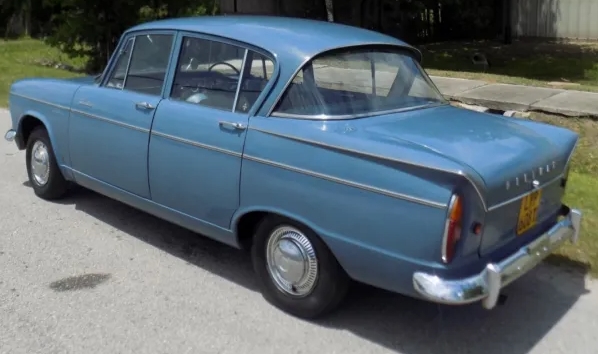
After a long hiatus during the war, during which Rootes focused on military production like the Humber Heavy Utility, the company turned its sights back to the civilian market. The result, unveiled in 1956, was the “Audax” series Minx. It was a thoroughly modern car for its time, styled by the renowned Raymond Loewy and his team. With its sweeping curves, integrated boot, and distinctive chrome grille, it was a world away from the boxy pre-war cars. The body was designed by Pressed Steel, the company that supplied bodies for much of the Rootes Group’s output, and featured an innovative “backbone” chassis for rigidity.
The first “Audax” Minx, the Series I, was powered by a 1184cc four-cylinder engine, a development of the pre-war 10hp unit, producing a respectable 38 horsepower. It was offered as a four-door Saloon, which quickly became the standard for the family-oriented brand. This established the Minx as a direct competitor to cars like the Ford Consul and the Austin A40. The early Audax models set the template: comfortable, well-equipped for their price, and powered by a modest but robust engine.
.
THIS might be a great place to get your new car from!
Or for those who are into the “car flipping” business, here’s an excellent resource for you!

.
The Peak of the Audax Era: Series II to V (1958-1964)
The Audax Minx was not a static design. It evolved rapidly over its eight-year lifespan, reflecting the fierce competition of the “white heat” of technology” era.
- Series II (1958-1959): This update brought cosmetic changes, most notably a larger rear window, which gave the car a more airy feel. Inside, there were improvements to the dashboard and heating system. The engine remained largely the same, but the car was refined in small but significant ways.
- Series III (1959-1960): This was a pivotal model, marking the first appearance of the “Super” trim level. The Super offered enhanced specifications, including two-tone paintwork, a revamped interior with more luxurious trim, and a heater as standard. This created a distinct tier in the Minx range, offering a taste of the high life for a small premium. Mechanically, a new overhead-valve engine was introduced, the 1390cc “Blue Streak” powerplant, which offered significantly more power at 48bhp and improved drivability.
- Series IV (1960-1963): Alongside the existing Super, the Series IV introduced an even more opulent top-of-the-line model: the California. The name was a marketing masterstroke, evoking images of sun-drenched coastal highways. The California was distinguished by its contrasting roof colour (usually white or black), wire-spoked wheels, and a plush, rolled-edge leatherette interior. It was the Minx that looked and felt a cut above the rest. The Series IV also saw a host of mechanical upgrades, including a clutchless semi-automatic gear option known as the “Saxomat.”
- Series V (1963-1964): The final evolution of the Audax Minx was a significant one. The range was simplified into two models: the base Saloon and the Super. The California was discontinued, leaving the Super as the premium choice. More importantly, the engine was bored out to 1494cc and fitted with twin carburettors in the Super model, boosting power to a lively 53bhp. The Saloon retained the smaller 1390cc engine. This move brought the Minx in line with the growing trend for more powerful family cars.
The Rootes “Avenger” Era and the Minx’s Indian Chapter (1970-1976)
By the mid-1960s, the Audax bodyshell was becoming dated. Rootes launched its new “Avenger” platform in 1970, and the Hillman Minx name was transplanted onto this modern, crisp-looking four-door saloon. This new Minx was a world away from its predecessor, featuring a contemporary “coke-bottle” shape and front disc brakes as standard.
However, the British car industry was in turmoil. The 1970s saw the oil crisis and increasing competition from Japanese imports. The Hillman Minx was effectively replaced in the UK by the Chrysler Hunter in 1976, with the Hillman nameplate being phased out on larger cars.
But the story doesn’t end there. In a fascinating twist, the Minx name was granted a new lease of life in India. In 1959, the Rootes Group had formed a joint venture with Mahindra & Mahindra to produce the “Mahindra Major,” a version of the Jeep. Following Rootes’ acquisition by the American Chrysler corporation in 1967, the Indian operation began assembling the Hillman Minx from Completely Knocked Down (CKD) kits.
This “Indian Minx” was produced from 1970 until 1976. It was based on the British-designed Avenger platform and was offered with a choice of 1.5-litre or 1.6-litre engines. In a market dominated by the Hindustan Ambassador (a Morris Oxford design) and the Premier Padmini (a Fiat 1100 design), the Minx was seen as a modern and slightly more premium alternative. It was a rare sight on Indian roads even in its day, but its production marked the final, unique chapter of the Minx lineage. After 1976, the Mahindra plant switched to assembling Peugeot and later, Renault cars, and the Hillman Minx name was finally retired.
The Models and Trim Levels: A Quick Reference
Navigating the Minx’s long history can be complex, but its evolution can be summarised as follows:
- Pre-War (1932-1940): The original Minx, available in various iterations, establishing the brand’s reputation.
- Post-War Audax Series (1956-1964):
- Series I (1956-1958): The original modern post-war Minx. Basic but stylish.
- Series II (1958-1959): Cosmetically updated with a larger rear window.
- Series III (1959-1960): Introduction of the “Super” trim and the 1390cc engine.
- Series IV (1960-1963): The range-topping “California” is introduced. The Super becomes the mid-range luxury model.
- Series V (1963-1964): Range simplifies to Saloon (1390cc) and Super (1494cc twin-carb).
- Post-Audax & Indian Era (1970-1976):
- Avenger-based Minx (1970-1976): A completely new car on the Rootes Avenger platform, sold in the UK and internationally under various badges (e.g., Sunbeam, Singer). Trim levels were typically base, Super, and GL.
- Indian Minx (1970-1976): Assembled by Mahindra in India, a unique regional variant of the Avenger-based model.
Legacy and Future Outlook
The Hillman Minx never had a direct successor in the traditional sense. The Rootes Group, and its successors Chrysler and Peugeot-Talbot, moved towards new model names like the Horizon, the Sundance, and the Solara. However, the Minx’s spirit—the practical, affordable, and user-friendly family car—can be seen echoed in many of the cars that followed, right up to modern C-segment hatchbacks like the Vauxhall Astra or Ford Focus.
Today, the Minx is a beloved classic. The Audax models, with their delightful 1950s style, are particularly sought after, enjoying a loyal following in the classic car community. They are regular participants in historic rallies and remain relatively affordable classics, offering a gateway into post-war motoring for enthusiasts. The later Avenger-based cars are rarer, but the Indian Minx has achieved a cult status among Indian classic car aficionados, a symbol of a bygone era of international automotive collaboration.
The future for the Hillman Minx is one of continued appreciation. As one of the last true “Rootes” cars, it represents a distinct and important chapter in British industrial history. It was a car that was built to a price, yet was engineered with a care and quality that allowed it to survive the rigors of daily life for decades. It was a car that, while never claiming to be the fastest or the flashiest, did its job with quiet competence and an undeniable charm. For that alone, the unassuming Hillman Minx has earned its place as a true and enduring icon of the British motor car.