The Australian Dragon: Tracing the Two Eras of the Holden Colorado
For nearly two decades, the name “Colorado” was a mainstay on Australian roads. It was a badge that symbolized the rugged utility of the Australian ute, a workhorse on the farm, a weekend warrior for the tradesperson, and a capable tourer for the family. However, the story of the Holden Colorado is not a simple, linear tale of a single vehicle’s evolution. Instead, it is a tale of two distinct eras, separated by a dramatic corporate shift that fundamentally changed the vehicle at its core.
The First Era (2008–2012): The Isuzu Foundation
The journey began not in Australia, but in Japan. In the early 2000s, Holden was in need of a robust, modern ute to compete with the growing dominance of the Toyota Hilux and the recently arrived Ford Ranger. While they had the aging and rather agricultural Holden rodeo, a new platform was required. The solution came from within the General Motors global portfolio, specifically from Isuzu.
In 2008, Holden unveiled the Colorado, a rebadged and locally tuned version of the acclaimed Isuzu D-Max. This first-generation Colorado was built on the Isuzu TFS platform and was immediately recognized for its tough-as-nails mechanicals. Power came from a venerable 3.0-litre turbo-diesel four-cylinder engine, producing 115kW of power and a hefty 380Nm of torque, paired with either a five-speed manual or a five-speed automatic transmission. It was a simple, reliable, and highly effective powertrain that would become a hallmark of the vehicle.
The Range at Launch (2008):
Holden offered the first Colorado in a straightforward, work-focused lineup:
- Workmate: The base model, available in single-cab chassis form. It featured vinyl flooring, basic instrumentation, and steel wheels. It was the quintessential “builder’s ute.”
- LS: A significant step up, offering more comfort. It was available in single-cab, space-cab (with rear-hinged rear doors), and dual-cab configurations. Features included cloth upholstery, a CD player, and more body-coloured trim. The LS became the volume-seller, balancing work capability with family usability.
- LTZ: The range-topper, aimed at the lifestyle buyer. It added alloy wheels, fog lights, a tub liner, side steps, and a chrome bull bar as an option. It was the most comfortable and visually distinguished model.
The 2010 Facelift and V6 Petrol Option:
In 2010, the Colorado received a noticeable update. The front fascia was redesigned with a new, more aggressive grille, giving it a bolder “face.” The interior also saw improvements in materials and sound deadening.
More significantly, this update introduced a petrol V6 engine option to the Australian lineup to appeal to those who didn’t require the diesel’s torque. Buyers could opt for GM’s familiar 3.6-litre High-Feature V6, producing 190kW and 340Nm. This engine was mated to a four-speed automatic transmission and was available on LS and LTZ dual-cab models. While it offered smoother performance on-road, it lacked the pulling power and fuel efficiency of the diesel, and it never achieved the same popularity.
By the end of its run in 2012, the first-generation Colorado had firmly established itself as a durable and dependable player in the burgeoning dual-cab market, laying the groundwork for its successor.
.
THIS might be a great place to get your new car from!
Or for those who are into the “car flipping” business, here’s an excellent resource for you!

.
The Second Era (2012–2020): The American Shift
In 2012, everything changed. Holden retired the first-generation Colorado, and with it, the Isuzu connection. This new model, known internally as the “RG” series, was a completely different vehicle. It was based on the global GM “Isuzu D-Max” platform, but this time it was a joint venture where the Australian division had significant input. It was a larger, more modern, and more refined vehicle designed to take on the class leaders head-on.
At its heart was a new, all-aluminium 2.8-litre Duramax turbo-diesel engine. This engine was a technological leap forward, featuring a Variable Geometry Turbocharger (VGT) for better low-down response and a balance shaft for smoothness. It produced 132kW of power and a formidable 440Nm of torque in its initial tune, with later models boosting this to 500Nm. A six-speed manual and a six-speed automatic transmission were offered, providing a much-needed modern spread of ratios.
The Initial Range (2012):
The new Colorado launched with a familiar naming structure but a vastly improved product.
- Workmate: Still the bare-bones option, but now with a more modern interior and improved safety features. Available as a single-cab or space-cab chassis.
- LS: The heart of the range. It offered a significantly better cabin with improved infotainment (a 6.1-inch colour screen), more storage, and a more comfortable ride. It was available in space-cab and dual-cab forms, with the choice of 4×2 or 4×4 drivetrains.
- LTZ: The premium model. It was now a genuinely comfortable and well-equipped vehicle, featuring 18-inch alloy wheels, a tub liner, side steps, fog lights, and a rear view camera. The LTZ was aimed directly at the Ford Ranger XLT and Toyota Hilux SR5.
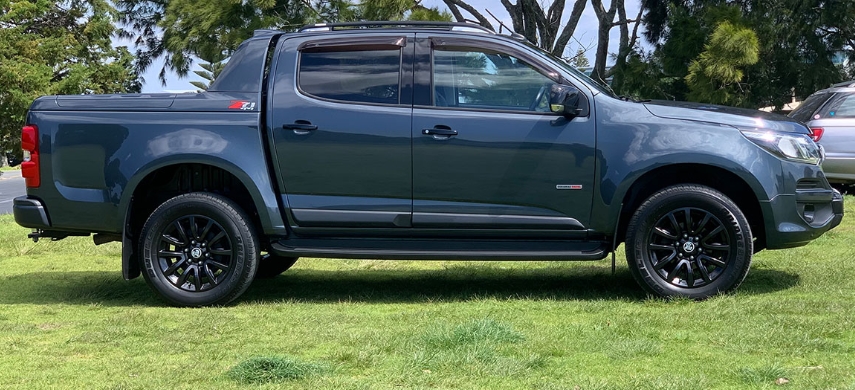
- Z71: The Halo Model. For the first time, Holden introduced a dedicated off-road variant. The Z71 (pronounced “Z-seven-one”) was based on the LTZ but added serious off-road hardware, including Bilstein performance suspension, a two-stage electronic rear differential lock, aggressive all-terrain tires, unique Z71 decals, and underbody protection. It was an instant hit with off-road enthusiasts.
The 2016 “MY17” Major Update:
In late 2016, Holden released a major update for the 2017 model year (MY17) that addressed criticisms and kept the Colorado competitive. This was a pivotal moment in its life.
- Engine: The 2.8-litre Duramax received a significant power boost, now producing 132kW and a massive 500Nm of torque. This catapulted it to the top of the class for pulling power.
- Exterior: A bold new front end with a prominent horizontal bar grille and a more muscular bonnet gave the Colorado a tougher, more modern appearance.
- Interior: The cabin was overhauled with a new 8-inch touchscreen featuring Holden’s MyLink infotainment system, Apple CarPlay, and Android Auto. A new steering wheel, instrument cluster, and higher-quality soft-touch materials brought the interior up to date.
- Safety: A suite of advanced driver-assistance systems was introduced, including Forward Collision Alert, Lane Departure Warning, and a Forward Distance Indicator, bringing the Colorado’s safety rating up to modern standards.
- Trim Level Evolution: The range was tweaked and expanded:
- Workmate: Continued as the base model.
- LS: Remained the core of the range, now with the updated tech and engine.
- LTZ: Gained the new safety tech and more premium feel.
- LTZ+: A new variant introduced, adding luxury items like heated leather seats, a power driver’s seat, and a sunroof, positioned above the standard LTZ.
- Z71: The off-road hero received the updated engine, new 18-inch wheels with off-road tyres, and the new front-end styling, cementing its place as one of the most capable off-the-shelf utes.
This updated model continued largely unchanged until the end of its life, proving to be Holden’s most successful and popular ute, often battling for top spot in the Australian sales charts.
The End of the Line and the Future Outlook
The clock ticked loudly for the Holden Colorado. The “GM-H” era was drawing to a close. General Motors made the global decision to retire the Holden brand in Australia, and with it, the locally assembled Colorado.
Production of the Holden Colorado ceased in October 2020. The final models were the “Colorado LSX,” a special edition based on the LS model, and the “Colorado 10-Year Anniversary Edition,” a limited-run model celebrating the 2010 launch of the second-generation ute. These special editions featured unique decals, alloy wheels, and other cosmetic extras to mark the end of an era.
The Aftermarket and the Future:
With Holden’s departure, the question remains: what is the future of the Colorado?
- The Aftermarket Scene: The Colorado’s future is now in the hands of its owners. The vehicle’s large engine bay, robust drivetrain, and strong aftermarket support mean it will be a popular choice for used buyers and enthusiasts for years to come. Companies that previously supported Holden Special Vehicles (HSV) and other local tuners have pivoted to supporting the Colorado, offering performance tunes, suspension upgrades, and off-road accessories. The Z71, in particular, is becoming a sought-after used vehicle for its factory off-road capability.
- The “Global” Colorado: The story of the name doesn’t end in Australia. The “Colorado” name was continued by GM in North and South America on a completely different mid-size truck, which was based on the Chevrolet/VM Motori platform. In late 2021, GM announced it would be retiring the Colorado nameplate in North America for the 2022 model year, rebranding it simply as the Chevrolet Colorado. The new 2023+ Chevrolet Colorado is a technologically advanced and thoroughly modern vehicle, proving the name still has a vibrant future globally, even if the specific Australian-market vehicle is no longer in production.
Conclusion
The Holden Colorado’s journey is a perfect microcosm of Australia’s automotive industry in the 21st century. It began with a tough, reliable Japanese truck, blossomed into a world-class Australian-tuned powerhouse, and ultimately fell victim to global corporate decisions. From its humble Isuzu beginnings to its class-leading Duramax peak, the Colorado carved out a powerful legacy. It may no longer be sold in showrooms, but the sight of a Z71 conquering a muddy trail or an LS carrying a full load of building materials is a testament to its enduring toughness—a true Australian dragon, now retired to the history books, but far from forgotten.